
Published November 3, 2026 06:00AM
There are few races Sullivan Middaugh would like to target more than next year’s XTERRA World Championship in New Mexico. However, if everything goes to plan, there’s only a slim chance he’ll be on the start line to defend his title.
That’s because Middaugh is part of an exciting crop of American men trying to help the Project Podium program live up to its name at the 2028 Los Angeles Olympics. And with an increasingly crowded triathlon calendar, the timing doesn’t quite work.
The challenge is that the 2027 XTERRA World Championship weekend in Ruidoso falls between the World Triathlon Championship Finals in Hamburg, Germany, and another top-level race in Weihai, China. Both are part of the rebranded T50 Championship series.
Not only could these events prove critical in helping the U.S. secure three men’s spots for Los Angeles – the host nation is already guaranteed two – but Hamburg could also present an opportunity for Middaugh to stake his claim to one of those places.
He can’t afford to let up. It’s still early in the Olympic qualification cycle, but the U.S. currently has eight men in the top 50 of the Olympic rankings, more than any other nation, with Middaugh the fourth-ranked American at 31st overall.
A historic Middaugh family triumph
But while the focus will understandably shift toward the work of coach Parker Spencer’s Project Podium squad, which splits its time between Tempe, Arizona, in the winter and Park City, Utah, in the summer, XTERRA will never be entirely out of mind.
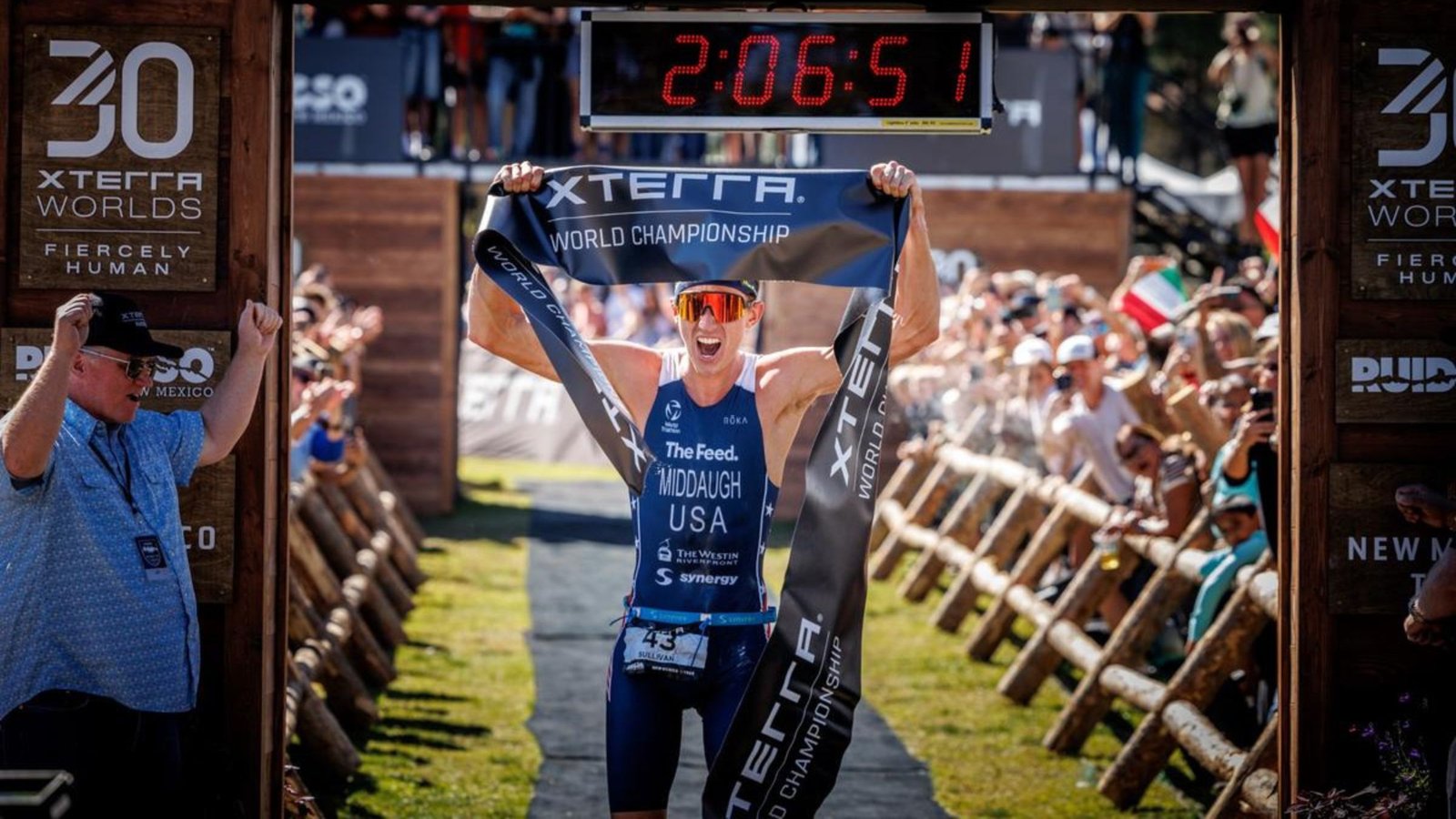
After all, it’s the discipline that put the Middaugh family on the triathlon map, and never more so than earlier this month, when Sullivan claimed his first full-distance XTERRA world title, younger brother Porter finished seventh, and father Josiah, at 48 years young, placed sixth.
Three members of the same family, spanning two generations, finishing in the top seven of a World Championship race is a remarkable feat, with few obvious parallels across elite sport.
The achievement was even more special because it had been 11 years since an American man last won the event. That was Josiah, in 2015. Before him, you have to go back another 15 years to Michael Tobin’s victory in 2000.
“No, I haven’t heard anything quite like that,” Sullivan confirms. “And especially having my dad in the race is pretty incredible!”
More than the result itself, it’s the opportunity to continue racing alongside his father that Sullivan appreciates.
“Following in his footsteps is pretty awesome,” he continues. “Every year he says he’s gonna retire, but I don’t know. It’s been pretty awesome to be able to continue to train and race with him. I grew up just following him on the XTERRA circuit and going to races and watching him. I never really thought we’d be racing together.”
Preparing for the world title
Sullivan’s success also made up for his defeat by Reed Legg at the North American Championship earlier this year. Legg’s victory interrupted a Middaugh dynasty that has seen Josiah win 15 U.S. elite national titles and Sullivan dominate the more recent championship era.
And it was made all the sweeter by the XTERRA World Championship’s return to the U.S. after four years in Italy.
“I put it on my calendar and kept it in mind all year,” Sullivan says. “It was a race at altitude, which I grew up at, and so I felt like it was a good opportunity. Grindstone Lake, where we swam, is at 7,000 feet and the course got up to maybe a little bit over 8,000 feet. But at home in Colorado, my house is at like 7,500 feet, and you can only really go up from there. So, the six or seven weeks leading in, I went home and trained with dad because I knew it would be a big advantage if I could be fully acclimatized.”
While Porter, who also trains with Project Podium, finished seventh, Sullivan believes his younger brother might have mounted a stronger challenge had he not been racing at the Under-23 World Championship in Spain.
Sullivan skipped that race to sharpen his mountain biking skills, although it didn’t prevent an early spill on the bike.
“Yeah, I overcooked the corners a little bit on the first couple of turns in the single track section,” he explains. “It wasn’t a bad spill out, but I kinda had to slam on the brake, go off the trail, tip over and get up quick. My bike computer fell off, which wasn’t a big deal, and maybe a blessing in disguise to not worry about power and just focus on effort.”
Sullivan had an almost four-minute lead heading onto the run and extended his advantage with the day’s fastest 10K split, but at no point did he feel comfortable.
“I didn’t really get any splits and thought that no lead was safe on the run. I just tried to give it full gas, focusing on pushing the climbs and rolling the downhills because I knew they’d be coming.”
Among the athletes trying to hunt him down were two very familiar faces – Porter and Josiah – and there was a brief moment of family camaraderie as their paths crossed on the course.
“I just focus on myself for the most part, but it reminds you that they’re also out there battling. I saw them running together, so that was pretty cool because I knew they’d be pushing each other. We were all pumped, gave each other a high five, and that was pretty much it.”
There were plenty more high fives and hugs at the finish, where Sullivan’s mom, sister, and grandparents were also in attendance.
While this was Sullivan’s first full-distance XTERRA world title, he had previously won the Short Track World Championship in Molveno, Italy, in 2024.
In recent years, short-track racing has typically taken place a couple of days before or the day after the main event, although it wasn’t on the schedule in Ruidoso.
“It’s like a three or four-minute swim, maybe a 15-minute bike and a seven-minute run,” Sullivan says, with distances depending on the course layout. “It’s all under 30 minutes for the most part, so more intense and a little bit different, and you can’t make as many mistakes. I think it suits me because I’ve spent a lot of time training for sprint distance draft-legal triathlons. I really enjoy it.”
While XTERRA might be seen as a distraction from road triathlon, Sullivan believes it complements his efforts elsewhere.
“It helps me with my skills for the draft-legal stuff as well. I look to people like Flora Duffy and Hayden Wilde who were able to do well at both, and think they’re an example for me.”
The road to the LA 2028 Olympics
For the next 18 months, the priority will be collecting Olympic qualification points, with the window having opened in May.
Sullivan has already recorded top-10 finishes at World Triathlon Cups in Huatulco, Mexico; Edmonton, Canada; Rio de Janeiro, Brazil; and Asunción, Paraguay. He also competed at the Americas Triathlon Championships in Antofagasta, Chile, finishing 11th. He now heads to Chile for two more World Cup races, in San Pedro de la Paz and Iquique.
While USA Triathlon hasn’t officially released its selection policy for Los Angeles, Sullivan expects the Olympic test event in July 2027 and the World Championship Finals in Hamburg to be key races. He anticipates that a top-eight finish, combined with being the leading American, could be enough to meet the automatic selection criteria.
But first, he needs to secure starts at the biggest races. “Spots keep flipping, so it’s gonna be pretty tough,” he adds. “I’ve been mostly focusing on the World Cup level, which is the step below the World Championship Series, but as my swim develops, I’ll try and focus more on the World Championship Series because that’s the level you need to be at in the Olympics.”
The higher the level, the more critical the swim becomes. “If you’re the best swimmer, you can be in the race up until the run, but if you don’t have a good swim, you may never even be in the race,” he explains. “The swim sets you up for a good day to get in the right bike group, but you also need to be able to run well off a hard bike. That’s something XTERRA helps me with.”
Sullivan admits that bridging the gap in the swim is his biggest immediate challenge, but he also knows he’ll need a blistering run to compete at the very top.
“Especially with Alex Yee and Hayden Wilde, it is just getting faster and faster,” he says. “You need to be an elite runner if you want to be on the podium, and that means hitting sub-14 minutes sometimes in the 5K and sub-29 minutes occasionally on the 10K. Right now, I’m in the low 14s and around 30, maybe a little under depending on the course.”
Project Podium and beyond
If he can get there, it will be with the help of Project Podium. Established in 2018, Project Podium is funded by USA Triathlon, corporate sponsors, and private donors, including longtime benefactors Dr. Bill Warren and his wife Lynne. Based at Arizona State University, the program provides promising American male triathletes with coaching, scholarships, and financial support as they pursue Olympic ambitions.
Sullivan, who graduated with a degree in biomedical sciences in August, has enormous respect for coach Spencer, who he says also understands his passion for the trails and why XTERRA should remain part of his program.
“I love mountain biking, and so it’s good for me to be able to kinda go in and out, but I think that as the Olympics get closer I’ll have to take a slight step away from XTERRA, but we’ll see.”
Finally, if Sullivan’s Olympic dream does come to fruition, could there be more than one Middaugh on the U.S. team?
“That’s definitely a big ask, but would be amazing. I don’t know if it’s on the cards for ’28, but maybe for ’32 it could be more plausible. I think we both have the ability to get to that level if we stick with it, and when I see Porter in the race, we don’t really need to say anything. We just understand what we need to do.”



