
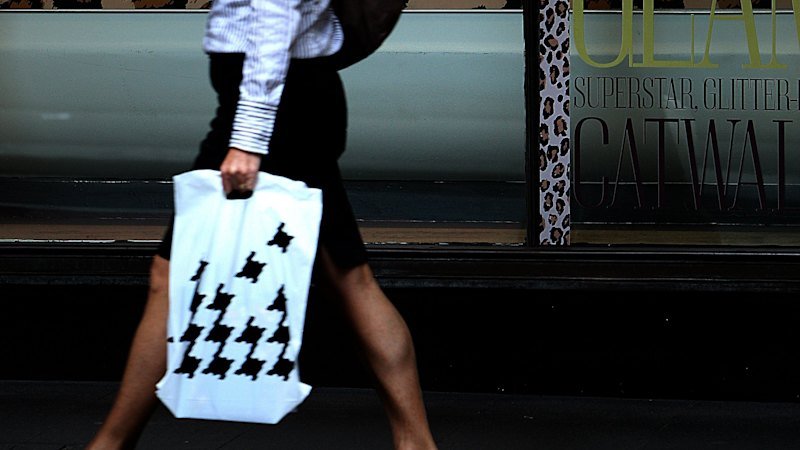
The black-and-white houndstooth print on a David Jones bag has been a badge of honour for generations of Australians.
For many, growing up in the suburbs meant a train trip to the city for school uniforms or, come December, the window display and Santa, and lunch in the food hall. Dressed in their best clothes, children wandered the floors of this bastion of middle-class refinement with mothers who inspected and touched the racks of leading Australian fashion labels and had their own dreams.
Prue Acton, Sportscraft and Carla Zampatti were joined by the best global labels and, together with seasonal shows replete with big names on the runway and celebrity guests, made David Jones Australia’s fashion central.
It was more than a shopping emporium too. The David Jones Art Gallery supported Australian artists; before television arrived in the 1950s, a staff amateur theatre group, the Dajonian Repertory Society, staged six plays a year; on her first visit to Sydney in 1954, Queen Elizabeth II attended a banquet dinner on the seventh floor of the Elizabeth Street store.
But after 188 years, David Jones’ future hangs in the balance, with the board calling in administrators and the lender sending in the receivers. The department store chain is still trading, but no one is sure for how long.
David Jones employs about 6000 staff and has 38 physical stores, with 17 of those in Westfield shopping centres. Unions are concerned about layoffs before Christmas.
Suppliers are under no delusions. Various businesses have been left in the lurch and the owners and agents of luxury brands have began removing stock from outlets where they have “concession pad” agreements with the store.
The collapse is part of a worldwide phenomenon – department stores have been smashed by an alarming combination: the global financial crisis, the COVID-19 pandemic, the ongoing cost-of-living crisis; and, most painfully, the rapid rise of online shopping. They have also been hit by what’s termed the bifurcation of retail, where top-end shoppers have migrated to super-luxe stores and the bottom end of the market hunts for more bargain-basement offerings, with department stores taking the hit in the middle.
David Jones’ problems were compounded by dubious business decisions that began during the 1980s takeover fad with the Jones family selling out, and continued on and off for years until the company was unable to pay rent to Westfield last September.
Twelve years ago, a South African company reportedly paid $2.1 billion to buy David Jones. Three years ago, Anchorage Capital Partners bought the department store chain for less than $100 million but still could not make a go of it.
It is a long way from 1838, when Welsh draper David Jones opened one of the world’s first department stores in Sydney. It remained largely a Sydney phenomenon for the first century or so, opening in Newcastle in 1957 and then expanding into the regions and metropolitan suburbs around the nation.
David Jones arrived in Victoria in the 1960s, and in 1982 it acquired the three stores of Buckley & Nunn located in Bourke Street, Northland and Chadstone. In 1987, David Jones purchased the former GJ Coles store and building at 299 Bourke Street, Melbourne, converting it into a David Jones store.
David Jones had always been Sydney’s most upmarket store, specialising in quality goods and elite customer services.
But in Melbourne, David Jones was slightly lower down the pecking order.
Georges Store in Collins Street had long catered to the cream of Melbourne society and liked to think of itself as the equal to Harrods of London.
In 1981, David Jones bought Georges and slowly squeezed it into oblivion, eventually closing it in 1995 in the hope of keeping much of the cream for itself. It did not happen.
In the end, David Jones was slowly squeezed by rising costs, changing shopping habits and online technology, a vestige of a way of shopping out of step with the times. The sun is setting on an Australian retail icon.
Get a weekly wrap of views that will challenge, champion and inform your own. Sign up for our Opinion newsletter.
 The Herald’s View – Since the Herald was first published in 1831, the editorial team has believed it important to express a considered view on the issues of the day for readers, always putting the public interest first.
From our partners
Source: www.smh.com.au



