
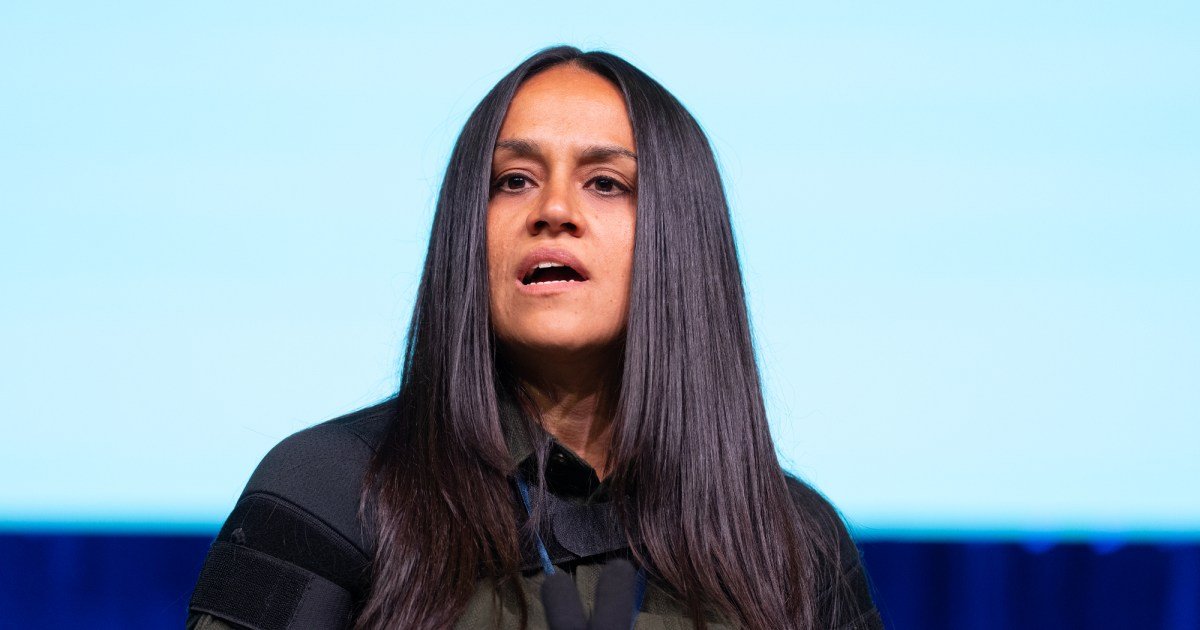
“It’s a difficult road. It has not been fun. But I think we need to do this,” Aliya Rahman said Tuesday. Alex Kormann/The Minnesota Star Tribune via Getty
Aliya Rahman, the disabled Minneapolis resident dragged out of her car and detained by federal immigration agents last January, has tried over and over to get some accountability from the government that harmed her. Today, she filed an assault and false imprisonment lawsuit against the federal government—one she hopes could be “copy and pasteable” onto other people’s cases.
“What happened to me is not just about ICE, and lawsuits are only one tool for fixing what is really going on,” Rahman said at a press conference Tuesday. “These things happened because it was already culturally normal for law enforcement officers to operate without accountability.” The day Rahman was arrested, the Department of Homeland Security’s X account posted a message “to all ICE officers,” telling them “you have federal immunity in the context of your duties.” In the following months, Rahman tested every possible strategy to prove that statement false.
In February, Rahman testified before Congress that ICE agents smashed her windows, pulled her out of her car, ignored her assertions that she is a US citizen, taunted her for her disability, and withheld medical care until she blacked out on the floor of a cell.
She filed a tort claim against ICE and DHS this April, seeking personal injury damages through one of the few avenues an individual can legally use to sue an otherwise-unaccountable federal agency. Then, in June, Rahman filed a complaint with DHS’ internal Office for Civil Rights and Civil Liberties. But that office was gutted after Trump’s return to office, so Rahman didn’t expect much of a response. “It’s hard to imagine that sending a letter to DHS to ask them to respect our civil rights will do anything,” she told me at the time.
Rahman’s tort filing from April also went unanswered. As the six-month timeline for a government response ran out, she filed a new lawsuit today, alleging assault and false imprisonment—and joining a growing number of people who are demanding legal restitution for violence done by ICE and DHS. Carlos Jimenez, a US citizen from Southern California who was shot in the back and shoulder by an ICE agent, sued the government for $25 million yesterday; in August, 54 people represented by the ACLU filed tort claims over harm done by ICE agents nationwide.
“We followed their process; they didn’t respond,” Jessica Gingold of the MacArthur Justice Center, Rahman’s lawyer, said Tuesday, referring to Rahman’s previous attempts at accountability. “Nearly seven months later, we have heard nothing. The federal government has chosen to hide.” The names of the officers who hurt Rahman are currently unknown. Through the lawsuit process, Gingold said, they will be unmasked.
“We have their pictures; we have a right to know their names. We have a right to depose them. We have a right to get their records.” Images of the six masked officers who were there that day are attached to the lawsuit as an exhibit.
Almost a year since the beginning of Operation Metro Surge, Rahman is far from the only Twin Cities resident still dealing with the repercussions of ICE’s months-long occupation. As the global NGO Human Rights Watch wrote in June, the ICE operation—which left two civilian protesters dead and entire communities traumatized—was a “humanitarian crisis.” The city of Minneapolis estimates that the surge caused $700 million in damages; the Department of Homeland Security says 4,000 people were detained.
But months after the ouster of former Border Patrol commander-at-large Gregory Bovino and ICE’s partial retreat from Minnesota, Rahman says the fight isn’t over. Less than two weeks ago, an investigation by KARE 11 revealed that the Trump administration used taxpayer funds to purchase a detention center in Western Minnesota from CoreCivic—for $420 million more than the building was worth.
“When I see ICE Out signs, I wonder what they mean now,” Rahman said Tuesday. Getting rid of ICE in Minnesota, she said, means addressing the cash bail industry, extractive prison labor, and qualified immunity for police. “I desperately hope that beyond pushing Greg Bovino out of town, we will fight the things that gave rise to Metro Surge. Those are the body parts ICE is made of.”



