
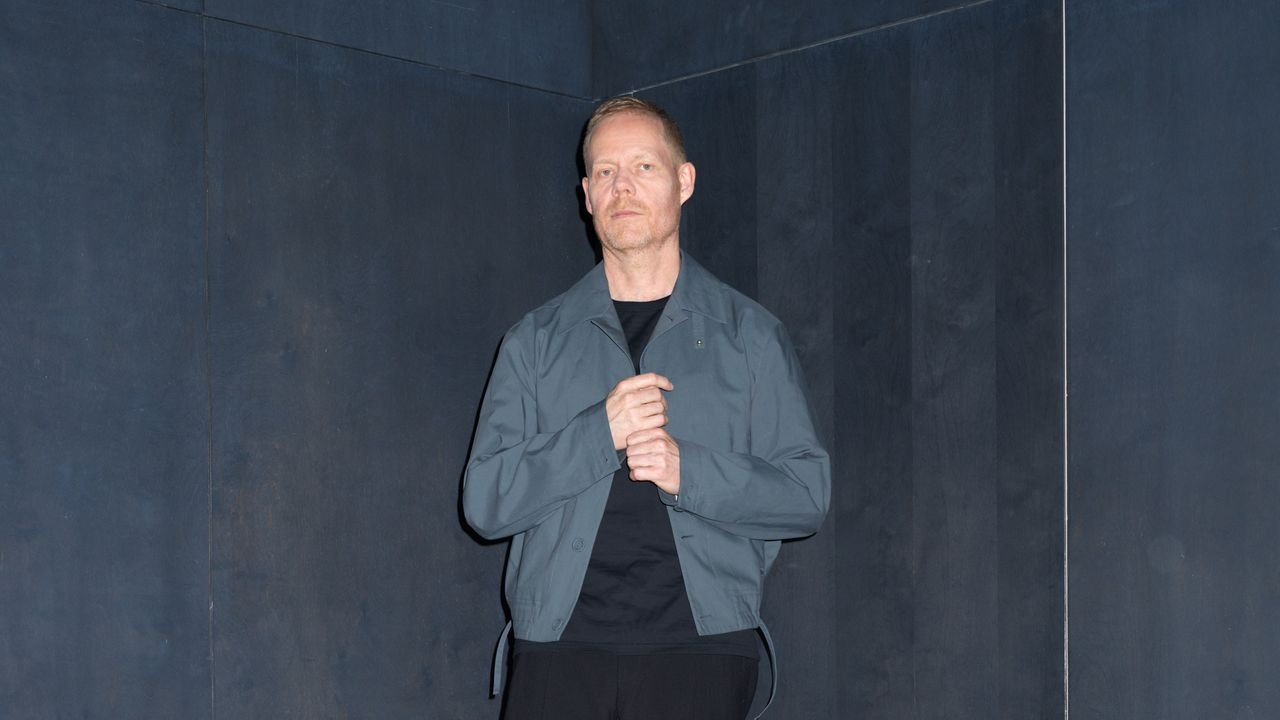
“I had fallen in love with Vivaldi as a tiny kid, but grew to hate it as an adult because you hear it in insurance adverts or when you’re on hold, or whatever. So I wanted to get that out of my system,” Richter said. “I assumed I was going to be destroyed for it—the end of my career. But it’s not like I really had a career.” The record topped classical charts in twenty-two countries. Two years later, Richter came out with a follow-up, a spoken-word album, his mellow voice explaining each piece on the record, DVD-extra style. (Track 9: “ ‘Autumn 1’ is pretty much the original Vivaldi for quite a long time, except I’ve sort of sliced it up and cut holes in it.”) Then, in 2022, he released “The New Four Seasons: Vivaldi Recomposed,” which is the same music, this time made with era-accurate strings, plus one of many Moog synthesizers he owns. “I heard a performance on period instruments and just thought, This is brilliant,” he said. “I thought it was a nice learning journey. A three-hundred-and-sixty-degree project.” His label extended the journey three years later, with “Vivaldi by Max Richter,” which includes tracks from both versions of “Recomposed.” Perhaps a person might save some time by simply listening to Vivaldi.
The masses swooned over the project, but it irritated many musicians. “The way ‘The Four Seasons’ was adopted by the Pottery Barn Muzak crowd already harmed Vivaldi’s status as a serious composer,” Ethan Iverson, a critic and composer, told me. Richter’s own “defanging,” he said, “suggests a future where nobody knows anything about anything: we are all senseless drones, oblivious to the mystery and magic of tonal harmony.”
Not long ago, an A.I. company approached Richter about a potential collaboration. “Their pitch to me was ‘Hey, Max, say you’re writing a song and you get stuck. You’ve got the beginning and you’ve got the end. That’s where we come in. You click this and it’ll fix that for you.’ But that bit is what I live for. That’s where I learn stuff.” He has advocated before British Parliament on the need to protect artists and regulate A.I. Has that been successful? “No, in short.”
Richter believably insists that the art must always come first. “As far as I know, I’m the biggest seller on D.G., but I see that as kind of their problem, not mine,” he said. “I’m very hazy on the commercial side. I don’t love sitting in meetings. The only thing I can control is where I put the notes on the page.”
Richter was born in 1966, in Hamelin, Germany. “It’s where the Pied Piper came from—that’s the only reason anyone knows it,” he said. When he was three, his family moved to Bedford, England, after his father, an electrical engineer, was posted there. His mother, who eventually ran a health-food shop, was an amateur pianist. At age five, Richter started piano lessons: “My teacher was a very lovely elderly woman named Mrs. Hart. If you played a wrong note, she’d hit you with a ruler.”
During Richter’s childhood, the classical world was in the midst of a counterstrike against modernist complexity, which had become an academic norm. In the nineteen-twenties, Arnold Schoenberg had pioneered the twelve-tone method, rejecting the idea of a central key. After the Second World War, this musical language, which yielded a lot of atonal work, became more widely accepted and was further developed by figures like the French serialist composer Pierre Boulez. Artists began to push back against what Richter described as a “modernist hangover,” stripping away the elaborate status quo. In 1964, the composer Terry Riley put out the groundbreaking piece “In C,” which consists of a high C being pinged to eternity for forty minutes, against pulsing instrumentation. Riley’s friend, the New York City-born composer Steve Reich, had suggested the idea of an eighth-note heartbeat—one of many stamps Reich left on the contemporary scene, including “Clapping Music.” Philip Glass, who had studied at Juilliard before doing a Fulbright with the composer Nadia Boulanger, knew Reich and was paring back his own compositions. He soon established the Philip Glass Ensemble for experimental work.



