
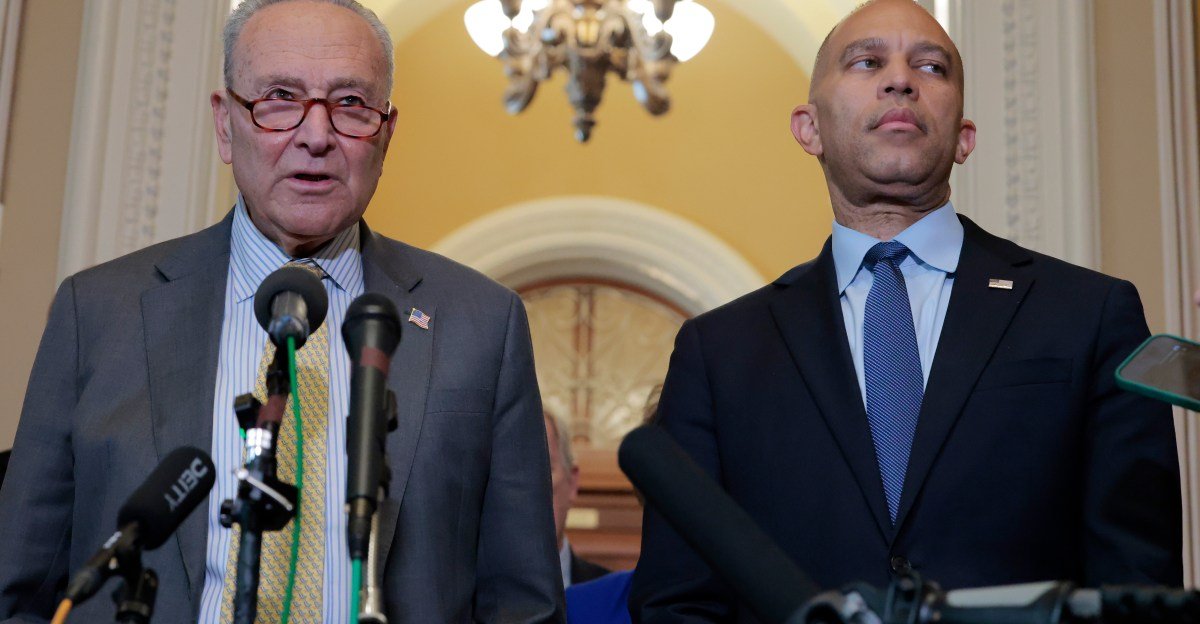
The Democratic Party just won its largest congressional majorities in more than a decade. In the House specifically, if current vote tallies hold, it will boast more seats next year than at any time since 1992.
Now what do they do with that power?
In the near term, the extraordinary scale of the Democrats’ midterm victory might be of little consequence. So long as President Donald Trump holds veto power over legislation, a 254-seat House majority may be no better at advancing the Democratic agenda than a 218-seat one would be.
- Democrats’ midterm landslide makes it likely that if they win the White House in 2028, they’ll also have comfortable congressional majorities to pass their economic agenda.
- The party has promised to expand the welfare state, cut taxes for everyone but the rich, and bring down inflation and interest rates, but those goals will likely prove incompatible.
- Taxing the rich alone probably can’t fund a massive new safety net, yet even this year’s unusually Democratic electorate rejected broader tax hikes.
- To ease the tension between their priorities, Democrats should embrace policies that boost the economy’s productive capacity.
Two years from now, however, the blue tsunami’s size could matter enormously. Democrats are unlikely to do quite as well in the 2028 election as they did this year, when the Republican base largely abstained. But Democratic Senate leader Chuck Schumer’s party now has plenty of seats to spare. For this reason, if Democrats win the presidency in 2028, they are now extremely likely to also secure full control of Congress — and by comfortable margins.
This is no small thing. Under President Joe Biden, Democrats held only a bare Senate majority, enabling any individual senator to dictate the terms of their policymaking. A Democratic president has not had the chance to govern with robust congressional support since 2010.
Democrats are therefore within striking distance of a rare opportunity — a chance to enact their economic agenda without asking Republicans or their party’s most unreliable centrists for permission.
To seize this historic opening, Democrats will need to formulate a platform that effectively advances their core goals. Unfortunately, this will be harder than it sounds — because the party’s current economic priorities appear incompatible with each other.
During the midterm campaign, Democrats promised to:
• Dramatically expand the welfare state.
• Raise taxes on the very wealthy — but no one else — while cutting taxes for millions of Americans.
Democrats have good reason for embracing all of these objectives. In the last three federal elections, voters punished incumbents for presiding over a rising cost of living. So any governing party would be eager to reduce inflation and borrowing costs, both of which continue to trend in the wrong direction.
“This was the biggest change election in any of our lifetimes,” Democratic Rep. Greg Casar, chair of the Congressional Progressive Caucus, told me. “And Americans are demanding that we take on these high prices, root out corruption, and make their lives better.”
Democrats’ desire to expand the welfare state is similarly understandable. Americans lack many forms of social insurance that are common in wealthier countries, such as truly universal healthcare.
Finally, the party’s embrace of middle-class tax cuts reflects the US electorate’s growing antipathy for taxation. Indeed, last Tuesday, a historically Democratic electorate voted to restrict or cut taxes in states across the country.
If Democrats’ goals are understandable, however, they aren’t necessarily coherent. In economic conditions similar to today’s, it probably won’t be possible to create large new social programs, avoid tax hikes on anyone but the rich, and drive down inflation and interest rates.
For now, the party can skirt these questions; so long as Trump is in the White House, Democrats can simply agitate for an end to the Iran war and tariff relief, while denying full responsibility for the economy.
To govern effectively when and if they win full control of the government, however, Democrats need to recognize the tension between their economic priorities early on — and try their best to reduce that friction.
Americans are warming up to Democrats — but not to taxes
On election night, Democratic proponents of a more robust safety net prevailed in battleground races across the country.
But the Democratic Party’s economic reformers face a fundamental challenge: The large welfare states they admire have traditionally been financed by broad-based taxes. In nations like Sweden, Denmark, and Norway, high taxes on the middle class suppress consumer spending, clearing fiscal space for large social programs. This is how social democracies are able to have their comprehensive welfare states and stable prices too.
But that model does not seem to be politically viable in the United States. To the contrary, America is currently witnessing a vast and growing tax revolt.
That rebellion has been visible in polling and state-level policymaking for some time. Between 2020 and 2025, the share of Americans who considered their federal tax burden “too high” jumped from 46 percent to 59 percent in Gallup’s surveys. Meanwhile, states slashed taxes by tens of billions of dollars.
But the 2026 midterm results may be the starkest illustration yet of America’s anti-tax mood. This year’s electorate was America’s most Democratic in more than five decades. We essentially saw what a US election looks like when a large share of the Republican base stays home. It turns out that, once you subtract tens of millions of conservatives from the American electorate, Mississippi, South Carolina, and Texas become blue states.
And yet, even this historically Democratic voting public mostly rejected “tax-and-spend” liberalism at the ballot box.
In North Carolina, voters backed Democratic Senate candidate Roy Cooper — and lower income taxes. In Iowa, they rallied behind Democrat Josh Turek for Senate, while also forbidding the legislature from increasing income taxes without a two-thirds majority. In Florida, an atypically Democratic (if still majority Republican) electorate voted to slash property taxes by nearly $5 billion a year.
In Illinois and Virginia, most localities shot down referendums on new property or sales taxes; in the Old Dominion’s case, municipalities largely rejected a 1 percent sales tax hike to fund school construction and renovation. Likewise, on a good night for Democrats in the Grand Canyon State, Arizonans voted to cap the sales tax on grocery purchases and constitutionally prohibit the taxation of vehicle miles traveled to fund road maintenance. (Today, road construction is often financed with a tax on gasoline, which ensures that those who use the roads contribute to their maintenance. As more drivers switch to electric vehicles, however, an alternative means of measuring road use has become necessary.)
Finally, in deep blue California, a proposal for a one-time wealth tax on billionaires appears to have failed.
This is not to say that the 2026 electorate took the anti-tax side of every ballot measure. There were many important exceptions to this rule. Nevertheless, the fact remains that an exceptionally Democratic electorate opposed higher taxes in a remarkably wide array of cases.
And this anti-tax mood was not lost on Democrats. Virtually all of the party’s battleground Senate and gubernatorial candidates campaigned on tax cuts. In Texas, Sen.-elect James Talarico promised to deliver a “cost-of-living tax cut for the middle class,” while Gov.-elect Gina Hinojosa pledged to pursue the goal of “eliminating residential property taxes.” In Mississippi, Democrats’ unlikeliest new senator, Scott Colom, called for ending all income taxes on teachers and cops. Even Sen.-elect Abdul El-Sayed, one of the Democrats’ most progressive candidates, who wrote a book on Medicare-for-all, vowed to help freeze property taxes on senior citizens.
Notably, this large, bipartisan tax revolt has emerged at a time when federal tax rates are unusually low; the bottom 80 percent of workers pay much lower federal taxes today than they did three decades ago.
Large welfare states can’t live on the rich alone
As I’ve already suggested, the Democrats’ growing appetite for tax cuts has not dampened their enthusiasm for new public spending.
The party’s congressional leaders have signaled support for a social welfare agenda at least as ambitious as President Joe Biden’s unpassed Build Back Better Act, which contained $4.73 trillion of new spending (assuming that all its programs were made permanent, as its authors intended).
Add up the estimated fiscal costs of all these programs and the bill comes out to nearly $5 trillion. Repealing all of Trump’s tariffs, as Democratic leaders have also promised, costs another $1.4 trillion (although, tariff relief has more complicated implications for inflation than other kinds of tax cuts).
Critically, America is already on track to run an average annual deficit of $2.4 trillion over the coming decade. It is impossible to know with certainty what the macroeconomic conditions of 2029 will be like. But all else equal, a greater than $2 trillion deficit will put upward pressure on interest rates and prices.
For this reason, there’s a good chance that the next Democratic government won’t be able to inject trillions more dollars into the economy without undermining its own goals on inflation and borrowing costs.
To be sure, Democrats aren’t saying that they will deficit-finance their proposed spending. Rather, the party generally suggests that it will pay for its new programs (and working-class tax cuts) by soaking the wealthy and corporations.
But that approach probably won’t be sufficient to offset the inflationary impact of the party’s full social welfare agenda. For one thing, congressional Democrats’ appetite for new taxes on the rich has its limits.
In 2021, the House version of Biden’s Build Back Better Act contained only $1.47 trillion worth of taxes on companies and high earners. And that sum proved too much for multiple Democratic senators. The fiscal policy that actually made it into law — the Inflation Reduction Act — included a mere $349 billion in such taxes.
As noted above, if a Democrat wins the presidency in 2028, he or she will probably have larger majorities than Biden ever did. But it seems unlikely that Senate Democrats in 2029 will be eager to raise taxes on the rich by trillions more than their Biden-era counterparts were.
Regardless, there is a more fundamental problem: Taxes on the rich do not suppress inflation as effectively as taxes on the middle class.
This is because middle-class families spend a higher percentage of their earnings than millionaires and billionaires do. If you take $2,000 out of every middle-class family’s annual income, many will be forced to consume fewer goods and services, which will reduce consumer demand — and thus, inflationary pressure — throughout the economy.
By contrast, even if you reduce Jeff Bezos’s post-tax income by $200,000, he will feel no need to moderate his spending. His savings might marginally decline. But his consumption is liable to stay about the same, since he will still have more money than he could spend in a lifetime. For this reason, taking money from billionaires — and giving it to working-class families — will tend to nudge inflation upward, all else equal.
“Tax increases on those at the absolute top can address wealth or income inequality, but probably won’t do much to manage demand,” Skanda Amarnath, executive director of the economic research organization Employ America, told me. “If you want to fund big new social programs, the most robust version of that has historically involved broad, regressive taxes, which don’t leave you dependent on the support and compliance of rich people.”
If you don’t want to constrain demand, at least increase supply
It’s possible that inflation will cease to be a pressing concern by 2029. Merely ending the Iran war could cool prices significantly. And if the AI buildout falters, that would also reduce our economy’s demand for labor, chips, and electricity (albeit, perhaps by causing a recession). Alternatively, if Anthropic or ChatGPT builds a machine God in the next couple of years — and puts tens of millions of Americans out of work — we might even see deflation.
But it would be imprudent for Democrats to bank on any of these scenarios. In all likelihood, they will need to scale back their ambitions for the welfare state, grow more comfortable with broad-based taxes, or make peace with pushing up inflation and interest rates.
This said, the party can work to reduce the tension between its objectives. Inflation is what happens when demand for goods and services rises faster than their supply. If Democrats are hellbent on pushing up demand through high social spending and low taxes, they should think seriously about how to make the economy more productive and efficient (and thus, able to generate a larger supply of goods and services).
Massachusetts Rep. Jake Auchincloss is among the Democrats focused on this dimension of the “affordability” challenge.
“Healthcare, home ownership and taxes now consume more than half the middle-class wallet,” Auchincloss told me. “And housing construction, healthcare and government are all very low labor productivity industries.” Therefore, in Auchincloss’s view, delivering on affordability requires increasing the productivity of the construction, medical, and public sectors.
With respect to housing, this entails new subsidies and regulatory changes that encourage modular construction — the manufacture of new homes in factories, where productivity gains are easier to achieve — along with zoning reforms.
In healthcare and government, the path to progress is less clear, but Auchincloss believes that a concerted push for greater efficiency — and the thoughtful deployment of AI — can drive down the unit costs of medical treatment and social service provision in the US (at least, if Democrats prove willing to challenge the interests of healthcare providers, many of whom benefit from the existing system’s inefficiencies).
More straightforwardly, Congress is presently considering legislation that would erode permitting obstacles to new energy infrastructure. That bill is expected to eventually reduce Americans’ electricity costs by expanding the nation’s supply of both green and carbon power. The more committed Democrats are to growing the welfare state and avoiding middle-class tax hikes, the less they can afford to pass up these kinds of opportunities to increase the economy’s productive capacity.
The great perk of powerlessness is the freedom to ignore trade-offs. When crafting campaign rhetoric, a political party can conjure a world where voters will enjoy a robust safety net, large tax cuts, and low prices — so long as the government ends “corporate subsidies,” or cuts aid to Israel, or deports all the undocumented immigrants, or whatever else its base is already eager to do.
When it’s time to actually govern, however, a party ignores inconvenient truths at its own peril, as Trump’s GOP just ably demonstrated. Democrats must therefore recognize their agenda’s internal contradictions as soon as possible. To execute a coherent economic strategy in 2029 — or whenever they next secure full federal power — the party will need to know what it actually cares about most.



