
Brad Bird is tired of animation being stuck at the kids’ table.
After winning two Oscars and directing six films that have grossed a collective $3.5 billion at the global box office, the filmmaker still notices people aren’t taking animated movies as seriously as live-action cinema.
“When I did my first live-action film, Mission: Impossible – Ghost Protocol, people would start an interview by saying, ‘So, you’ve done your first real movie,’ and I went, ‘No, this is my fourth real movie, three of them before were animated,’” he tells MovieMaker, ahead of the December release of his latest film, Ray Gunn.
“They’re all real movies, but you’re patted on the head,” continues Bird. “And there’s so many instances of this in animation. It really is shocking, even down to Walt Disney accepting the Oscar that he got for Snow White, which was groundbreaking in so many ways for cinema. He gets a statue with seven little statues presented by Shirley Temple. I mean, ugh. If you take the best parts of Snow White and put them up against the best parts of any film that came out that year, it kicks butt.”
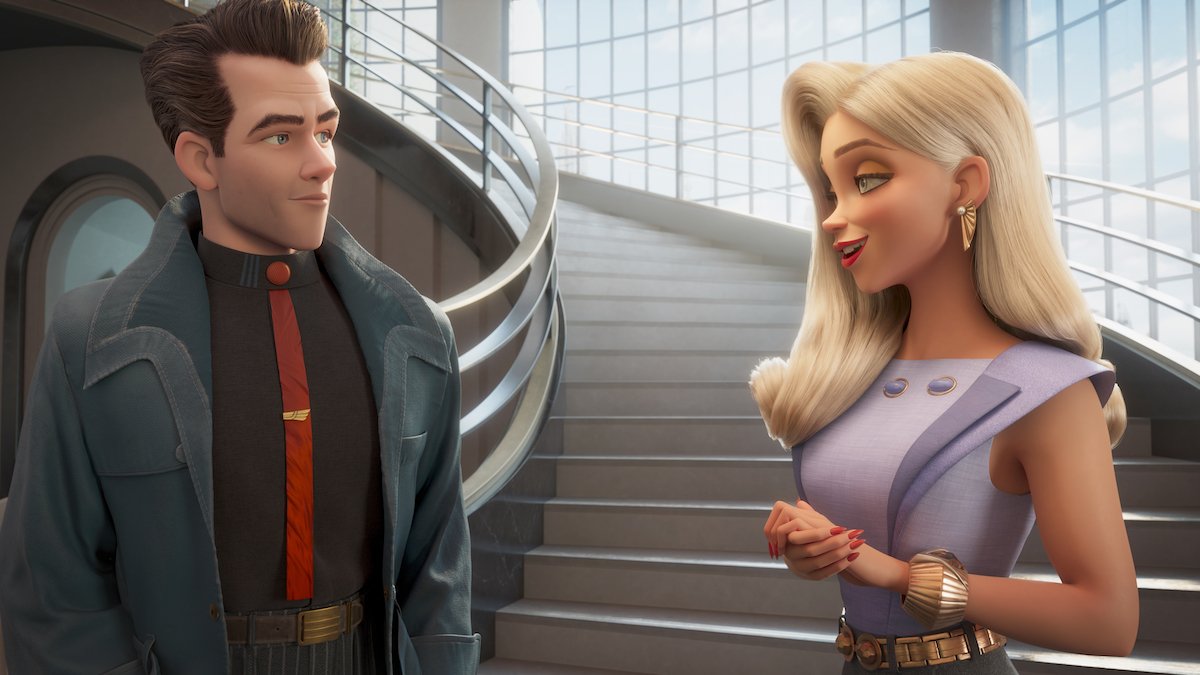
Ray Gunn kicks butt, too, which is no surprise from the writer-director of The Iron Giant, The Incredibles and Ratatouille. The futuristic, neo-noir thrill ride — which Bird co-wrote with Matthew Robbins — follows the eponymous private eye (voiced by Sam Rockwell) on a case to keep the unstable pop star Venus Nova (voiced by Scarlett Johansson) out of trouble. She’s on the way to what could be her biggest album drop yet, one that could make or break her turbulent career.
The whirlwind plot, loaded with twists, turns, aliens and flying cars, is elevated by fantastic vocal performers (also including John Ratzenberger, Tom Waits, Jamie Costa, and Bird) who in turn elevate the digital, keyframed animation.
“I loved working with the voice cast, and what was really good for me was that they set the bar for the animators,” Bird explains. “Their line readings had enough nuance and levels to it that animators could stay interested in hearing it hundreds of times and trying to get underneath it, and really capture what was going on in the voice with the body and the face. So, a good voice track is, for me, the most valuable part of it. It’s inspiring animators to do really good animation.”
Brad Bird on His Filmmaking Origins

While Bird was still just a kid, he was mentored by one of the all-time greats, Milt Kahl — one of Walt Disney’s supervisory team of animators known as Disney’s Nine Old Men — who carefully observed real-life inspirations for his characters before drawing them.
“He would study the living s— out of things, and then once he understood it, he’d put it away, and he would go straight from his imagination,” Bird says.
Bird cites Kahl’s animation of the tiger Shere Khan in The Jungle Book, particularly as he goes for the kill.
“He studied the s— out of tigers, and once he understood it, he put all of that away and then went for it,” Bird notes. “And it’s very similar to what they teach you in acting class, which is… do all the homework and learn the lines so well that you don’t have to think about them, and then you deliver your performance. It’s the same thing with animation.”
Good animation takes time. But getting the story to the point of being animated takes even longer. The upcoming Netflix release, produced by Skydance Animation, has been bouncing around in Bird’s mind for so long, some of the original actors he originally imagined casting have since passed away.
“I wanted Ray Liotta to do Ray, and I wanted Harry Dean Stanton to be Eye-Ra,” says Bird. The latter character is Ray Gunn’s one-eyed, extraterrestrial sidekick, perfectly voiced by Waits, 30 years after the project was initially in development at Turner Animation in the mid ’90s.

“When Turner Animation got absorbed along with the rest of Turner into Warner Brothers, WB didn’t want to make Ray Gunn, and they had three months left on my contract. And they basically said, ‘We don’t want to make Ray Gunn, but we have 45 projects in development,’” Bird recalls. “But one of the ones that they had was Iron Giant.”
“I read the book, and I thought it was really poetic and beautiful. A different idea occurred to me, though, which was: What if a gun had a soul and didn’t want to be a gun? And that is different from the book,” Bird says. “But to me, the movie was between the kid and the robot, and so I came back and I said, ‘Here’s what I’d like to do with it,’ and then it went from there. But Ray Gunn just went into a filing cabinet. But I always felt like this would be a really good movie, a movie that I wanted to see, and the only way to see it was to make it.”
His first directorial credit is a 1980 pencil test for a proposed animated film based on Will Eisner’s noir pulp comic character The Spirit. Forty-six years later, Bird’s mastery over the medium reaches new heights in Ray Gunn, which feels like a perfect blend of animation styles displayed in The Iron Giant and The Incredibles — a daunting challenge for the animation team assembled at vendor studio Cinesite in Canada.
“We kind of said this is going to be really hard,” Bird says. “The subject material and the design of the characters demanded sort of a narrower range of what works, and so it was really easy to underdo it, and it was really easy to overdo it.
“There’s so many ways that it could have gone wrong,” he adds. “It’s not as industrial strength as something like The Incredibles, where Bob has gigantic hands and tiny feet and it’s more caricatured. Ray Gunn was a little more of a tightrope.”
Though the digital animation tools available in this era of filmmaking are continuously improving, Bird says the biggest challenge that remains “is getting people to feel emotional about the characters.”
“What you’re looking for is not necessarily reality. You’re looking for believability. You’re striving for the same thing the master Disney animators in Walt’s era were going for, and those guys were my mentors,” he explains.
“They were saying, ‘You’re animating thought. You’re animating a character’s thinking, and you need to see what the character is thinking without necessarily telling the audience what he or she is thinking.’ And we had some very difficult things to convey in the film, and I’m very happy that they’re really animated. They’re animated sometimes very subtly, but they’re still a little bit stylized, a little bit like dance, but it’s also filled with emotion. So, I’m very happy with the way everyone stepped up to meet those challenges.”
Ray Gunn Is a Callout

The entire film is something of a challenge to the rest of the film industry, too. Ray Gunn is a call for the medium of animation to grow up. As animators and audiences mature, so should the films they make and watch.
“What has moved, but not as far as it should, is the acceptance of different kinds of ideas for animation to do. Animation keeps wandering towards the kids’ table, and animated filmmakers are as guilty as anybody.
“The market is seen as lucrative, which is different than when I started out, when feature animation was almost dead. It’s now seen as a very lucrative thing. What’s unfortunate is that it’s still seen as a kid’s medium, and we don’t do ourselves any favors by constantly supporting that idea.
“I feel like a lot of people that make animated films make films that they themselves wouldn’t necessarily want to see if they were out on movie night. And I think that’s terribly disrespectful to the audience. You better be in the audience that you’re aiming toward, and if you’re not, you’re in trouble.
“I actually had an executive say about this movie, ‘Who is this movie for?’ And it’s like, ‘What? It’s for me! It’s for people that like movies.’ It was ridiculous to me that it was a question at this point. It’s got action in it, it’s got comedy, it’s got interesting things on its mind. All the reasons that we like movies, that’s the audience. Who’s it for? The really large number of people that like movies!”

Convincing executives to greenlight a film is Bird’s least-favorite part of the moviemaking process.
“The financing of it, the pitching of it to get people to do it, is always sort of depressing to me,” he says. “That part is not my favorite, because you’re trying to unscare people that are generally kind of scared.
“If you win awards, you think that’s going to unscare them, because I have this thing that says that I actually won’t destroy your investment — that doesn’t work.
“I thought, well, if the previous movie is really successful, then people will trust me on the next movie. I found people that did eventually, but the hunt for that is really dispiriting, because the only thing that people are really enthusiastic about backing are ideas that you’re doing a sequel to, something that’s already successful.
“These things are expensive. Ray Gunn is a big film, and naturally, somebody’s going to be nervous about their investment, particularly if it’s something new, and people are nervous about that. But I kind of wish that they weren’t — that they just went, ‘What a great business to be in! Movies are a blast!’

“Movies are a blast. There are all these creative people, and you get to get the best out of all of them, and get them all coordinating and supporting each other, and that is just wonderful. The scared financial part about it is depressing.
“I haven’t figured it out. I still feel like I’m at square one every time.”
Ray Gunn’s winter release date positions it as a serious Oscar contender, but the Academy of Motion Picture Arts and Sciences has historically had a difficult time evaluating and rewarding animated films. Though Bird has taken home two trophies for Best Animated Feature Film of the Year — for The Incredibles and Ratatouille — only three animated movies have ever been nominated for the highest prize of Best Picture.
Disney’s Beauty and the Beast was the first to break through with a nomination in 1991. It was followed by Disney Pixar’s Up in 2010 and Toy Story 3. Bird was on the senior creative team for both.
Disney’s 1940 classic Pinocchio is, in Bird’s mind, one of the greatest snubs in Oscars history.

“Is Pinocchio not one of the five best movies of the year that it came out? It is, but people won’t nominate it because they don’t see themselves on the screen, they see a drawing,” Bird says. “The thing is, the people that did that drawing and the people that voiced that character were giving a performance.
“Technically, it was assembled a little bit more, but it’s still a performance, and it’s either a good performance or it’s not. But if it’s a convincing performance, if it tugs on your heartstrings or scares you or makes you laugh, then it’s doing the same thing that live-action craftsmen do. It’s no less of an art, but you’re often shuttled over to the kids’ table and asked to keep quiet.”
These days, the lines between live-action and animated are increasingly being blurred as CGI, motion-capture and virtual production technology play a bigger role in a medium that once relied entirely on practical props, sets and effects.
“In every instance, artists are in charge of doing something,” Bird says. “And that artist might be an animator, it might be an actor, it might be a blending of the two, but it’s all using technology to get emotion on the screen.”
Meanwhile, the visionaries behind animated feature films have never been nominated for another top Oscars category: Best Director.
“A camera angle is a camera angle. A character you care about is a character you care about. A surprise is a surprise,” Bird argues. “It’s the art of filmmaking: this to this to this, and assembling a series of shots, almost like you would words in a sentence. That’s the same, whether it’s animated or live action, but you never see an animated person getting nominated for Best Director.
“And yet, if I did the same exact sequence of some of the stuff in live action, people would suddenly consider it direction. And it’s like, no, it’s always direction. When they do live-action versions of animated films, oftentimes, they do exactly the same shots, but suddenly it’s considered serious and worth talking about, and it’s like, wait a minute! It’s all film.”
Regardless of how Bird’s latest animated feature shakes out with audiences and Academy voters, he’s already got his eyes set on his next project: “The next film I want to do is live action.”
He declines to elaborate on any details, but whatever the project is, he’ll make it for himself, first and foremost.
“I really think it’s the only way you can make a movie,” he says. “You’re supposed to appeal to people all over the world — of all ages, sexes, creeds, whatever — and what they will like several years from now. If you think of it that way, if that’s your assignment, you just go insane.
“Because, I don’t know what an old woman in Nairobi is gonna be moved by. What you can do is say, ‘What would I like to see?’ And hope that you share a lot of emotions and feelings with a lot of people.
“You have to make yourself interested, and I think that’s the only way you can have a shot at something good.”
Ray Gunn arrives in theaters December 4 and on Netflix on December 18.
Main image: Ray Gunn (Sam Rockwell) and Venus Nova (Scarlett Johansson). Credit: Skydance Animation ©2026



