
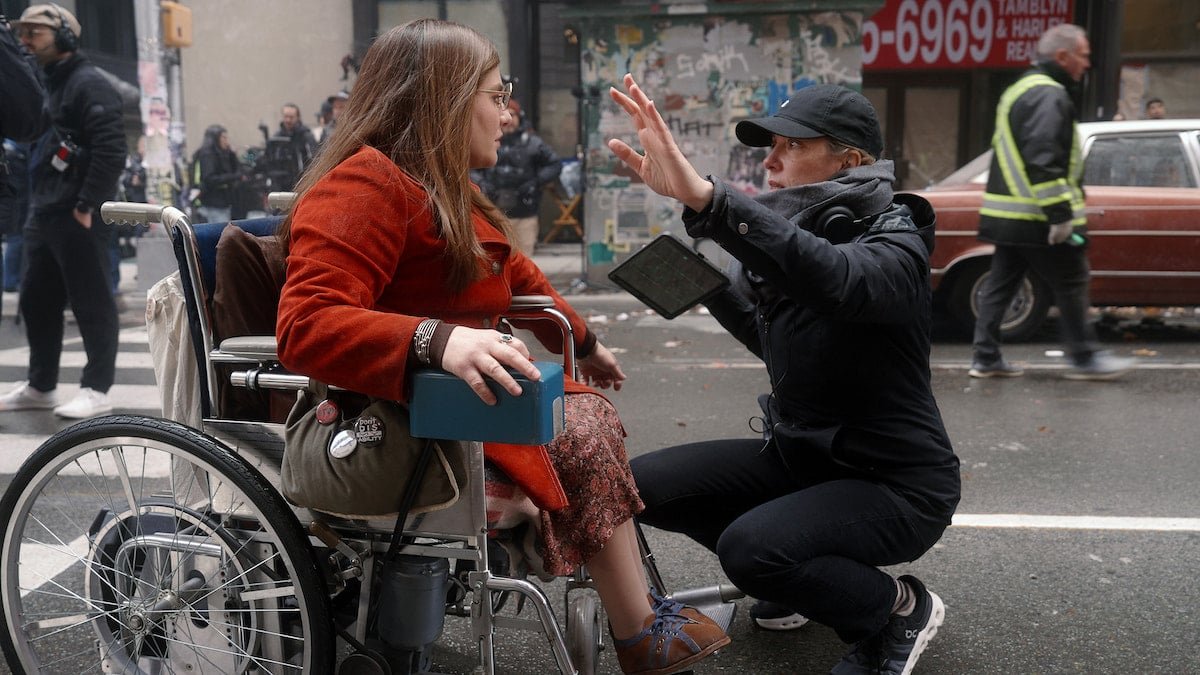
After her Oscar success with CODA, Siân Heder, director of the new drama Being Heumann, found herself in an unusual place for any filmmaker.
“I had a moment of power,” she recalls. “And you don’t often have a moment where you have capital and get to choose how you spend it.”
CODA had started out as an indie film made in Gloucester, Massachusetts, not far from Heder’s hometown of Cambridge. The film follows a young woman (Emilia Jones) helping her Deaf fishing family while yearning to become a professional singer. At a very strange Sundance — it was virtual because of Covid lockdowns — Apple seized the distribution rights for a festival-record $25 million. Then CODA went on to win three 2022 Oscars, including for Best Picture. Heder, who wrote and directed, won for Best Adapted Screenplay, and Troy Kotsur became the first Deaf male actor to win an Oscar, for his supporting role.
“There were a lot of complicated feelings after the Oscars because suddenly a bunch of eyeballs turned to me, like, ‘What are you doing next?’ And it took a minute to re-center myself and touch base with why I tell stories,” Heder recalls. “And I realized that all of the noise around what I should be doing after CODA was just noise. I tell stories because I connect to them, and they move me, or they make me laugh, or I feel connected to a certain character.”
She was developing several stories, but felt especially close to the one she was working on with Judith Heumann, widely known as “the mother of the disability rights movement.” Heumann became a quadriplegic after a bout with polio when she was a toddler, and spent much of her life mounting confrontational — and effective — demonstrations demanding access for people with disabilities.
Heder had met Heumann after she appeared in the 2020 documentary Crip Camp, and they worked together to adapt her memoir, Being Heumann: An Unrepentant Memoir of a Disability Rights Activist, for the screen.
Heder wanted to make the film in part because it was “the hardest story I could think of telling.”
“This was an incredibly hard movie on paper,” Heder says. “It was a period piece. I wanted to shoot with an entirely disabled cast of unknown actors. There were a lot of things which would have made a studio say no to this movie.”
So Heder took her newfound Hollywood power and used it to empower others. Apple Studios greenlit the film, and Being Heumann was born.
It is a striking movie in many ways — for its fealty to the facts, its surprising candor and comedy, and most of all its cast of largely unknown actors with disabilities, performing alongside stars like Mark Ruffalo and Dylan O’Brien. Ruth Madeley, who was diagnosed with spina bifida before she was born and uses a wheelchair, anchors it all as Judy.
The film focuses on a 1977 sit-in at a San Francisco federal building. Heumann and fellow activists demanded that then-Secretary of Health Joseph Califano (played by Ruffalo) sign and enact Section 504 of the Rehabilitation Act of 1973, which called for Civil Rights protections for disabled people. It was a step toward the greater accessibility promised by the American Disabilities Act of 1990, and part of a fight for equal treatment that continues today.
Heumann died in 2023, at the age of 75. But Heder carried out their shared dream of making a film that would prominently put actors with disabilities on screen. That meant ensuring equal access for them all.
To make Being Heumann, Heder says, “We had to reinvent how to make a movie.”
Cuts
Being Heumann opens with a high-energy sequence that takes us back to a time before curb cuts — the small slopes cut into sidewalks — were common. They were first introduced for people in wheelchairs, but now benefit anyone with a stroller, luggage, or aching knees.
It’s 1972, and Heumann races through Midtown Manhattan to a demonstration for disability rights. When she and her fellow activists are ignored, they descend — in wheelchairs and on crutches — into oncoming traffic.
It’s one of many sweeping moments in Being Heumann that may seem too cinematic to be real. But it happened pretty much like it does in the film.
It also sets the stage for a story of people from all backgrounds, coming together for an undeniable cause.
“The movie is intensely intersectional because disability touches every group,” Heder says. “It is the one minority group that we can all be a part of at any time. If you’re lucky to live long enough, you will probably join this group.”
The 1977 federal building sit-in came after years of breakthroughs by historically marginalized people, many of whom loaned their growing strength to the protest.
“When they took over the San Francisco federal building, the Black Panthers showed up, the United Farm Workers showed up, the Butterfly Brigade — lots of gay and lesbian groups in San Francisco — showed up. There was a feeling that if this group of the most vulnerable people among us could be this disregarded, then there was no hope for anyone, really,” Heder notes.
The film particularly notes that Black people with disabilities heard many of the same arguments they had heard just a few years earlier during the Civil Rights Movement.
“They’re hearing the same language of Jim Crow-era segregation,” Heder says. “So suddenly, ‘separate but equal’ was back, and it was like, ‘You’ll get to go to school, but you’ll get to go to school in the basement with a bunch of other disabled kids. You’re never going to go to mainstream school.’ Or, ‘Well, you don’t need to go to that building. We’ll give you this other space where you can be in.’”
Heder co-wrote the Being Heumann screenplay with Rebekah Taussig, a wheelchair user, and they tried to avoid the usual tropes of characters with disabilities.
“When disability is represented, it often falls into these really harmful tropes of characters either being saintly or the object of pity or struggling through incredible hardship,” Heder says. “And so the idea was that we could tell a story that felt like a heist movie that was really fun and really entertaining, and was there to take the audience on a wild ride, but also centered people that are often pushed to the margins. That was exciting.”
The production reflected the reality of the movement.
“I loved that the ensemble represents every race, every kind of sexual orientation, body, disability. It was really incredibly moving to see not just the way the real protest unfolded, but our own cast and the dynamics within that ensemble that were really beautiful, because it was professional actors and non-actors who’d never been in a movie before. We were having to create the kind of community that they created in the building in real life in order to make the movie,” Heder says.

Being Heumann is also a ‘70s story about young people, so the characters are fun, sexual beings who like to party. In one scene, Judy hooks up with her caregiver. Heder leaned on Taussig to get it right.
“When we were writing the sex scene, I remember talking a lot with her about the power dynamics for Judy with someone who was caregiving for her in that moment, and it turns sexual, and it was a very tricky scene to write. I would have been intensely uncomfortable, probably, writing that scene, if I hadn’t had a partner with me who could go, ‘No, actually, caregiving can be really hot,’” Heder says.
The moment reflects Heumann’s vulnerability, but also her assertiveness.
“Judy couldn’t move her body. So when Judy was in her chair, she had incredible freedom, and she could be very formidable physically in the world. She was very brave when she was in her chair,” Heder says. “When she was out of her chair, she couldn’t even sit up by herself. So, I think when Ruth and I were working on that character, it was really interesting to think about Judy in motion and Judy in stillness.
“And Judy told me a very scary story about almost being raped on a date in New York City, and that story she told me — which didn’t make it into the movie — definitely informed the character for me. There was this intense vulnerability of having this experience with this man that was very scary, but then she also needed his help to get back into her chair.
“And there was something about that where it stopped being about Judy as this icon — the mother of the disability rights movement — and was Judy. Every woman I know has an experience like that, and there was something about it that really tapped into Judy as a woman.”
Being Heumann Director Siân Heder on Living Another Life
Why is Heder, who doesn’t have a disability, drawn to stories of people who do?
“I’ve thought about that a lot,” she says. “I think I’m drawn to human stories. I’m always drawn to the underdog or people who’ve been marginalized and don’t often get to be the center of their own story. But also I’m interested in what it takes to make it through this life, and how we, as humans, connect or deal with challenges. And there’s something about looking at characters that are handling a disability, where you know it really pushes at the boundaries of what the human experience is.
“That being said, I’m also very aware of knowing what I don’t know, and I think when you’re entering a community that you are not a part of, it is really important to surround yourself with collaborators who are from that community, who speak to that lived experience.”
She started out as an actor, and one of her favorite parts of moviemaking is “imagining what it is to live another life.” When she wrote for Orange Is the New Black, for example, she was fascinated by how someone would be affected by prison, and even studied how to make a bomb behind bars.
To research CODA, she went along on Gloucester fishing trips that started at 3 a.m., and learned sign language.
That ability also proved helpful on the set of Being Heumann.
‘Keep Asking’

The production emphasized inclusivity, but the world of disabilities isn’t monolithic. People with different disabilities need different support. And people who don’t have disabilities sometimes need to take more time to learn to communicate with people who do.
The film makes this point in its portrayal of Hale Zukas, an activist with cerebral palsy who communicated with a pointer, mounted to a helmet, that he used to point to letters on a board. When O’Brien’s character, a reporter, first meets him, he thinks Zukas is simply incapable of speech, and doesn’t take the time to understand him.
Zukas is played in the film by filmmaker Andew Pilkington, who was born with cerebral palsy. At one point during rehearsals, the cast members sat in a circle, discussing their experiences, and Pilkington began to share. But because of his speech disability, others in the cast had trouble understanding him, but were afraid to say so.
“I watched the sign language interpreters,” Heder recalls. “I now sign well enough to understand what they were saying, and the interpreter signed, ‘He has an accent; no one can understand him,’ instead of signing what he was saying.
“And it was true — none of us could understand him, but we were all sitting there pretending that we could. And my heart dropped, and I stopped everything, and I said, ‘Hey, you guys, this is uncomfortable, but Andrew, we can’t understand you right now. The interpreter is not translating for you. What do we do in this situation?’
“And he said, ‘You ask me to repeat myself.’ And I said, ‘But what if we still don’t understand?’ And he said, ‘You keep asking until you do.’ And it was just such a lesson for all of us.”
O’Brien and Pilkington have several key scenes together. At the beginning of production, Heder recalls, O’Brien had trouble understanding Pilkington.
“But halfway through the shoot, I looked out of my office window on a lunch break, and Dylan and Andrew were sitting on the lawn chatting up a storm because they completely understood each other,” she says. “So I was watching the real-life arc of those two people mirror the characters in the movie.
“And that’s what I’ll say about authentic casting: People think that it’s for optics or it’s because it’s the right thing to do. But you’re actually imbuing your characters with the kind of reality that is so beautiful creatively.”
At one point, Heder’s children visited the Being Heumann production facilities, outside Toronto.
“I was working on this soundstage on our set, and at one point I came out and there was a huge football game happening, and my children were in the middle of a football game with everybody from the cast. So it was Matthew Jeffers, who’s a little person, and Antwan Tolliver, who’s a wheelchair user, and Jon Beavers, who’s non-disabled and six foot five, and everybody was playing this hardcore football game.
“And I looked at this and was like, ‘This is the world that I want to live in.’”
Being Heumann is now in theaters and arrives Friday on Apple TV.
Photos courtesy of Apple



