
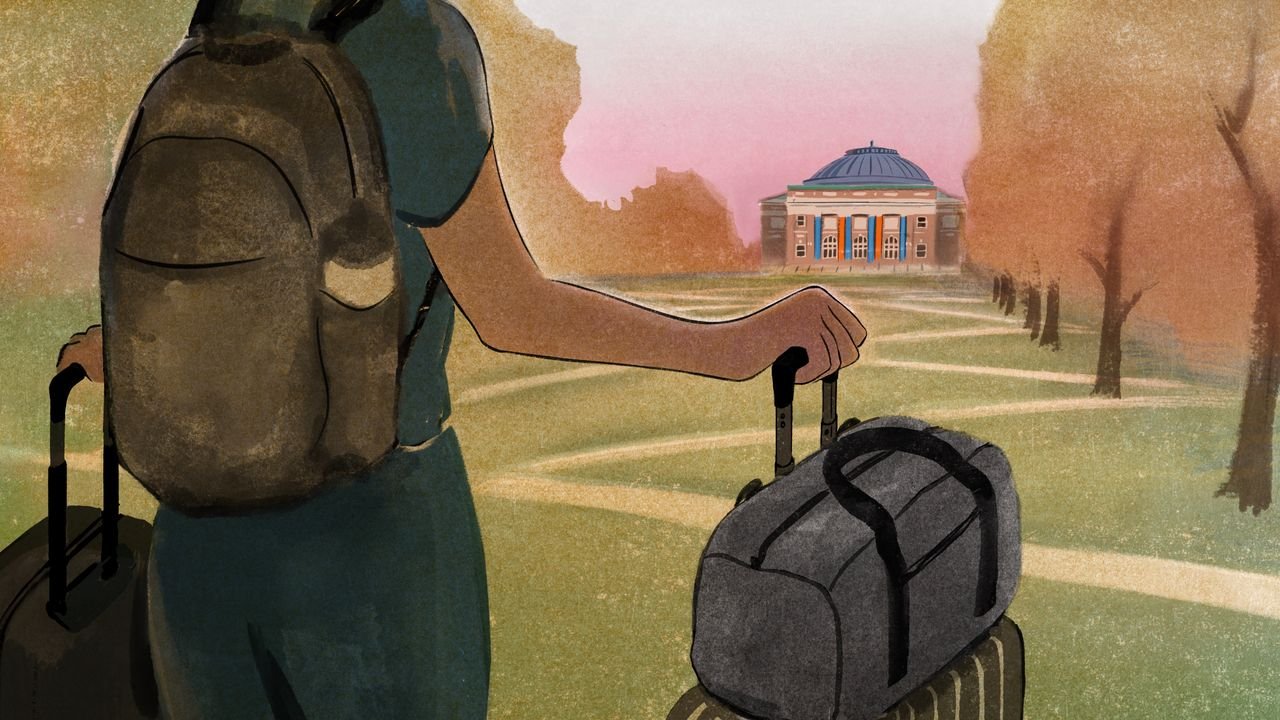
When I met with Liu again, this past August, before the start of her second academic year, she was on edge. Since we had last spoken, the Administration had announced that international students would be allowed to stay in the U.S. for a fixed period of no longer than four years, as opposed to for the duration of their status. A group of higher-education organizations and labor unions sued the Administration to stop the limitations; the University of Illinois Urbana-Champaign was one of fifteen schools to submit testimony. The Pentagon had also ordered thirty U.S. universities, including the University of Illinois, to review their ties to a hundred and thirty international research institutions, mostly in China, or risk losing their federal research funding.
It was getting harder for Liu to ignore the news stories. International students account for twenty per cent of the Urbana-Champaign campus enrollment this year, but, among Liu’s peers, interest in the school and in other institutions in the U.S. had been souring for a while. The restrictions “might not change the fact that people want to study abroad,” Liu told me. “But, for the U.S, they won’t choose here.”
I was born and raised in Champaign, and graduated from the University of Illinois, in 2000, when the campus had just thirty-seven undergraduate students from China. My father, an immigrant from Japan, came to town during one of the first waves of Asian arrivals, in the nineteen-seventies. I remember him buying furikake and nori at the lone Asian grocery store, AM-KO. Now Urbana-Champaign has multiple international grocers, and an H Mart opened last year. The town has also become, in the past decade, a hub for Chinese cuisine, earning a writeup in the Times, which described restaurants on Green Street serving “spicy bullfrog hot pot in a Sichuanese broth studded with green peppercorns” and “yangrou paomo, a Shaanxi lamb soup.”
The transformation happened quickly. As middle and high schools in China rapidly expanded their international programs, the University of Illinois climbed the U.S. News & World Report’s national rankings, and, for many Chinese students it went from being a backup school to their first choice. By 2012, the Urbana-Champaign campus enrolled more than eight thousand international students—more than any other American public university.
As the Asian population soared, backlash followed. In 2017, reports spread about Chinese Communist Party cell meetings being held in the same campus dormitory where I had resided as a freshman. A year later, Rubio, who was then a senator from Florida, raised questions about the “counterintelligence risk posed to U.S. national security from Chinese students.” Legislators worried about Chinese investment in Illinois farmland. In Champaign, a bus company complained about the university selling out “to the highest foreign bidder,” and used anti-Asian advertising: “You won’t feel like you’re in China when you’re on our buses,” one line read. That same year, fears heightened abroad about sending students to America after Yingying Zhang, a Chinese visiting scholar at the University of Illinois, was kidnapped on the Urbana-Champaign campus and murdered. This past spring, when I visited Zhang’s campus memorial site, near the bus stop where she was last seen alive, I saw that people had left flowers, a stuffed penguin, and a Hello Kitty doll. Although the horrific details of her death had spread across Chinese state-run media at the time, sparking safety concerns about the U.S., those worries were overshadowed by the quality of American schools, and so the students kept coming.
On a recent afternoon, Nancy Chen, a twenty-two-year-old who graduated last spring, stood on Green Street recruiting students to sign up for Hungry Panda, an Asian-food-delivery app. Chen came to Illinois, in 2022, after graduating from the Qibao Dwight High School, in Shanghai. When she first arrived, she found herself alongside thousands of other Chinese students, and the campus felt comfortable. Today, she said, the political hostility has shaded perceptions among students, and many are left feeling that schools “just want the international tuition from us.”



