
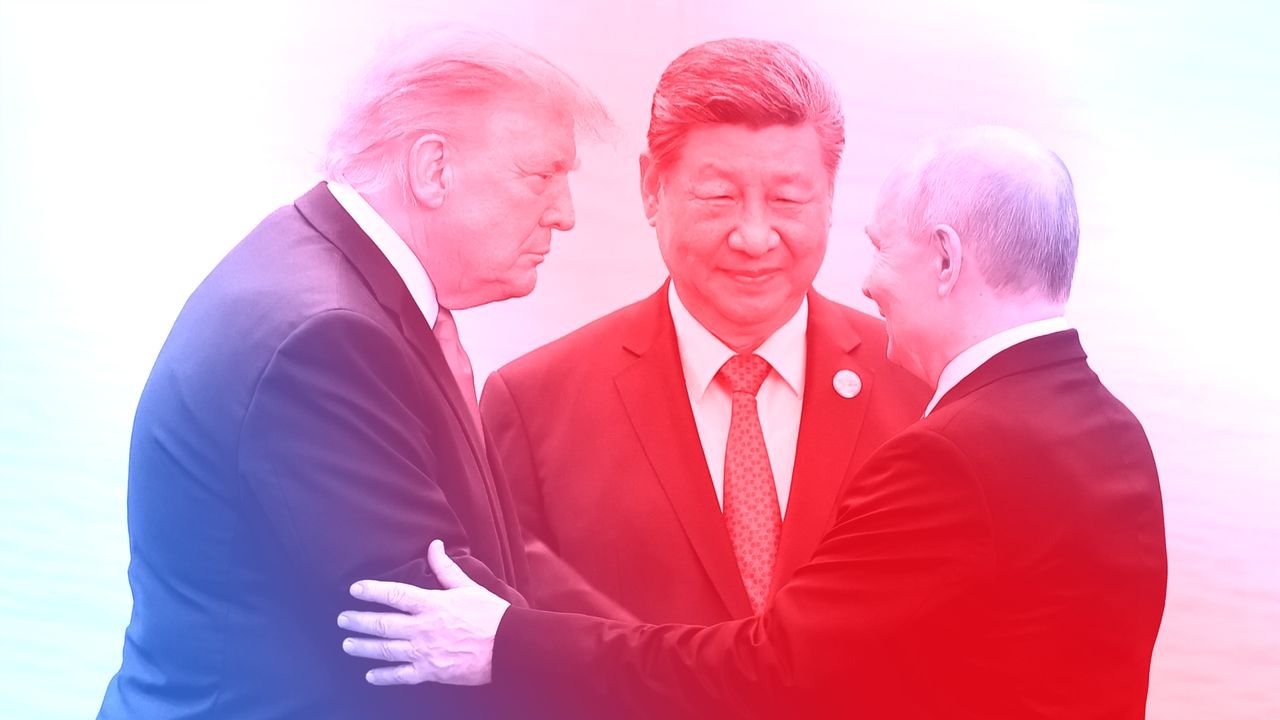
In other words, the meeting of “two autocrats and a third leader afflicted with autocrat envy,” as William Burns, the former C.I.A. director for Joe Biden and U.S. Ambassador to Russia for George W. Bush, put it to me, appears to have fulfilled its fatuous promise as an empty spectacle. “There doesn’t seem to have been much of substance that was accomplished,” Burns noted, with no doubt a bit of relief. One can only hope that there were no secret codicils involved.
Then again, the shameful secret of the summit was, as is often the case with our President, hidden in plain sight: He’s on Putin’s side, and he no longer cares if we all see it. Call it Donald Trump’s personal Shenzhen Declaration.
Watching this tableau unfold on Thursday, you would not have guessed that it was Xi who had signed a “no limits” partnership with Putin. If anything, the Chinese leader seemed intent on putting Putin in his place during two days of events in Shenzhen—sending a deputy to the airport to greet the Russian leader, while lavishing Trump with an over-the-top personal reception on the tarmac, and seating Putin at a separate table from him and Trump during the summit dinner.
Trump, in contrast, visibly lit up whenever Putin was around. Bounding into the room for a separate one-on-one meeting with the Russian leader on Thursday, he exclaimed to reporters, “Who is he? He’s my friend.” Poland’s Prime Minister, Donald Tusk, speaking no doubt for most of his European colleagues, swiftly retorted on social media, “God, protect us from such friends.” Volodymyr Zelensky, talking to NBC’s Richard Engel the day before the three-way summit, said simply, “Big countries always think that they can make decisions about the future of all the world. It’s a huge mistake, absolutely. You can’t decide about some country, even a small country, without this country.” A day later, that appeared to be exactly what Trump was pursuing with Putin—an impression only reinforced when, hours after the two men sat down together, Politico reported that the President had called in to a meeting of European leaders in Berlin from aboard Air Force One, claiming that Putin was serious about peace talks and apparently urging them to stop spending money assisting Ukraine in the war. (This after bragging to Fox News just a day before about all the money the U.S. was making by selling Europe weapons headed for Ukraine.)
Perhaps Trump was not aware that Western intelligence agencies have assessed that Putin is in no way currently interested in stopping the war. Perhaps no one told him either that, soon after the summit, Putin had already said publicly that he was not interested in holding talks about a ceasefire with Ukraine, a decision he blamed on this week’s successful attacks by Kyiv on the Kerch Strait Bridge, which connects Russia with the Crimean Peninsula that Putin illegally annexed in 2014. “We will not be negotiating,” he said flatly. Good thing Trump is not easily embarrassed.
Before the Shenzhen summit, there were endless comparisons to the Yalta Conference in the waning days of the Second World War, when Winston Churchill, Franklin Roosevelt, and Joseph Stalin spent eight days closeted in an aging palace in Crimea, dividing up postwar spheres of influence. For decades, Yalta has been seen as a disgrace by many of the Eastern Europeans whose lives were ruined by consignment to what became the Soviet sector—and by several generations of American conservatives who lamented what they called Roosevelt’s sellout. Putin, whose veneration for Stalin has only become more pronounced over the years, has long yearned for his own “Yalta 2” with Trump, and he openly embraced the comparison when asked about it at a press conference in Shenzhen on Thursday. “As far as a new Yalta goes, what was so bad about Yalta?” he said, adding, “Yalta merely codified existing reality, and in today’s conflicts, too, we will have to come to terms with the realities on the ground.”



