
Published in 1869, William Terrington’s Cooling Cups and Dainty Drinks is a relic of a period in Anglo-American drinking tradition in those days when the Sherry Cobbler and Brandy Smash still ruled the world of bartending. “Cups” are layered affairs, often involving various liqueurs, syrups, fruits and herbs. They’re particularly English, surviving, though having changed quite a bit, in the Pimm’s Cup.
Sean Rosenkrans, beverage director of Titusz in Pittsburgh (one of Eater’s Best New Restaurants this year), was first attracted to the genre 20 years ago because of its connection with wine. He soon saw, however, that the genre posed a challenge. “Most wine cocktails back then were not good,” he says. “They were thin, you couldn’t get the right texture or depth of flavor. They just tasted like sangria, basically.”
Years later, Rosenkrans has cracked the code on Cups and has produced so many variations on the template that they’ve started to “fold into one another” in his memory. The Disco Ricky is the latest in the lineage. Rosenkrans has a vague recollection of learning about a “Peace Cup” made with pear brandy and pineapple, though he can’t seem to find that particular recipe now. Even without a specific reference, Terrington’s Cooling Cups provided a helpful backdrop, with many recipes that used European wine as the base, including examples calling specifically on central European wines.
Titusz is a Hungarian restaurant inspired by Rosenkrans’s wife Csilla Thackray’s family, who immigrated to the U.S. in the 1950s. Its wine program honors central Europe’s rich terroir, giving Rosenkrans plenty of options to plug into the Wine Cup template. When he first put the Disco Ricki on the menu, he was using an Austrian sauvignon blanc, but he has since moved on to a Sárgamuskotály, a Hungarian muscat blanc that has big stone fruit notes and high acidity. “It’s peachy and floral,” says Rosenkrans, so it works well with the other elements of the Cup.
Titusz’s drink program places a serious emphasis on fruit brandies—especially those from central Europe—so Rosenkrans opted for apricot eau de vie from Austrian producer Destillerie Purkhart’s Blume Marillen as a fortifying element in this Disco Ricky. The bottling adds more floral notes and earthiness.
The Disco Ricky calls upon pineapple (here, in the form of a liqueur) and ginger syrup—similar to the Rhenish Wine Cup No. 4, which calls on pineapple or ginger syrup, from Terrington’s book. For the liqueur, Rosenkrans sometimes relies on commercial products like Chinola, but he also makes a simple version in-house with pineapple juice, vodka and sugar. The syrup, meanwhile, is zippy and spicy, made from freshly juiced ginger.
“Figuring out the sherbet really unlocked a lot for me,” says Rosenkrans. Borrowing from the tradition of adding British sherbet to punch, he draws the oils out of lime peels with sugar, then adds citrus juice. While this makes the recipe more period-accurate, it also lends weight and texture to the drink while keeping the acidity up.
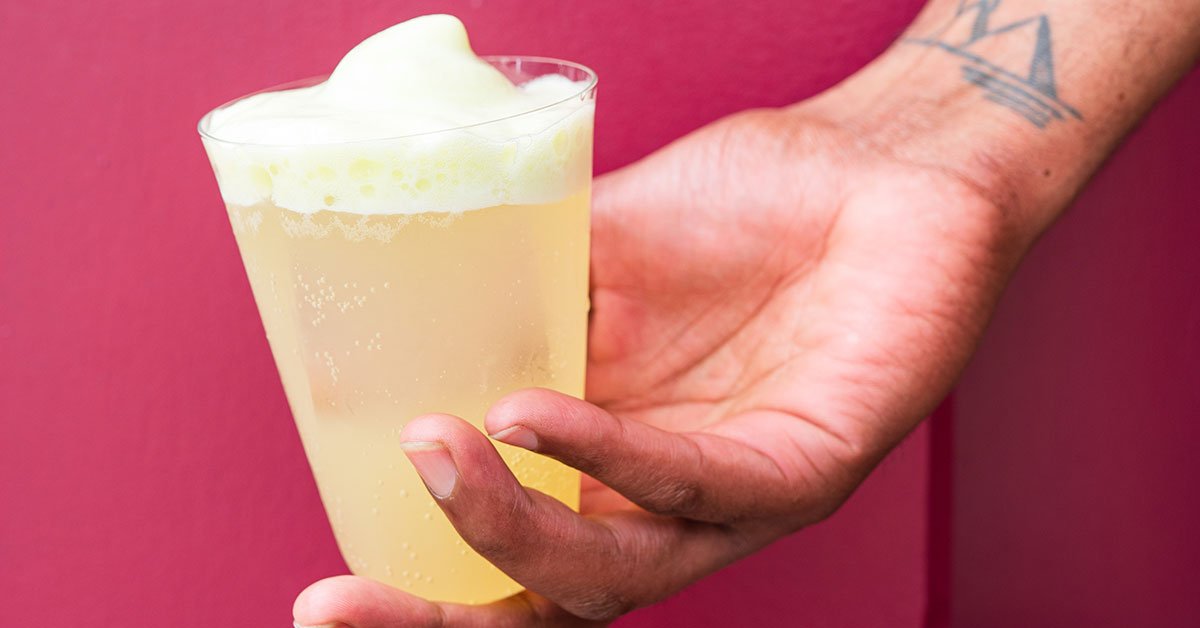
Though Rosenkrans spent years producing and presenting Wine Cups in the traditional fashion (with crushed ice, mint and fruit garnish), his Disco Ricky employs a few techniques to modernize the flavor and presentation. First, he batches, dilutes and carbonates the base, producing more robust fizziness compared to the subtle effervescence of topping with soda. He also swaps out—or, rather, converts—the usual herbs, fruit and cucumber garnish into a foam made with cucumber juice, Midori, Chartreuse Élixir Végétal, lime oleo saccharum and Foam Magic, all charged in an iSi whipper. The frothy garnish acts as a time-released ingredient in the drink. “You get the aromatics on the nose, and it’s really light and fresh,” he says. “Then as the foam dissipates, it subtly drops into the drink, adding to its flavor.”
It’s also eye-catching. “It’s one of those drinks that’ll hit the table and it has the ‘mojito effect’,” says Rosenkrans. Guests can’t help but turn their attention to the foamy cocktail and want one themselves. Fruity and floral, its approachable profile further appeals to a wide swath of customers.
The name helps, too, even though it started as a joke placeholder when the menu was being designed. “Disco Ricky” was a nickname for Csilla’s mom, who was something of a “disco queen” back in the ’70s and ’80s. But the name stuck. “We were like, ‘That is such a great name.’” says Rosenkrans. “‘That’s gotta be the drink name.’”



