
Mother Jones illustration; Tribune News Service/Getty
Brandon Thomas DiSabatino is used to receiving unusual emails. DiSabatino is a poet, author, playwright, and the owner of Conveyor Belt Books, a rare and eclectic books dealer in Covington, Kentucky. A certain amount of strange correspondence is inherent in the business. But over the last two months, he has received two emails that stood out: each of them had a spreadsheet attached, detailing very large, and very odd, orders.
The requested books didn’t make a lot of sense, for one. “Some of which I didn’t carry,” DiSabatino explained to me recently, “and none of which were related at all. It was all over the place. There was no thematic tissue” connecting the attempted orders. There wasn’t much overlap between the lists, but both emails sought one specific rare book, a self-published work by the conceptual artist Chris Burden. The book contains barely any text; it’s mostly images of the artist’s work, and it is exceedingly hard to find. “There’s maybe one or two floating around on the Internet,” DiSabatino says.
DiSabatino had gotten a similar email from another company recently, also asking to buy the Burden book. And he’d received an unusual offer from a third company that appeared to be based in the Dominican Republic, offering to buy all of the books he had in stock—his store’s entire inventory.
“I looked up the people involved and it was all tech related,” DiSabatino says of the Dominican-seeming company. “The person who’d reached out to me was a digital strategist.” He declined to make the sale.
“What is reality… What is real?”
Another thing DiSabatino noticed about the emails with the spreadsheets was the name of the company attempting the purchases: Blue Angel. The employee supposedly requesting the books was named Crystal Kanemoto, who, DiSabatino deduced after a quick Google search, did not seem to be a real person. While I have not found that to be a real person’s legal name in any public records, DiSabatino has pointed out that the name corresponds to a chatbot on a site called Emochi—one with whom users are encouraged to have adult conversations. (Emochi’s parent company did not respond to a request for comment.)
DiSabatino was also confused by Blue Angel’s website, which boasts that it sells “high-quality industrial supplies.” On a page dedicated to its “products and services,” the company displays a series of photos without links, showing things like steel drums, modular offices, gravel, a Jeep Wrangler, and, for some reason, two close-up photos of trout eggs.

“We believe that once our company wins, we all win,” Blue Angel says on their website, under a heading labeled “Our Principle.”
“We treat our company as the Queen bee of the beehive,” the section continues, “and our goal as bees, is to empower our Queen and enrich our beehive by cultivating and enhancing the growth of the flowers that provide us with nourishment to achieve our goals. Our customers are like the flowers in the flower field that help bees live.”
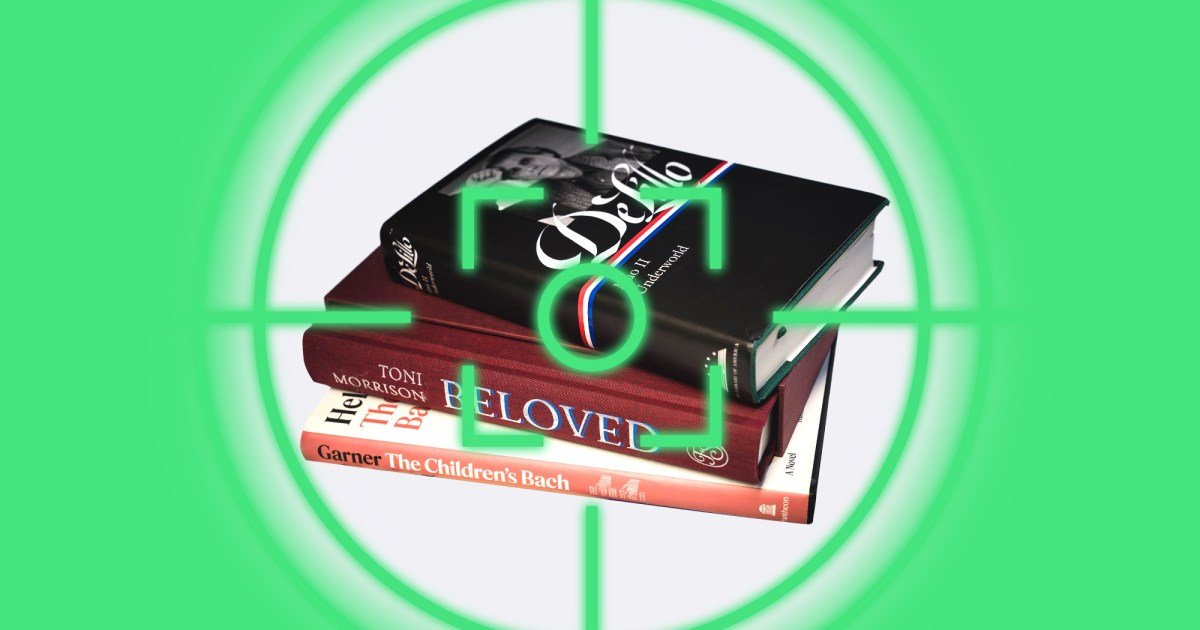
The oddities and the emails from Blue Angel made DiSabatino recall a recent story by 404 Media about a similarly-named company, Green Parrot, which the news site found had shipped rare books to an Amazon AI training facility. As journalists from 404 and elsewhere have reported, companies are now buying rare books and feeding them into computers to train large language AI models, destroying the original copies. Anthropic, for instance, is set on trying to acquire as many books as possible—a secretive project that the company itself has described as “our effort to destructively scan all the books in the world.” That’s what it sounds like: buying books and slicing them apart in order to scan them.
DiSabatino quickly became concerned that Blue Angel might be trying to buy his books for a similar ulterior—and to him, sinister—purpose. In so doing, he joined the ever-expanding crowd of people who the AI rush has forced to constantly reconsider their reality.
The situation is made stranger by the ways in which it mirrors a 2023 novel, Forget I Told You This by Hilary Zaid, in which a mysterious company called Q buys and consumes novels. Zaid began writing the book during the Obama administration, after Google had embarked upon a project to acquire and scan as many books as possible, leading to objections from authors and publishers. (After a long-running copyright lawsuit, a judge eventually ruled that Google Books constituted fair use.)
“As a fiction writer you try to create trouble,” Zaid told me recently, “and to me the most horrifying thing that you can think of is the logical extension of the current trajectory.”
“Given the enormous egos involved in these tech projects,” she added, writing a world where such a company destroys books “seemed like a reasonable place to go.”
For some booksellers, the run on rare books has been a windfall, a way to offload product that no one else wants, DiSabatino says: “There are people in the book world who have no ethical or philosophical issue of selling these things and not caring where they end up or the purpose for which they’re being used, and knowing there’s a possibility of their consumption and destruction.” But he didn’t feel that way. Instead, perusing photos of trout eggs and reading emails from a woman who didn’t seem to be real, he felt uneasy.
“I’m not a paranoid person, despite my penchant for Don DeLillo’s work,” he told me. “But it’s hard not to be discomfited and concerned.”
DiSabatino decided to call “Crystal” at Blue Angel and get some insight into the orders. When he was connected, to him she simply didn’t sound like a real person. He suspected he was speaking to a bot. When he asked what Blue Angel wanted with his books, he says, “It giggled. It kept just doing this coy giggle.” When pressed, DiSabatino says that Crystal replied, “We offer many services. We are collecting books for a library.”
Even if Crystal and the other people he spoke to at Blue Angel are real, DiSabatino says, it makes no sense the company would be buying books for a library. He speaks with librarians all the time. They do their own purchasing, and don’t require the intervention of a secretive third-party company.
“We’re not interested in these games.”
DiSabatino also pointed out to Crystal that Blue Angel has an active U.S. Department of Transportation number, suggesting that the company has something to do with bulk freight and truck shipping. (According to DOT records, the company says it works with “general freight” as well as “household goods.”) What, DiSabatino wondered, “is the connection between that and fuckin’ rare books?”
When he asked, “Crystal,” DiSabatino says, “wouldn’t give any straight answers.” To test his theory he was talking with some sort of machine agent, he started asking questions “that had a nonlinear aspect… ‘What do you see when you close your eyes?’” he inquired. “’Can I ask, do you dream of electric sheep?’”
In response, DiSabatino says “it glitched” and that Crystal repeatedly said “I’m sorry, I think you’re breaking up,” followed by more robotic giggling. He says he tried slightly less surreal questions: “’Do you know what a high school is? Do they program you to have a high school in the cybernetic world in which you’ve been created?’” Again, he recounted being rewarded with a robot giggle and the words, “I think you’re breaking up.”
“I was having fun with it,” DiSabatino says, “while also being vaguely terrified.” He hung up.
When he called back to the company’s main number and tried to reach its customer service department, he says he was connected with what he describes as an “Asian-accented bot named Elsa,” who knew, even though he hadn’t said, that he was calling from Conveyor Belt Books. When he offered to come to Blue Angel’s offices, he says Elsa also claimed the call was breaking up; when pressed, she robotically giggled, said there was no one in the office, and offered to set up a Zoom call. He never did.
Blue Angel is, for what it’s worth, a real company that’s been incorporated in California since 2015 under the name Blue Angel International LLC. The company’s founder and CEO is a woman named Avon Zhang, who appears to be a real person with a sparse social media presence. (I emailed Blue Angel multiple times asking to interview Zhang, and about their attempted Conveyor Belt orders, but did not receive a response.) Public records show Blue Angel has supplied consumer products to city and county agencies in California. Recently, the company has provided “plant material” for the city of Richmond, for instance, “safety supplies” to San Diego’s transit agency, and sold a 2025 Chevrolet Malibu to Imperial County.
Blue Angel did not return three emails requesting comment. But when I called the company, dialing an extension DiSabatino had been given for Crystal in one of the purchase request emails, I had a different experience than DiSabatino’s. I spoke to two women who didn’t seem to be bots, but who were clearly speaking English as a second language and using anglicized names. After explaining this story to an employee who called herself Alice, I was connected to someone who introduced herself as Crystal Kanemoto. She told me, quite simply, that Blue Angel was trying to buy Conveyor Belt’s books for a library.
“One of our end users ordered these books for the city libraries,” she said, adding that after “we found some of the books” on Conveyor Belt’s website, Blue Angel placed the orders. “We are sourcing the items requested by our end users,” Crystal explained. “We actually do source books, school supplies for the state of California. We source a lot of things, actually. We have like trailers, [and] cars for state departments.”
Crystal wouldn’t disclose which library or which city was making the request. “This is a city library so I’m not sure if they are willing” to be identified, she told me. “But if you are really doubting the identity of our company, you can just give me your email address so we can set up a video conference.” I sent Crystal three emails and a voicemail trying to take up that offer, but she never responded. I never spoke to anyone at Blue Angel over video or in person.
Like DiSabatino, when I had Crystal on the line I also tried asking questions designed to see if she’s a real person. She told me she had heard from her coworker that I thought she may be a bot. “I’m not,” she told me. Feeling slightly ridiculous, I attempted to ask a version of a question from the movie Blade Runner.
“If you see a turtle lying on its back in the road…” I began.
Crystal interrupted me, sounding both real and extremely impatient. “We’re not very interested in some kind of dramas here,” she interrupted me. “We’re not interested in these games. Just want to make sure we’re straight to the point here as well.” We soon ended the call.
DiSabatino remains convinced that the people he spoke to were not real.
“Im tellin ya, sincerely,” he told me by email, “as someone who doesnt believe in UFOs, Elvis on an island with Tupac or anything involving Bigfoot, the Bermuda Triangle or frogs being turned gay from fluoridated water, the ‘people’ we spoke with were not able to sit in chairs, brush their teeth, dream of fields or understand a cartwheel.”
DiSabatino did not fill Blue Angel’s purchase orders. But he kept ruminating uneasily on the specific request for the Burden book. “This thing doesn’t have a barcode or an ISBN number. Typically those things don’t end up on those bulk platforms” like AbeBooks or Amazon, DiSabatino explains. So how AI companies could, if an AI company were in fact involved, become “aware of something as obscure as a Chris Burden self-published artists’ book is also baffling,” he told me. “Why does it want it? It can’t learn anything from the text because there’s barely any text. If one were to have a more possibly grim dystopian—or hell, realistic—perception, one could say that it’s a lack of linear thought. It’s just all appetite. It’s a fuckin’ predator.”
“Books have an ephemerality to them,” DiSabatino says. “So to further endanger the availability and access to them by having them be destroyed and the information isn’t retained… I don’t know where that leaves us. We’re eliminating portions of our cultural history and sending us back to this area of: who controls information, who has access to information?”
I was bothered too, by my inability to decisively solve this mystery, give DiSabatino a satisfying answer, or even feel clear who—or what—I had talked to. For me, Crystal and the other person I reached at Blue Angel seemed real—but I no longer felt totally sure that that was a judgment I could accurately make, the first time in my career as a reporter that I’ve felt that way. I both worried about discounting DiSabatino’s experience, and about bothering or harassing people at Blue Angel trying to do their jobs.
The whole thing was deeply unsatisfying, surreal, and unpleasantly postmodern. In a way, DiSabatino’s experience and my own are a sign of the times, as AI agents with human-like capabilities cause more of us to question what and even who is real. Call center workers are regularly accused of being AI robots. Students and working professionals are unjustly accused of using AI to write for using things like hyphens or big words.
Regardless of Blue Angel’s real motivation, he told me, he’s decided he has to be more careful about vetting every order that comes in than ever before. In the course of simply doing his job he was becoming, I suggested, a kind of existential detective. “That should probably come with some kind of socialized insurance,” he cracked.
“If I see something that is in any way suggestive to me of this kind of chicanery I’m going to reach out via email to someone,” he told me. “I have to verify who the fuck is purchasing these things, if it’s something that has even the faintest miasma of falseness. Which is hilarious. It’s the question of the 21st century: not what is reality, but what is real?”



