
Not so very long ago, the Justice Department stood as a bulwark of facts against Donald Trump’s wildest claims. During his first term, a pattern emerged: Trump would make a bizarre assertion (say, that Barack Obama had illegally wiretapped Trump Tower), a litigant would point to this assertion in court to cast doubt on the Justice Department’s arguments, and DOJ attorneys would be forced to explain to an irritated judge that the president’s statements did not actually reflect the government’s position on the matter. Checking Trump’s comments against what a government lawyer was willing to swear in front of a judge was a handy way of demonstrating how Trump’s version of reality measured up to the truth.
In the second term, the Justice Department no longer sets itself at a polite distance from the baseless allegations shared by the president in his late-night Truth Social posts. This week, DOJ announced an “anti-weaponization” fund of dubious legality, intended to pay back victims of “weaponization and lawfare”—an apparent reference to prosecuted January 6 insurrectionists. In language that could have been written by Trump himself, the press release derides “the unlawful raid of Mar-a-Lago and the Russia-collusion hoax.” The dollar amount of the fund, $1.776 billion, seems selected more for symbolism than for utility.
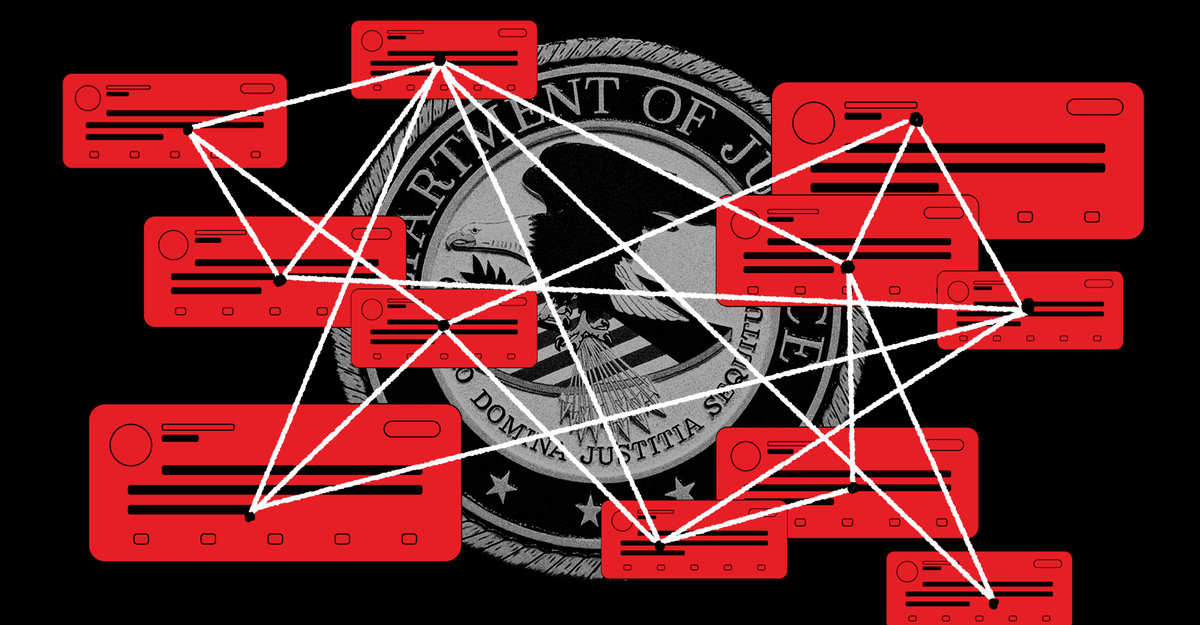
DOJ is now very much an active participant in today’s conspiracy-theory ecosystem. On X, official DOJ accounts and those of the department’s leaders produce a steady stream of images, clips, and one-liners in the apparent hope of drawing in MAGA influencers. These posts, light on facts and heavy on exaggeration and outrage, echo far-fetched ideas already popular on the right and help seed new narratives—part of a give-and-take relationship in which DOJ both feeds and responds to conspiracy theories.
Kate Starbird, a computer scientist at the University of Washington, has argued that we live in an age of “participatory propaganda”—rumors and falsehoods developed through an improvisational exchange between influential figures and the audiences who follow them. The propaganda can range from outright lies to misleading framings of things that really did happen. In 2020, this iterative process helped develop the Big Lie of a stolen election and fueled the attack on the Capitol. Now the government has inserted itself into the process. As Starbird put it in a 2025 lecture, “The machinery of bullshit” has become part of “the political infrastructure of this country.”
DOJ is itself an influencer. In its announcements, lawsuits, investigations, and settlements, the department regularly drops hints to provide conspiracy theorists with a sense of legitimacy and material for further speculation. This is the give in the give-and-take relationship between DOJ and its online audience. Over the past several months, for example, DOJ has settled at least six lawsuits filed by conservatives—subjects of Robert Mueller’s investigation into 2016-election interference, an anti-abortion protester prosecuted over a scuffle outside an abortion clinic, right-wing writers and media sites alleging “censorship” by the Biden administration. Such settlements are then metabolized by the online ecosystem as evidence that the grievance in question was real all along. As the internet researcher Renée DiResta writes, they “can be quoted, cited, and covered as if they resolved questions the courts never actually decided.”
The recent criminal charges against the Southern Poverty Law Center, an antiextremism organization, is best understood as another instance of DOJ throwing red meat to MAGA. The indictment is notably light on detail but heavy on ominous implications, almost as if it were designed to encourage irresponsible speculation. Acting Attorney General Todd Blanche hinted as much in his public comments about the case: “Today is just the beginning, stay tuned,” he wrote on X. Rapidly, online influencers and right-wing-media personalities spun the relatively humdrum facts of the indictment—allegedly, the SPLC paid informants within extremist groups for information, a practice that is not illegal—into evidence of a major conspiracy in which the organization was behind the violent far-right rally in Charlottesville in 2017. “Charlottesville was staged by the SPLC,” the MAGA influencer Jack Posobiec posted. Soon, Trump had adopted the idea, telling CBS, confusingly, that Charlottesville “turned out to be a total fake. It basically was a rigged election.”
In other instances, DOJ has shown itself capable of responding rapidly to MAGA’s demands for action when new topics of outrage arise—the take part of the dynamic. Perhaps the most blatant example came during the federal surge of immigration enforcement in Minnesota this winter, sparked by the MAGA influencer Nick Shirley’s viral videos, which quickly became an excuse for the Department of Homeland Security to carry out immigration raids. (DHS was an early and eager convert to the government-as-propaganda approach, sharing menacing social-media posts and allowing far-right influencers to tag along with immigration-enforcement agents.) On January 18, shortly after an anti-ICE protest inside Cities Church, in St. Paul, conservative influencers began angrily posting on X about the event. The attorney general, Pam Bondi, and the assistant attorney general for civil rights, Harmeet Dhillon, quickly joined in, reassuring their followers that DOJ was “ON IT!,” as Dhillon wrote. The department announced criminal charges two days later, after Trump complained on Truth Social about the “agitators and insurrectionists” who had gathered in the church.
This is lightning fast for the Justice Department, which once preferred to take its time in conducting serious investigations. By online standards, though, the wait to bring charges—just a few days—was agonizingly long, and Dhillon complained on X about MAGA supporters heckling her to move faster. Once DOJ unsealed the case, the cycle of give-and-take continued. Gratified right-wingers closely examined the charges and pointed to the prosecution as validation of their belief that conservative Christians across America are being oppressed by violent left-leaning protesters.
Neither the Cities Church prosecution nor the SPLC case seems destined to do particularly well before judges. Legal scholars and former prosecutors have voiced astonishment at the factual and legal shoddiness of both cases, and the government already had to dismiss charges against one Cities Church defendant because it turned out that she had not actually attended the protest. But to focus on humiliations in court is to miss the point. The goal of securing an indictment is no longer, as Justice Department regulations still require, to put together a case strong enough to persuade a jury to convict. More and more, DOJ primarily aims to participate in the call-and-response of the right-wing propaganda machine.
In prioritizing splashy lawsuit announcements over long-term success in court, the Justice Department is adopting the strategy of other right-wing litigants. Zarine Kharazian, a Ph.D. student who works with Starbird at the University of Washington, has studied how activists on the right used litigation as a form of participatory propaganda in the 2022 midterm elections, creating spectacles meant to draw attention to baseless allegations of election fraud and generating even more fodder for future such allegations. “Most of the time, they don’t succeed in the courtroom,” Kharazian told me, referring to these lawsuits. “But they do manage to extend the news cycle.”
This approach may work well for activist groups, but it has more downsides when the party filing a lawsuit is the United States of America. Destroying trust in government is a riskier proposition when you are the government. If DOJ announces four weak, politically motivated prosecutions, who is going to believe in the legitimacy of a fifth case? Judges newly skeptical of the government’s reliability may examine run-of-the-mill DOJ cases with greater scrutiny, creating more work for a department strapped for resources after thousands of lawyers quit. Juries may be less inclined to believe what prosecutors tell them, which could place at risk DOJ’s ability to win convictions, even in serious cases.
The corrosive effects of this behavior are already visible outside the courtroom. Almost immediately after the attempted attack on the White House Correspondents’ Dinner last month, theories proliferated that the incident had somehow been staged. Under previous administrations, the Justice Department might have been able to dispel some of those doubts by producing a solid indictment of Cole Allen, the alleged would-be assassin. The department had high standards for what information it included in court documents, and its commitment to accuracy helped establish it as a generally reliable source. But those standards have collapsed—and DOJ’s halting effort to set out the facts of what happened at the dinner was not helped by days of caginess about whether Allen had shot a Secret Service officer. Scroll through the X comments on DOJ’s numerous posts about the charges against Allen, and you will find many skeptics demanding that the Justice Department tell them the truth about what really happened.
DOJ’s willingness to toy with conspiracy theories has accelerated America’s plunge into a murk of uncertainty and paranoia, where nothing can be taken as it seems. According to a recent poll from NewsGuard and YouGov, roughly a fourth of Americans believe that the dinner attack was faked, the same proportion who believe that the 2024 assassination attempt against Trump in Butler, Pennsylvania, was staged. Those numbers are particularly high among Democrats, of whom one in three suspects the Correspondents’ Dinner shooting to be fake and more than 40 percent have doubts about the Butler shooting. Perhaps this skepticism should be unsurprising given Democrats’ loathing of Trump, but it also indicates that the conspiracist thinking flourishing on the right has found newly fertile ground across the aisle. Even in the fevered environment of the Trump era, the American center-left has tended toward an institutionalist bent that has insulated it from the temptations of paranoia. Now, though, the second Trump administration has set about demonstrating that institutions are no longer worthy of trust.
Republicans have doubts about what happened at the dinner, too—one in eight, per the NewsGuard/YouGov poll. Although many MAGA voices fell in line after the attempted assassination, parroting Trump’s insistence that the risk of violence necessitates the construction of his ballroom, a loud minority expressed doubts. Marjorie Taylor Greene, the former GOP member of Congress who has refashioned herself as a far-right Trump critic, posted on X that unspecified “people” had discovered “some interesting things” about Allen. Other conspiratorial posts from right-wing accounts explained their skepticism of Allen by pointing to past frustrations with the government’s failure to release information about Butler, the Epstein files, or details about Charlie Kirk’s killing.
Reading through the social-media posts airing distrust of DOJ, I was reminded of Don DeLillo’s novel Libra, an exploration of John F. Kennedy’s assassination in which almost every conspiracy theory about his death turns out to be true. The characters both plot Kennedy’s murder and seek to discover the real killer out of a desperate desire to make sense of the world and alleviate their loneliness in it. Ultimately, though, nobody—not even DeLillo’s fictionalized CIA—really understands what is going on. They have lost any stable sense of reality, and their attempts to map a way out of the morass plunge them deeper into it. In the end, humoring conspiracy theories achieves only one thing: increasing the number of conspiracy theorists.



