
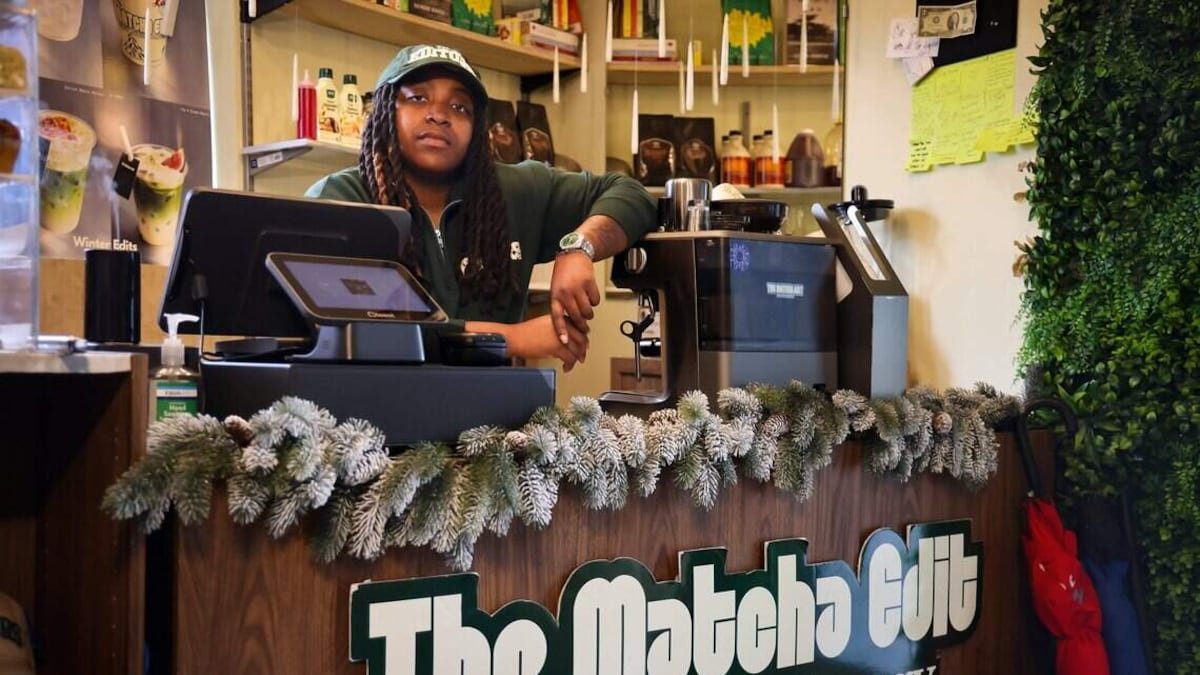
At The Matcha Edit, a Liberty City-based coffee business within Roots Bookstore and Market, owner Marissa Johnson has tourists from countries as far away as France and Ukraine regularly come in to try her drinks.
But she was disappointed when a friend in New Orleans sent her a video from a Starbucks coffee shop there earlier this year.
“She asked, ‘Did you collaborate with Starbucks?’” said Johnson, 31. “They have your brand all over the menu in here.”
Johnson opened up the Starbucks app to see for herself. The app read, “The Matcha Edit: The New Way of Matcha.”
She was stunned.
“They had matcha [before], but they never called it ‘The Matcha Edit,’” Johnson said.
Since starting the business as a pop-up last year, The Matcha Edit has earned significant buzz on social media as Johnson looks for ways to sustainably expand the concept. The experience with Starbucks led her to file an application in May for a trademark of “The Matcha Edit,” which is now pending. She said she posted about the situation in part to encourage other entrepreneurs to protect their business ideas and intellectual property.
When Johnson reached out to share her grievances with Starbucks, she said the company responded by saying that it wasn’t aware of her business and that it would avoid using the phrasing in the future. The company promptly removed the mentions from its social media, according to Johnson.
Starbucks did not respond to a request for comment from the Miami Herald last week.
But the experience was discouraging, Johnson said. She said she opened a coffee business to follow her dreams and never expected to deal with anything like this.
“It made me feel like they copied me. It was all over the United States,” she said.
What can small businesses do to protect their intellectual property?
Downtown Miami-based lawyer Rebecca Beliard helps clients manage their intellectual property. Although she doesn’t work with Johnson, she explained that Johnson’s situation is all too common.
“It happens more often than you think,” said Beliard, 37. “And the worst part about it is that a larger company can replicate a small business innovation and bring it to market faster than a small business can.”
Beliard said she worked as a corporate lawyer earlier in her career and saw firsthand how corporations can overpower and shortchange small business owners.
“One of the reasons I left corporate America was because I was constantly sitting across the table from entrepreneurs, creatives and artists,” she said.
Beliard believes small business owners should prioritize managing their intellectual property and business ideas. She recommends that they hire a legal professional to do a comprehensive IP search to make sure they own the parts of the business they are building. Without checking first, a business owner could end up making money for someone else who owns the intellectual property or trademark without knowing it.
“An LLC doesn’t do that,” she said. “Having a social media handle doesn’t do that. Having a domain doesn’t do that.”
Johnson also strongly recommends that other entrepreneurs invest in trademarks to protect their work.
“A lot of people don’t do it because they’re not sure if it’s going to be something successful, so they don’t want to invest,” she said.
As Johnson continues operating The Matcha Edit, she’s focused on building a sustainable business that she can expand on her own terms when she is ready. In the meantime, she feels strongly that a major corporation shouldn’t take ideas from smaller companies.
“Whatever you’re starting, believe in it, because someone else will obviously believe in it,” she said.



