
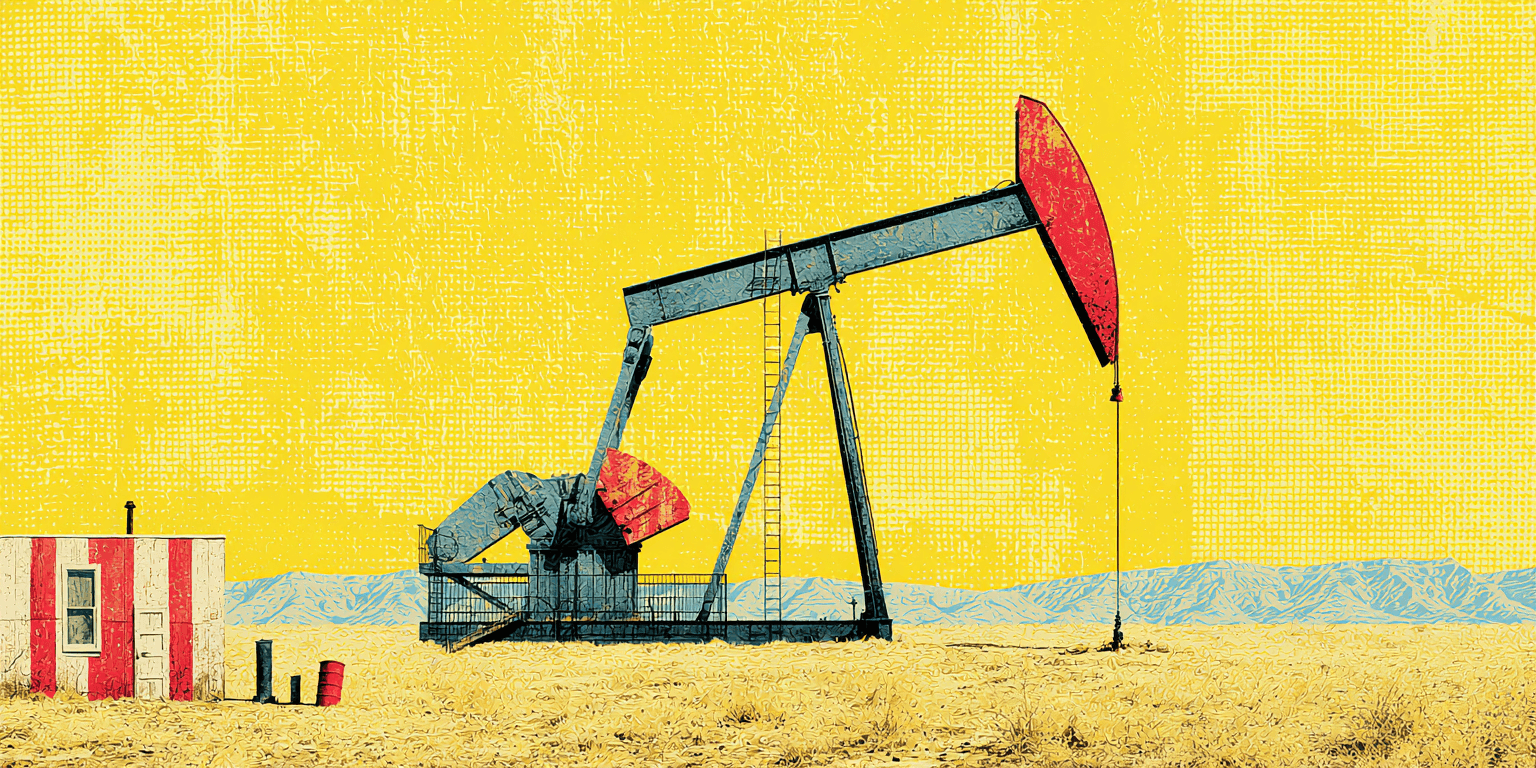
Across the United States, millions of abandoned oil and gas wells remain after production has ceased. Image: Midjourney
The transition to cleaner energy is reshaping the way energy is produced and consumed. It is also redefining how engineers manage the infrastructure left behind. Across the United States, millions of abandoned oil and gas wells remain after production has ceased. As they age, some begin releasing methane through deteriorating well barriers, and those emissions can’t always be traced by conventional inspection methods.
At USC Viterbi‘s Mork Family Department of Chemical Engineering & Materials Science, PhD student Nima Daneshvarnejad is developing an alternative approach to methane monitoring, guided by Iraj Ershaghi, Omar B. Milligan Chair in Petroleum Engineering and founder of the USC Ershaghi Center for Energy Transition (ECET), and Donald Paul, William M. Keck Professor of Energy Resources and executive director of the USC Energy Institute.
“When I came to California, I realized the energy engineering challenges were very different from what I’d seen elsewhere,” Daneshvarnejad said. “I wanted to use my background in petroleum engineering and fluid mechanics to solve a problem that was both scientifically interesting and immediately practical.”
That goal has led Daneshvarnejad to develop an Internet of Things (IoT)-enabled system that continuously measures methane emissions from abandoned wells, making accurate and long-term monitoring possible at a fraction of the cost of existing methods. The paper is published in the MDPI journal, Environments.
The monitoring problem
According to the 2025 Orphaned Wells Program Annual Report to Congress, approximately 142,000 orphaned wells have been identified across the United States. The total potential leak sources may exceed 3 million, because many wells were drilled before modern record-keeping standards.
Existing monitoring methods rely largely on periodic field inspections using expensive equipment. If a well isn’t leaking during an inspection, emissions can go undetected. Current technologies also fall short of providing continuous, low-cost monitoring at the detection limits recommended by the US Department of the Interior.
Daneshvarnejad wanted to know whether continuous monitoring could provide a clearer picture of how abandoned wells behave over time. “We wanted to come up with a system that could find the signature of these leaks in real time, be sensor-enabled, low-power consuming, and require as little on-site intervention as possible,” he explained.
Capturing intermittent emissions
Rather than redesigning methane sensors, Daneshvarnejad focused on improving the conditions in which measurements are made. His solution is an IoT-enabled static flux chamber that sits over a well while remaining open to the atmosphere. Designing the chamber required navigating two competing objectives: slowing methane-air mixing enough to produce reliable measurements while maintaining sufficient ventilation for safe operation. That balance became the central engineering challenge of the project.
An initial version detected methane over the detection limit — problematic, because smaller leaks went undetected. A second improved sensitivity but produced unstable measurements because turbulence continued to disrupt the methane plume. The final design incorporated a steel-wrapped wind cap that further reduced methane-air mixing while stabilizing airflow, allowing the system to detect emissions as low as one gram per hour.
Built from commercially available components, the prototype costs approximately $250 and can be redeployed across multiple wells. Conventional field equipment typically costs tens of thousands of dollars and requires on-site personnel.
From detection to prediction
Continuous monitoring changes the kind of information engineers can collect. Instead of producing a single measurement, the system records how emissions vary over time, creating a statistical signature of how an individual well behaves over time. The data can then be used to train machine-learning models capable of forecasting future leak events and identifying patterns associated with deteriorating wells.
The project also addresses another practical challenge. Because abandoned wells vary considerably in size, a monitoring chamber that performs well on one site may not be optimal on another. Rather than running computational fluid dynamics (CFD) simulations for every deployment — a process that can take several hours — the team combined CFD with machine learning to develop a design recommendation tool that generates optimized chamber dimensions in approximately five minutes.
Today, abandoned wells are typically prioritized according to factors such as location and proximity to homes or other sensitive areas. Those criteria reveal little about how a well’s condition is changing over time. “The ranking of these wells has not been as efficient as it could be,” Daneshvarnejad said. “Without a ranking system, we will be allocating our resources to wells that may not need it as immediately as the wells that do.”
By generating continuous records of methane emissions, the monitoring system could provide another source of information for identifying wells that require the most urgent attention. With millions of abandoned wells potentially requiring monitoring over the coming decades, better information about how individual wells behave could help operators direct limited inspection and remediation resources to high-priority sites.
The project reflects ECET’s broader approach to the energy transition, bringing together expertise from across engineering disciplines to reduce the environmental footprint of both conventional and emerging energy systems.
“I’m a petroleum engineer, but I work on the environmental side of things,” Daneshvarnejad said. “Everything we do has an environmental impact. At ECET, we try to minimize those impacts across every energy source.”
Published on July 24th, 2026
Last updated on August 13th, 2026
This article may feature some AI-assisted content for clarity, consistency, and to help explore complex scientific concepts with greater depth and creative range.



