
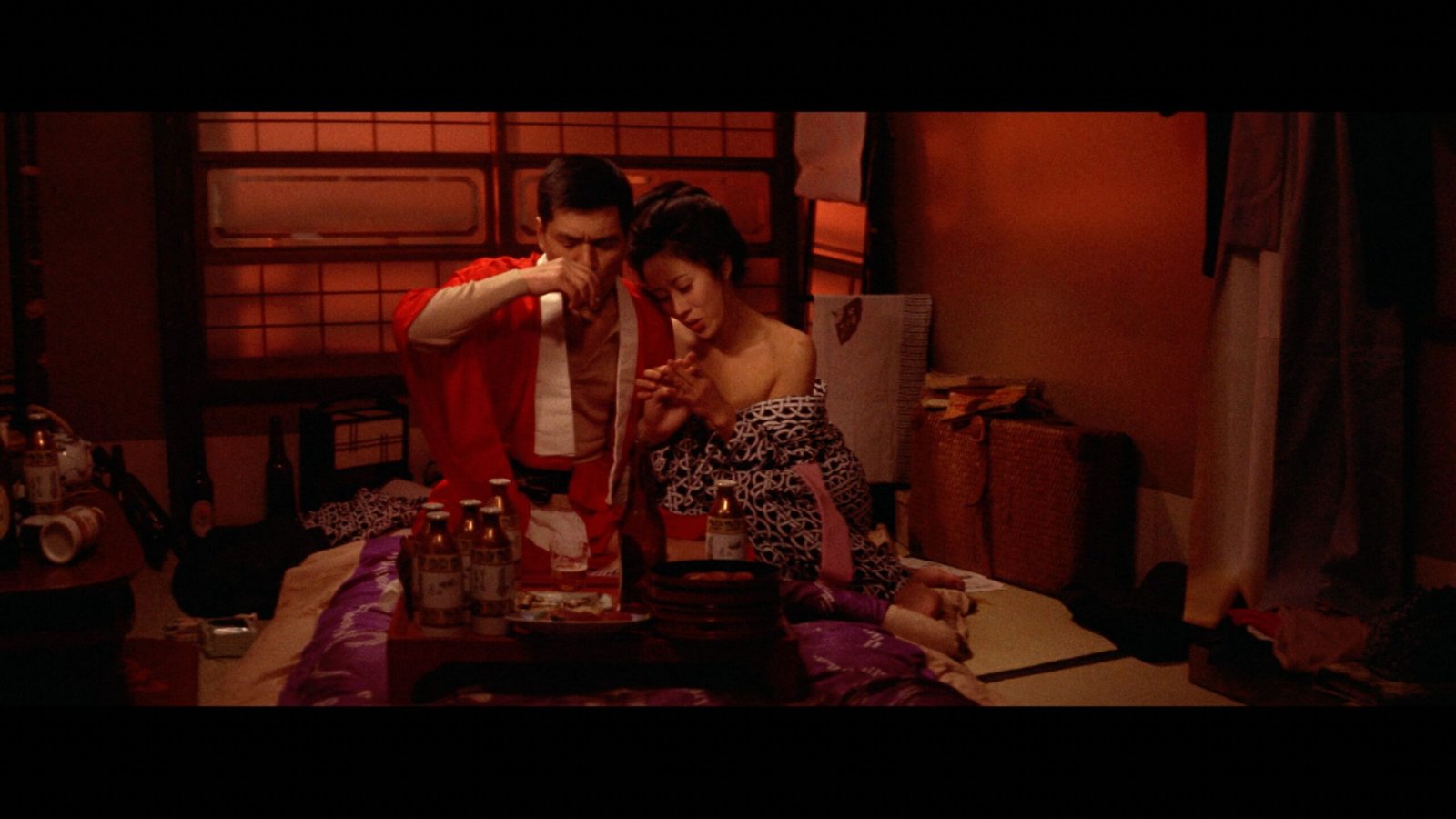
“A Woman Called Sada Abe” is a 1975 Japanese erotic drama directed by Noboru Tanaka and produced and distributed by Nikkatsu as part of its Roman Porno series. Shot in color and CinemaScope, the 76 minute production was released theatrically in Japan on February 8, 1975. The production dramatizes the notorious 1936 Sada Abe incident, in which Abe killed her lover Kichizo Ishida and mutilated his body.
The movie followed Tanaka’s “Secret Chronicle: She Beast Market” and continued his work within Nikkatsu’s Roman Porno cycle. Rather than approaching the case primarily through the sensational newspaper coverage that surrounded it at the time, the production focuses on Sada’s relationship with Ishida and the events that led to his death. “A Woman Called Sada Abe” was ranked tenth in Kinema Junpo’s 1975 Japanese Best Ten and was a major box office success in Japan. It has also been suggested that the success of Tanaka’s movie caused Nagisa Oshima to distribute his own version of the events, “In the Realm of the Senses”, internationally before releasing it in Japan. Along with the earlier Roman Porno production “Wife to Be Sacrificed” from 1974, “A Woman Called Sada Abe” was released to an enthusiastic reception in San Francisco in 1998
Premieres via VOD & Leading Digital Platforms on September 4, 2026
Sada Abe works as a maid at Yoshidaya, a restaurant in Arai, Nakano, where she meets the owner, Kichizo Ishida. The two quickly become lovers, and after their relationship is discovered by Ishida’s wife, they leave the restaurant together and begin moving between inns and waiting houses. Eventually, they settle at Mansaki in Ogu, Arakawa, where they spend days almost continuously together. Their relationship becomes increasingly intense, with Sada and Ishida engaging in dangerous sexual practices, including cutting and strangulation.
As their money begins to run out, Sada visits her former acquaintance, Professor Omiya, and receives money from him before returning to Ishida. Meanwhile, radio broadcasts report on the February 26 Incident unfolding in Japan. When Ishida suggests returning home, Sada becomes increasingly jealous at the thought of losing him.
The reds that dominate the movie, both in the clothes Sada wears and in the overall coloring of the room, are quite impressive to watch, with DP Masaru Mori using them to set a tone of perversity, promiscuity and, above all, eroticism from the beginning. The bottles of alcohol scattered around the room and the way the maids are embarrassed by what they mostly hear, but occasionally even see, as in the funny episode with the singing geisha, add even more to this sense. Furthermore, the gaze of the maids is implemented to enhance the voyeurism that permeates the movie, with the frequent, but never excessive, close ups moving in the same direction. In that fashion, it is easy to say that the visuals in general emerge as one of the best traits of the movie.
The psychology of the two is the main narrative focus here. Sada Abe is definitely seductive, with her being presented in the beginning as having utter control of the relationship, mostly through her sensuality and sex. The sex becomes more and more sadomasochistic as the story progresses, but the control remains with her. As time passes and the knife is introduced, the game becomes more dangerous, although eroticism always remains the main factor.
Essentially, the eroticism is constant, with the movie frequently unfolding like one prolonged erotic encounter interrupted only by brief pauses. As the relationship intensifies, jealousy also becomes increasingly important, first on his side and eventually on hers as well. Intriguingly, Sada begins teasing Ishida about what she might do to him, while the biting, strangulation and repeated references to killing him gradually turn their sexual games into something far more dangerous. This merging of eroticism and violence becomes the central element of the narrative, with Sada’s final actions bringing that progression to its most extreme conclusion.
Just before that point, Tanaka attempts to show the reasons behind her behavior through flashbacks to her past, suggesting that her dependence on men and compulsive sexual behavior derive partly from her relationship with her father. However, there is definitely no justification offered for her actions, beyond the presentation of a woman whose psychological state has become increasingly unstable.
Junko Miyashita gives a powerhouse performance, being rather convincing as a nymphomaniac, a depraved woman, a victim and a femme fatale, in a role that also required her to appear almost constantly nude and participate in sex scenes. Eimei Esumi as Ishida is also good in a similarly difficult part, with the moments when he becomes the victim being the highlights of his performance.
“A Woman Called Sada Abe” is an excellent movie, managing to be both titillating and appalling, occasionally even within the same scenes, while working particularly well as a deep psychological portrait of an extreme but definitely multilayered woman. The result is probably one of the top pinku productions of all time.



