
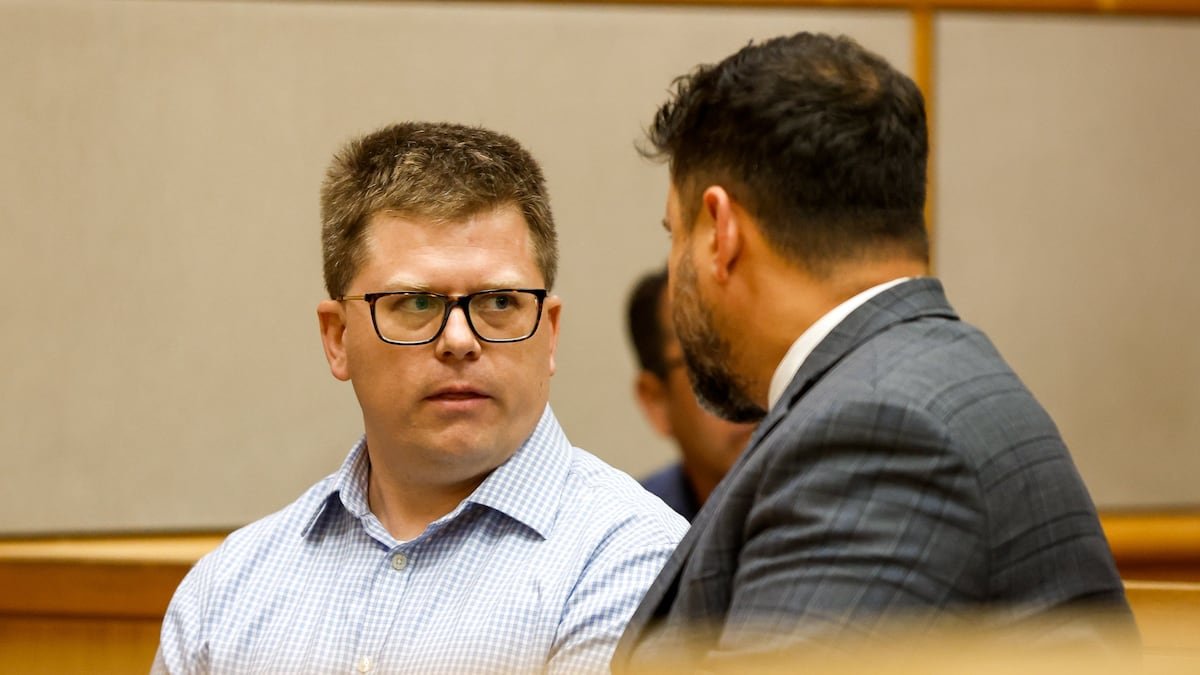
A former Tampa federal prosecutor on Monday apologized to the man he stabbed during a bizarre encounter on the Howard Frankland Bridge three years ago, pleaded guilty to felony charges and was led away to serve three months in the county jail.
Patrick Scruggs, 41, initially claimed self-defense after his arrest and tried unsuccessfully to have the case dismissed under Florida’s stand your ground law. On Monday, in a Pinellas County courtroom, Scruggs was contrite and apologized to Blake Sharp for what happened that day.
“It was a very chaotic and hectic situation, and I agree with you in retrospect, I should have just called 911,” Scruggs said. “I’m really sorry for the extent of your injuries and what you’ve had to go through.”
The former prosecutor for the U.S. attorney’s office in Tampa pleaded guilty to one count each of aggravated assault with a deadly weapon and aggravated battery. Prosecutors reduced the third and most serious charge, armed burglary, to burglary of a conveyance.
Judge Keith Meyer accepted the negotiated plea deal that he told Scruggs was a “golden opportunity.” Meyer sentenced Scruggs to 90 days in jail, followed by five years of probation, and ordered him to pay Sharp $100,000 in restitution.
The sentence was largely the result of Sharp’s decision not to push for harsher punishment. During Monday’s hearing, he took the stand and explained why.
He had his own criminal history, he told Scruggs, and was working to get his life back on track when he crossed paths with Scruggs that day.
“I’m really trying in my heart to be lenient to you because if you go to Florida (Department of Corrections), you probably won’t come out,” Sharp, dressed in a gray three-piece suit, told Scruggs from the witness stand. “Because of your job, because of how you look, you’re not built for it.”
The plea resolves a case that began with a crash on Sept. 26, 2023, during the morning rush hour in the southbound lanes of the bridge, which spans Old Tampa Bay.
Sharp, now 38, who was driving a Lexus, stopped in traffic and slumped over into the passenger seat, according to court records and testimony from a May 2025 hearing on Scruggs’ stand your ground motion. A fellow driver, Ahmed Gahaf, saw him and pulled over to try to help.
Sharp did not immediately respond. As Gahaf walked to get a tool to break the window, Sharp suddenly sped forward, crashing into the back of Gahaf’s car. He then backed up before veering into a left lane, where he collided with Scruggs’ Honda Civic.
Scruggs got out, carrying a small pocketknife, and broke Sharp’s car window. Sharp would not respond when Scruggs told him to get out. The car door was locked.
“I realized something was wrong, and my first thought was I just needed to figure out what’s going on,” Scruggs testified during the stand your ground hearing. “I need to stop this driver, whatever’s going on. And that’s when I grabbed the pocketknife, because it was the first thing I could think of in the panic of the moment.”
Scruggs used the back of the knife to shatter the window. As he reached to turn the car off, a struggle ensued.
Sharp then tried to accelerate, documents state. It was then that Scruggs stabbed him several times in his arm.

As Gahaf spoke with a 911 call-taker, a court paper states, Scruggs shouted into the phone, “He’s bleeding! I just stabbed him! He needs an ambulance!”
Scruggs was cooperative when police arrived. Florida Highway Patrol troopers arrested him at the scene, and he bailed out of the Pinellas County Jail that night.
Scruggs, of Tampa, spent about a decade of his career in the U.S. attorney’s office. Before joining an Atlanta-based private law firm in May 2023, he appeared on behalf of the federal government during hearings for Florida residents accused of taking part in the riots at the U.S. Capitol by supporters of President Donald Trump on Jan. 6, 2021.
His attorneys argued in a court paper that Scruggs feared not only for his own safety but for that of the general public. They alleged Sharp was trying to flee the crash scene because he had multiple arrest warrants.
Scruggs’ attorneys argued that their client found himself in a “highly dangerous situation,” was trying to protect himself and other drivers on the road, and should be immune from prosecution under Florida’s stand your ground law.
On the books since 2005, the stand your ground law extended self-defense in Florida by removing what’s known as the “duty to retreat” when a person is faced with the threat of a violent confrontation. It permits the use of deadly force in situations where a person reasonably believes it is necessary to prevent death or great bodily harm.
If a judge determines a case meets the criteria of the law, the defendant will be declared immune from prosecution. Meyer rejected the stand your ground motion, writing that testimony showed Scruggs was “acting out of anger and frustration, not in fear,” and that he “was not acting reasonably.”
Sharp, who was later sentenced to prison for a probation violation in a Hernando County case, denied that he was under the influence or that he was trying to flee when he collided with Scruggs’ car.
As he did at the stand your ground hearing, Sharp said Monday that he fainted while driving to work from his Seffner home.
Sharp said Scruggs severed all the tendons in his left arm and sliced an artery in his wrist, leaving him unable to use his arm for some 20 months. He said had there not been witnesses or video evidence, Scruggs would have been successful in concocting a story to “benefit him and squirm out of responsibility for what he did.”
“I really think that he should have just owned up to it from the beginning and taken responsibility,” Sharp said before turning his gaze toward Scruggs. “I’m the type of person that if you would have came, looked me in the eye and apologized for what you did, I would have forgiven you, but instead of doing that, what you did was try to spin everything around and pin it on me.”
He said the ordeal has been especially difficult for his wife and children from the moment he called her that day to say he wasn’t coming home because he was “bleeding out in my car.” Sharp said the ensuing media coverage further sullied his reputation and forced him to move his family to a new county.
“All of this because you couldn’t just pick up the phone and call 911,” Sharp said.
Assistant State Attorney Nathan Vonderheide asked Sharp why he was OK with a key facet of the deal: that the court would withhold adjudication, meaning Scruggs would not have a felony conviction.
“When this is all said and done, I’d like you to have the opportunity to rebuild yourself and still have your legal career,” Sharp told Scruggs.
Scruggs told Sharp he would never get involved in anything like this incident again and praised Sharp for turning his life around.
“I appreciate that for you, and I wish you success, and I thank you for your leniency and your generosity in this,” Scruggs said.
Vonderheide told Meyer that under state guidelines, Scruggs scored 62 months in state prison. But Vonderheide said there were legal reasons for departing from that sentence, including the unsophisticated nature of a crime that was an isolated incident, Scruggs’ show of remorse and Sharp’s approval.
Lee Pearlman, one of Scruggs’ lawyers, told Meyer he had a $50,000 check ready for Sharp and that Scruggs would pay off the remaining $50,000 in monthly installments. As part of the deal, Scruggs must undergo a psychiatric evaluation and take an anger management course.
Meyer reminded Scruggs that had the original charges been proven at trial, he could have faced life in prison. And if he violates probation, he still could face a couple of decades behind bars. He told Scruggs that he was a lawyer, not a police officer or other first responder, and that he’d “seemed to have forgotten your role in this world that day.”
“Hopefully you’re able to maintain your livelihood and practice law, and I hope you do some good with it because you’ve been given a golden opportunity,” Meyer said.



