
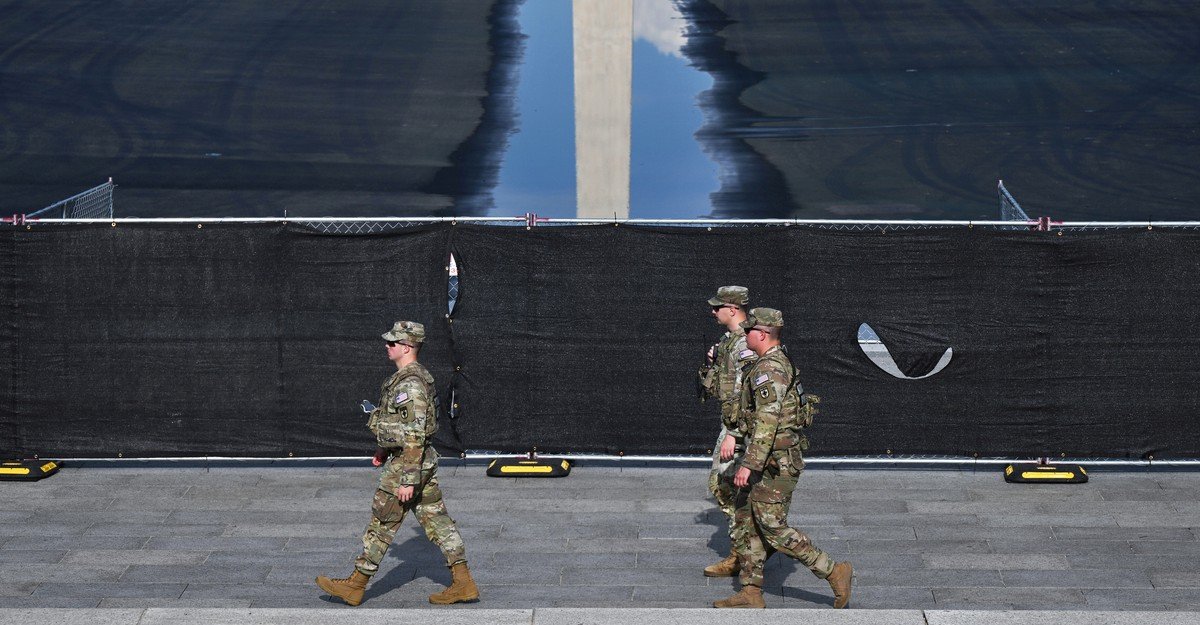
The sight of military troops patrolling in a peaceful American city would once have been strange, if not outright alarming. But since last August, when Donald Trump first deployed the National Guard to Washington, D.C., residents have become accustomed to seeing men and women in camouflage military fatigues on duty throughout the city and its public-transit system. Sometimes, they trail federal officers from agencies such as the FBI and U.S. Marshals Service, dispatched by Trump to patrol the district in bulletproof vests. More often, the troops wander around unaccompanied, in small groups.
D.C. has now entered its second year with federal troops on its streets. President Trump initially ordered the Guard into the capital city, sent federal agents to work as beat cops, and briefly seized control of D.C.’s local police department following the attempted carjacking of a former member of Elon Musk’s DOGE team. The early days of the D.C. Safe and Beautiful Task Force produced dramatic headlines. As the year dragged on, though, its activities faded from national news coverage, even as armed troops and federal agents continued to patrol. The Pentagon says it plans to keep the Guard in D.C. through January 2029—which will cost taxpayers more than $1 billion.
For all that money, the Guard’s purpose here is largely inscrutable. “They don’t bother nobody; they just go back and forth, and back and forth,” Aundrea’ Pulliam, a Washington Metropolitan Area Transit Authority employee at the Dupont Circle Metro stop, told us. (As we spoke, a few Guard members walked by, heading toward the escalators.) Occasionally, Pulliam said, she has seen Guards help a rider who’s “super drunk,” or check out an abandoned backpack. But most of the time, a station manager, Deidra Foster, told us, it seems like “they’re really bored.”
Whereas other American cities targeted by Trump with National Guard deployments found success in court, D.C.’s lack of statehood limits its ability to fight back. The presence of the task force represents a particularly Trump-era indignity for the city: both comic and menacing; abusive and ineffective; appalling to some and, as time goes on, exhaustingly commonplace. Antidemocratic though the federal takeover may be, D.C. residents have been forced to live with it.
Matt McClain for The Atlantic
A National Guard member yawns as he and others stand near the Korean War Veterans Memorial on Monday, August 03, 2026, in Washington, D.C.
At first, the 800 or so troops called up were locals: members of the D.C. National Guard, which, unlike other state and territorial Guard units, is under the president’s direct control. Then, governors from around the country, mostly Republicans, began volunteering their own troops. The total head count was about 2,000 before ballooning to 5,000 before the America 250 celebrations—enough that, in some neighborhoods, walking to the Metro or picking up groceries without encountering Guardsmen became nearly impossible.
The Trump administration has promoted the Guard’s presence as an overwhelming success. “Washington D.C. went from High Crime to NO CRIME — Thank you President Trump!” the president posted on Truth Social in early July. (This month, Trump claimed that crime in the city had dropped by 92 percent, citing a favorite number of his.) True, crime has largely fallen in the capital over the past year—but it was on the decline before Trump’s surge, and cities across the country without any comparable federal presence have seen similar positive trends. (Numbers reported by D.C.’s Metropolitan Police Department suggest that violent crime in the district may, in fact, be slightly up.) A recent report by the moderate Niskanen Center found that deployment of the National Guard led to a roughly 25 percent decrease in petty property crime over the first six months, but had “no measurable effect on violent crime.” Another analysis, published by the left-leaning Center for American Progress, reported “strong evidence that the deployment of the National Guard did not result in a measurable decrease in violent crime rates.” In response, Trump threatened to sue the organization.
The National Guard may not have done much in part because there isn’t much for them to do. Troops have been sworn in as deputy U.S. marshals, which gives them some powers of law enforcement, but the terms of their appointment state that they cannot independently conduct searches or make arrests. (They can, however, detain suspected lawbreakers until either local or federal law enforcement arrives.) According to a recent analysis of court records by Reuters, troops have been mentioned in only 1.3 percent of criminal cases prosecuted in D.C. Superior Court over the past year—and in some of those cases, they were the victims. The media-relations page for the Guard’s D.C. presence includes stories about picking up trash and reuniting a lost boy with his parents on the National Mall.
Perhaps most notable, the Guard has begun carrying the overdose-prevention drug naloxone, commonly known by its brand name, Narcan. Early this month, the D.C. National Guard’s interim commanding general told reporters that Guardsmen had administered the drug 325 times. Sergeant Hare, a Guardsman outside the Woodley Park Metro station, who declined to give his first name, citing National Guard policies, told us that he had lost track of how many drug-related emergencies he’d helped with, but said it was “the main thing” he’d done during his deployment.

Andrew Leyden / Getty
Air National Guard airmen work clearing leaves and debris from McPherson Square Park on August 28, 2025, in Washington, D.C.
“Could this be handled without having the National Guard in D.C.? Probably,” Regina LaBelle, an addiction-policy professor at Georgetown University, told us. But “since they are here,” she said, “it’s really good that they are using naloxone where it’s needed.”
Whatever the troops are or aren’t doing, their presence is a reminder of Trump’s power to shape the world as he alone pleases. America’s Founders understood domestic deployment of the military as the tool of a tyrant, and put in place legal protections against it—protections that Trump has now set about eroding. The president treats America’s cities as though they’re populated by scofflaws to be subjugated rather than by citizens with a say in their own future, and deploying the Guard to D.C. is a way to make that vision into a reality.
“They’re an armed occupying force in our city,” Merawi Gerima, an organizer with the D.C. Alliance Against Racist and Political Repression, told us. Gerima and other activists we spoke with emphasized that they understood the Guard’s deployment as only one aspect of the larger federal presence in D.C. As part of the D.C. Safe and Beautiful Task Force, federal agents have been reassigned from their normal responsibilities to act as beat cops, dispatched from agencies such as the FBI; the Drug Enforcement Administration; the Bureau of Alcohol, Tobacco, Firearms and Explosives; Customs and Border Protection; the Secret Service; the Park Police; the U.S. Marshals Service; the Diplomatic Security Service; and, oddly, the IRS.
Although Guard troops are the visual signature of Trump’s seizure of control over the city, they comprise the least energetic component of the task force. The federal-law-enforcement officers deployed across D.C. at Trump’s directive have been far busier, and more aggressive. Twice this past fall, agents with ICE’s Homeland Security Investigations division fired their weapons during traffic stops. Months later, a deputy U.S. marshal shot and killed a robbery suspect. After the administration lifted restrictions on car chases by Park Police, the agency launched a flurry of high-speed chases; multiple crashes and at least two deaths—of a bystander and a fleeing driver—soon followed. During the first six months of the surge, immigration enforcement and other federal agents roamed the city, detaining residents off the street.

Andrew Leyden / Getty
A National Guard unit patrols the National Mall on August 30, 2025, in Washington, D.C.
ICE has been less prominent since December, when a D.C. federal court enjoined the government from carrying out mass immigration arrests without a warrant. But Sandra Benavente, the advocacy manager at the immigrant-aid nonprofit Ayuda, told us that immigrant communities still feel the aftershocks of those arrests. “We’ve seen since last summer this climate of fear around all uniformed law enforcement,” she said—including the National Guard. Some of the group’s clients, including those relying on Ayuda for food or assistance with seeking legal status, have missed appointments because they are afraid of being stopped on their way downtown.
Although ICE activity remains limited in D.C., other federal agencies continue to police the city in unprecedented numbers, sometimes alongside officers with D.C.’s local Metropolitan Police Department. The “lockup list” in D.C. Superior Court, which records people detained overnight by law enforcement for arraignment the next business day, routinely hovers near 100—far greater than the pre-surge norm of 60 or so. “There’s a difference in the intensity of the policing,” Gerima said, particularly “in Black and brown neighborhoods.” (All three of the men shot at by task-force members, including the person who died, were Black.) The additional federal presence provides law enforcement with more resources, he said, “and what they’re using that to do is to grab anybody for anything, any semblance of a crime.” Minor violations of local laws that might previously have brought about nothing more than a ticket—such as drinking from an open container—are now resulting in arrests by federal agents.
Early in the National Guard’s D.C. deployment, especially after Defense Secretary Pete Hegseth ordered that troops begin carrying firearms, some residents worried about potential violence. So far, the troops deployed to the capital have not been responsible for any civilian deaths—the bare minimum of what one might hope for from a military deployment on U.S. soil. In fact, the only bloodshed related to the Guard involved troops as victims, when an Afghan man who had served with U.S. Special Forces in Afghanistan shot two members of the West Virginia Guard near the White House, one of whom later died.
Apart from this burst of violence, the troops’ stay in the capital has thus far been largely peaceful, albeit the ominous sort of peace that results from uniformed men and women strolling around with guns. In one notable exception partially caught on video, three troops were physically aggressive in detaining a woman outside her home—pushing her to the ground and zip-tying her hands so tightly that, she later wrote in a claim against the Guard, the plastic cuffs “ruptured one or more ligaments in her wrist,” requiring surgery. The National Guard says that the woman, Anna King, had thrown “unknown liquid” at other Guard members. Prosecutors brought assault charges against King for the liquid incident and for allegedly harming a member of the Guard while being detained; she has pleaded not guilty.
Trump’s America is a land of perpetual indignation, where scandals that might once have ended a presidency have become commonplace. After a year of federal presence, D.C. is suspended somewhere between the routine and the outrageous. Still, activists we spoke with described continued energy to fight Trump’s overreach. Some organize protests; others quietly keep tabs on federal agents in their neighborhoods. The protest group Free D.C., which has grown prominent over the past year, encourages residents to voice their complaints by writing to governors who have sent their National Guard troops to the city.
“I feel like it’s just better for me to ignore them,” Jill Robinson, a health educator who has lived in the area for four decades, told us. Yet “I feel angry and annoyed.” Robinson was attending a Free D.C. event, one of nearly a dozen planned by the group in the days leading up to August 11, the first anniversary of the National Guard deployment. She had attended previous Free D.C. training sessions, including on how to stay safe if law enforcement becomes aggressive at a protest.
This event was meant to honor Nolberto Meza, the bystander who was struck and killed in Northwest D.C. during a Park Police chase of a suspected stolen car. (Meza had arrived in the U.S. from Venezuela, seeking asylum.) Amid torrents of summer rain, several dozen people had gathered on the bridge where Meza was hit, wearing ponchos, clutching umbrellas, and carrying signs with slogans such as END THE OCCUPATION. The attendees included more seasoned protesters like Robinson, but also newcomers such as Ella and Ant Peels, who’d moved to Washington in May from Annapolis, Maryland. They’d read about the deployment before their move, but seeing the Guardsmen out and about—“maybe three times every time we take a walk”—had made them uncomfortable. “It definitely gives an eerie feeling to living here,” Ella said. “It doesn’t make me feel safe.”

Matt McClain for The Atlantic
A demonstrator holds a sign referring to the National Guard deployment in Washington, D.C., as people gather for a FREE DC event entitled, “One Year of Occupation: 13,000 Arrests and Pirro’s Lies” outside the H. Carl Moultrie Courthouse on Monday, August 03, 2026 in Washington, D.C.
Those opposed to the increased federal presence have notched some wins. U.S. Attorney Jeanine Pirro’s office has been continually stymied in federal court by opposition from D.C. residents sitting on grand and petit juries. This spring, during D.C.’s Democratic primary, the mayoral candidate Janeese Lewis George won a decisive victory after advocating for a more adversarial approach to the president than that of the current mayor, Muriel Bowser. The D.C. city council passed emergency measures requiring the MPD to keep records of federal officers’ role in arrests and incidents involving the use of force.
But the city’s status as a federal enclave starkly restricts its ability to respond to Trump. Last month, all 13 members of the council signed letters calling on governors to withdraw troops from the city. A top Justice Department official dismissed the letters as “impotent theatrics.” (In response to a legal challenge filed by D.C. Attorney General Brian Schwalb, a federal judge ruled that both the D.C. and out-of-state Guard deployments were illegal, but that ruling has been paused while an appeals court considers the question.) The council can push MPD for transparency, but it has little power to constrain federal law enforcement, especially if those agents are patrolling separately from local police. These limitations underline the authoritarian tilt of the federal presence in D.C. The troops and federal agents are here without the city’s say, at the pleasure of one man only, and there is little the city can do about it.
The legal restraints on D.C. are unique, but the city is not going through this experience entirely alone. To the southwest, Memphis has a similar federal presence, alongside a deployment of hundreds of Tennessee National Guard troops sent by the state’s Republican governor. Trump announced the Memphis Safe Task Force a month after the D.C. task force began its surge, touting Memphis as a “replica of our extraordinarily successful efforts” in D.C. Now both the Guard and a contingent of federal agents have patrolled Memphis for almost a year. In four separate incidents, city residents died after being shot by members of the task force: Two National Guard troops were responsible for one shooting; the agents in the other three incidents were with the DEA and ICE’s Homeland Security Investigations division. (In one incident, it remains unclear whether the person died of the gunshot wound or a self-inflicted stabbing.) Memphis, a red-state “blue dot” whose autonomy has been continually rolled back by Republican state legislators, mirrors D.C.’s vulnerability.
In both Memphis and D.C., people harmed by the task force have limited options for legal redress. Although federal civil-rights law allows lawsuits against state and local officials for violations of constitutional rights, options for suing federal officers are far more limited. In one case, the ACLU is pushing for accountability after MPD, called in by an Ohio National Guard sergeant, handcuffed and detained a D.C. resident who had been protesting the Guard by trailing troops while blasting “The Imperial March,” from Star Wars, on his phone. D.C. settled, but litigation continues against the sergeant, who argues that he was acting in a federal role.
The activists we spoke with said they see their push to rid D.C. of this military presence as part of a larger effort to oppose authoritarian overreach. The “Imperial March” case makes the metaphor for them. It is absurd—a Star Wars joke that ended with someone in handcuffs—but also unnerving. In a city, or country, with fewer and fewer checks on presidential authority, a small act of dissent can provoke a big abuse of power.



