
As various protagonists in the sandpaper saga passed through Hobart airport on Thursday – Cricket Australia’s besuited Todd Greenberg with phone in hand pulling a trolley suitcase, a dressed-down Darren Lehmann with a backpack, a Coke, and a thousand-yard stare – there was activity up in Sydney too.
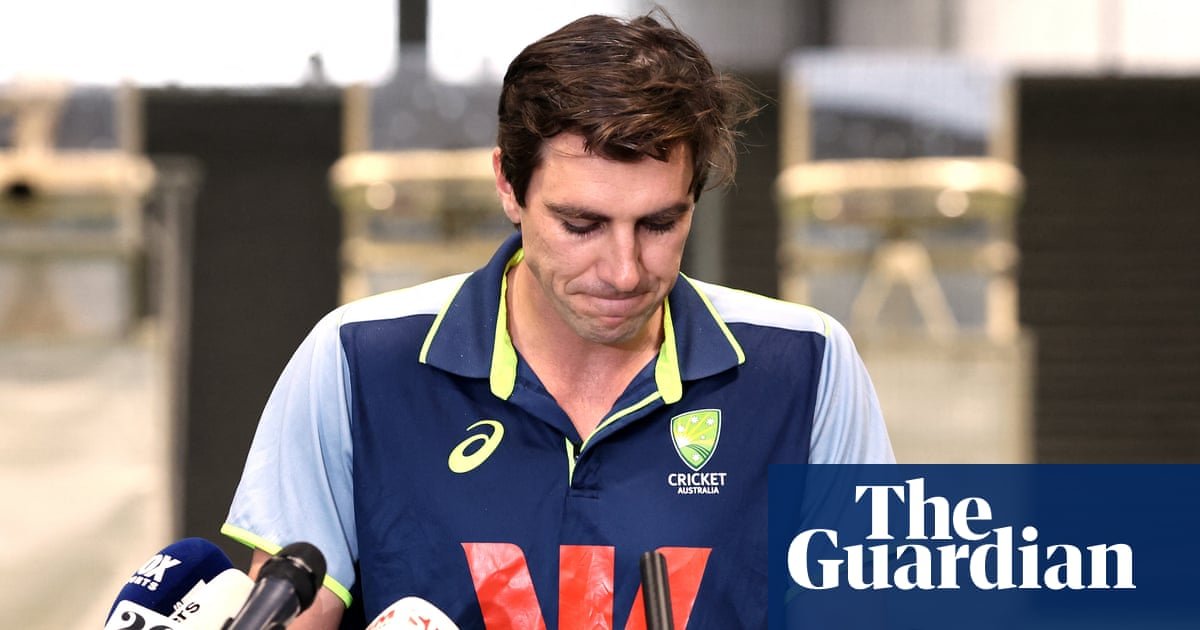
Emerging from the front door of his house and heading off to train with his New South Wales teammates, Pat Cummins was met by a gaggle of local television news reporters who were shouting various things in the hope that Australia’s Test captain might throw some fresh material back.
After an initial apology for the doorstep – “You’re probably not that sorry though, are you?” replied Cummins – came requests for a response to Cameron Bancroft’s 4,000-word statement overnight; whether he was concerned about his job; the latest outing for the “bus” that everyone seems to be “thrown under” in this whole thing; and a straight: “The English media is calling for you to be sacked.”
Last, as Cummins kissed his wife goodbye and climbed into his car, came: “Do you think it’s gotten out of hand?”
And they say irony is dead.
Another well-worn expression is that the captaincy of the Australia men’s cricket team is the second most important office in the country after the prime ministership and last week, after that 68-minute press conference in response to Usman Khawaja’s book revelations, Cummins was described as statesmanlike. After some early adrenaline it was a confident, charismatic performance, no question. But the tone was still unusual and the content has since aged like milk.
Looking on from the outside – here to cover an England cricket tour, only to land in the middle of a civil war that shows no sign of abating – it is hard to understand exactly what the thinking was here. Not least since Cummins and his management team had given themselves a few days to wargame things.
Without wishing to pull back the curtain too much, there is a reason why journalists sometimes qualify a news story with phrases such as “set to” or “expected to” and it is not a lack of confidence in the information they are about to relay. Call it wriggle room or simply good old arse-covering, but the fact is, things can change after publication. New information may come to light, or a decision that was said to have been made can suddenly be subject to a last-minute U-turn.
But rather than leave any wriggle room by meeting Khawaja somewhere in the middle – sticking to the carefully worded bowlers’ statement back in 2021 but ceding some ground more broadly – Cummins went definitive. With a single flat “no” he denied having any knowledge of ball-tampering at any point during that South Africa tour, and no recollection of a meeting where collective responsibility was discussed.
Recently nicknamed “7-Eleven” by his teammates because he increasingly bats like one or the other, Cummins also broke one of the golden rules in cricket: he chose to play the man and not the ball by openly casting doubt on Khawaja’s character, painting him as “casual” with the truth and friendships; a sneaky so-and-so who jotted down notes at the time “to release a book one day”.
That presser was the final straw for Bancroft and for those still to read Wednesday’s incendiary statement, now published by the Guardian, he has not simply repeated Khawaja’s account but gone way beyond. Chadd Sayers lending his support could be brushed aside as the grumblings of a one-cap wonder. It had a few inconsistencies, too. But Bancroft’s account is so detailed – names, quotes, and knowledge of sandpaper that even extended to the media officer on tour – it sounds far, far closer to the truth.
Yet the Cummins camp still maintains that none of what he said last week has been undermined. Looking on, no skin in the game, this is an utterly bizarre stance given some of the contradictions; as bizarre as Greenberg’s assertion on Wednesday that conflicting “truths” can coexist. Imagine if that logic were extended to the courts.
The only court in play here is one of public opinion, however. And while CA appears desperate to back Cummins, a poll on the Code Sports website – subscription-based, so one assumes a sport-enthusiast audience based mainly in Australia – shows 72% of 10,000-plus readers voted “no” to the question of whether he should remain as captain.
Though he is not universally popular in Australia due to his progressive views on things such as climate change, this poll suggests it is not just commentators in England, supposedly driven by schadenfreude or the Ashes rivalry, who believe his position has in all likelihood become untenable.
There is an irony here. Beyond the fact that Cummins is barely name-checked in Bancroft’s account of that tour – nor was he called an “architect of a masterplan to ball-tamper” by Khawaja, a straw man in that weirdly assertive presser – he has played a key role in recasting Australia’s image post-sandpaper, winning but with a smile rather than a snarl on the field.
It was the belated realisation of that previous image – a bullying, win-at-all-costs side – that contributed to the prime minister wading in, leading to those ludicrously harsh sanctions handed down to Bancroft, David Warner and Steve Smith by CA – a governing body that, by all accounts, had set the culture.
When James Sutherland, chief executive at the time, announced the punishments after that rapid-fire investigation in South Africa, he similarly left no wriggle room, stating he was “absolutely satisfied” that sandpaper was a one-off and only three players knew. Somehow, despite the odd wobble, that version held until a fortnight ago.
Cummins has chosen his path since this all blew up and, while everyone is trying their best to hold firm, the ripple effect from that rushed attempt at containment in 2018 may well cost Australia another captain.
Source: www.theguardian.com



