
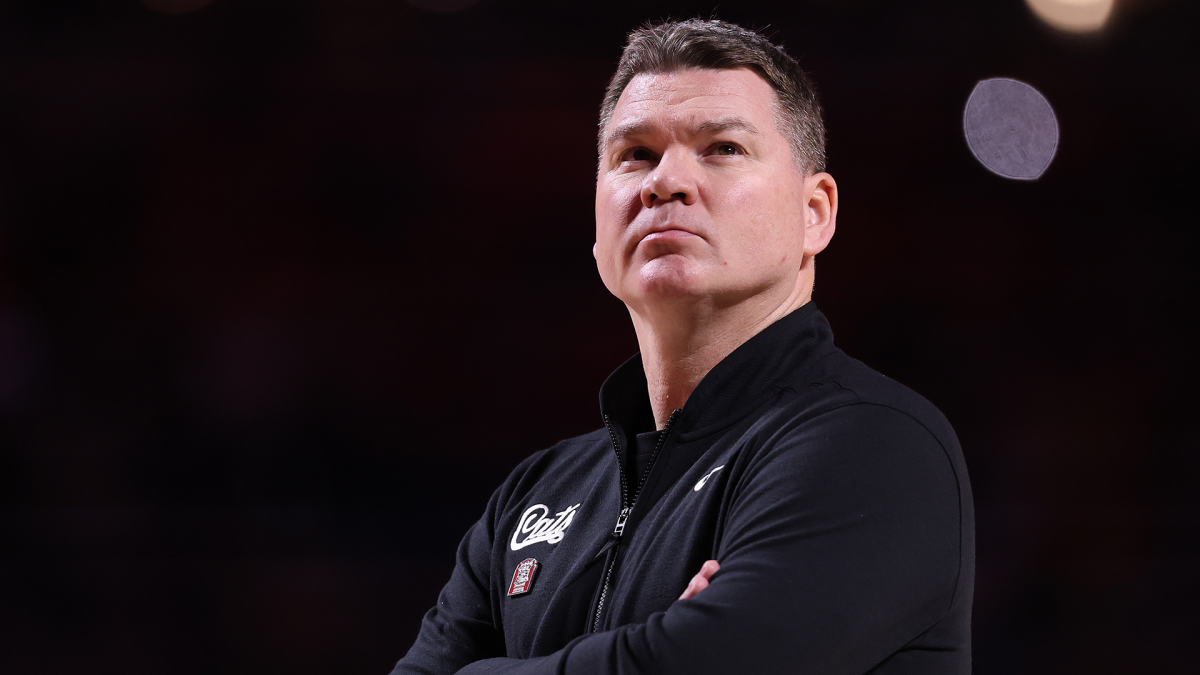
KANSAS CITY, Mo. — When I sat down with Tommy Lloyd this week here inside the T-Mobile Center during what amounted to the second half of Big 12 Media Days, I expected to talk to the Arizona coach about everything from his rejection of North Carolina to the additions of Caleb Holt and Cameron Holmes.
I figured Ivan Kharchenkov might come up. Perhaps even Bryce James.
But Diego Pavia?
The former Vanderbilt quarterback/future UFL player was nowhere in my notes. But Lloyd is coming off of a Final Four, in charge of one of college basketball’s biggest brands, and an obviously smart guy. So before I was done with our conversation about his program and team, I wanted to get his thoughts about A) Kansas recently, and controversially, enrolling a 24-year-old who was the 59th pick in June’s NBA Draft (Trey Kaufman-Renn), B) the NCAA relentlessly challenging five-year-eligibility-period cases connected to 2022 high school graduates, and C) everything else taking up so much oxygen in the sport of college basketball these days.
So I did.
Then the conversation got really good.
“My stance on the 5-for-5 is very clear,” Lloyd began. “If you’re a true 5-for-5 [case], and if the same situation were next year, and you could be eligible without a waiver, you shouldn’t be ineligible now. [But] if you’re in your sixth or seventh year [of college], and if you’ve got a story and a bunch of extenuating circumstances, yeah, I’m not too sympathetic to that. So I think what’s frustrating for me is [that] when you kind of take a step back and you think about all of the conversations that go on behind the scenes, and, you know, we could go through a few of them here …”
Lloyd trailed off there for a moment.
“The Pavia Case” is where he picked up before explaining the different ways in which the NCAA is handling things now compared to how it handled them just two years ago when Pavia sued the governing body while arguing that its rules counting his junior college seasons against his Division I eligibility violated the Sherman Antitrust Act by improperly limiting his career and ability to earn name, image, and likeness income potentially worth millions of dollars.
Pavia won his case.
His college football career continued thanks to an injunction. Not long after it was granted, the NCAA Division I Board of Directors approved a blanket waiver granting an extra year of eligibility for the 2025-26 academic year to former JUCO and non-NCAA school transfers who were in a position similar to Pavia’s.
“[After the Pavia case], the NCAA … released a memo to the schools that [more or less said], ‘based on this single ruling, we see it can create an uneven playing field among our competitive schools, so we are going to issue a blanket waiver for any kid that’s basically in the same circumstances that Pavia was in.’ And they did a blanket waiver.”
Lloyd’s point?
Why isn’t the NCAA issuing a blanket waiver now, considering there are men set to play college basketball in less than two weeks only because they received injunctions from local judges just like Pavia once did? Why isn’t the NCAA issuing a blanket waiver now while acknowledging that not doing so would create an unequal playing field based on which players get injunctions and which don’t, given that the NCAA did exactly that two years ago after acknowledging that not doing so would, yes, create an unequal playing field based on which players get injunctions and which don’t?
Those seem like totally reasonable questions. I asked Lloyd if he had an answer to them/theory about them.
Lloyd’s theory: Chaos may be the point
“I think I do,” he answered. “I think my theory is this thing has gotten so political — and, obviously, there are a lot of things that need to be fixed in college sports,” Lloyd said. “So [in my opinion,] the NCAA doesn’t mind the ‘chaos’ right now because it can help drive the case for them to promote the [Protect] College Sports Act, which I’m sure we need.”
(Translation: The NCAA desperately wants the PCSA to pass ASAP, and it’s easier to make the case to the public that college sports needs saving when there are stories weekly about players being ruled eligible and ineligible by local judges for reasons that are inconsistent, confusing and often biased. More specifically, the NCAA’s constant legal battles enhance the perception of “chaos” in college sports, which in turn makes it easier for senators like Ted Cruz to insist college sports needs “saving” via a federal law that, as currently constructed, would limit what athletes can make in a way that would otherwise likely be deemed illegal.)
Lloyd’s explanation makes as much sense as, if not more sense than, anything anybody else has floated because, he’s absolutely right, the NCAA is “digging its heels” in now in one case after another in ways that run completely counter to how it handled similar situations after Pavia’s case two years ago.
Why?
Lloyd thinks the answer is italicized above. If you care, I agree.
Either way, Lloyd’s larger point, and one I also co-sign, is that just because something might be a smart legal strategy, or a brilliant long-term play, that doesn’t make it good or right. As the sixth-year Arizona coach noted, there are lots of men — exactly 22 just in the Big 12 alone, by his count — who would be eligible for a fifth year of eligibility if the NCAA’s new five-year-eligibility-period rule would’ve been adopted earlier or if they’d just been born a little later. There’s no real difference between them and many of the people we’ll all watch play five years of college basketball moving forward or even this season. They were just born roughly a year earlier and enrolled in college when they did.
“Why should these individual kids [be punished and suffer] real damages?” Lloyd asked. “I mean, there have been guys that have come back for their fifth year and gotten drafted the next year because of that extra year of experience. And there [are players who are] going to make a lot of money [if they are eligible for a fifth year this season]. I mean, there’s real damage [being suffered if they can’t play this fifth year this season]. So, for me, somebody has to sit down and tell me why this makes sense and how it’s good for the sport.”
Players caught in the middle
Lloyd does have a so-called dog in this fight — namely RJ Godfrey, who graduated high school in 2022, played three years at Clemson, one year at Georgia, graduated, and would now like to play a fifth year at Arizona. A judge in his home state of Georgia initially granted an injunction clearing Godfrey to play. But, more recently, the Georgia Court of Appeals granted the NCAA a stay, leaving Godfrey’s future very much up in the air even though older players with less compelling eligibility cases are seemingly good to go thanks to how their legal cases have unfolded in different states with different judges.
“I get it’s complicated — but you can’t tell me it’s right that a true 5-for-5 [candidate] that’s younger than some of these European players [is ineligible],” Lloyd continued. “[The only difference is] these European players, you know what they didn’t do? They didn’t redshirt. They [instead] played four years of high-level basketball [professionally] — and just because they didn’t enroll in a school, now they’re getting [what amounts to] a [fifth] year of eligibility when our guy, or someone else’s guy, enrolled, graduated in four years, and now they’re getting penalized for a fifth year because they enrolled right when they graduated out of high school?
“It’s just tough.”
I’ll take it a step further.
Not only would it obviously be unfair and inconsistent if, just to name one case, Trey Kaufman-Renn is allowed to spend a sixth year in a college basketball program and play a fifth this season while Godfrey and other younger players like him aren’t allowed to spend a fifth literally in the same conference, all because of rulings by different judges in different places, I’d argue it’s also counter-productive to what so many like to call the good of the game.
As I’ve noted many times on the Eye On College Basketball Podcast, do you realize the number of minutes Matt Norlander and I have spent talking about judges and injunctions this offseason instead of Florida attempting to win a second national title in three years or Jon Scheyer trying to get his first at Duke? Every second spent discussing court rulings is a second not spent on Vanderbilt’s Tyler Tanner.
It’s damaging to the sport.
I should’ve been talking to Tommy Lloyd about Motiejus Krivas. Instead, I talked to him about Diego Pavia.
Why?
Because the very sensible position the NCAA took two years ago after Pavia’s ruling has been abandoned in a way that Lloyd and other coaches find inconsistent and frustrating — and tied to ulterior motives. While the NCAA is spending millions of dollars fighting against players like Godfrey, most coaches would’ve preferred it grant a blanket waiver to every 2022 high school graduate, allow them to play a fifth year this season if they wanted to, and if anybody wanted them to, and just be done with it. Doing so would’ve saved a lot of legal fees and decreased the amount of so-called “chaos” dramatically. It’s what coaches wanted — evidence being Norlander and I asked roughly 100 of them earlier this year, and most of them told us, yes, they would’ve preferred the 2022 high school graduates be grandfathered in, if only to cut down on the confusion and level the playing field.
But rather than listen to the coaches, or even to the arguments the NCAA itself made just two years earlier about an uneven playing field after Pavia’s ruling, the NCAA is out there fighting one legal battle after another, literally from coast to coast, at a cost that can’t possibly be sensibly rationalized, all while creating the chaos it swears it wants to end.
It makes no sense — unless the NCAA actually wants the chaos.
That’s Lloyd’s best explanation for what’s going on — going on still, with the season now just 10 days away — that the NCAA has dug its heels in to fight, fight, fight this time around, in ways that are almost certainly going to create an uneven playing field this college basketball season, and in ways that totally contradict what the same governing body priortized just two years ago, not because its leaders or lawyers believe it’s the right or logically consistent thing to do, but rather because it enhances the perception of “chaos” at a time when that perception, real or otherwise, might really be the thing that pushes a controversial bill through the senate and house and turns it into federal law.
“There’s literally going to be an uneven playing field created [this season]” Lloyd said. “And the NCAA is letting it happen.”



