
 WASHINGTON — Work could begin in the fall on a pair of dredging and construction projects in the waters between New York City and New Jersey, in particular to deepen shipping channels, the U.S. Army Corps of Engineers said in federal contracting documents.
The Corps is separately advancing a series of beach erosion projects planned for Cape May County.
One dredging project, estimated to cost $25 million-$100 million and run from September until February 2027, would remove as much as 400,000 cubic yards of largely silt and clay from Newark Bay, according to Corps documents.
Dredging would have to reach as deep as 50 feet in certain portions, the Corps said in a solicitation posted in March. “Additionally, multiple barges and tugboats will be needed to perform the work during the dredging, dewatering, and unloading operations.”
A second Corps project would remove material from waters south of the Verrazzano-Narrows Bridge and in the Arthur Kill Channel, the water between New Jersey and Staten Island.
Following the expansion of the Panama Canal in 2016, Eastern seaboard ports have sought to deepen their harbors for larger vessels that carry heavier loads and sit lower in the water.
The Corps recommended in April 2020 that the Port of New York and New Jersey be deepened, in part to accommodate U.S. Coast Guard inspections, security and refueling.

Funding bills Congress passed into law this year allocated more than a quarter of a billion dollars for local work in New Jersey, spread across at least 270 projects.
One of those bills included $53 million for beach replenishment within Rep. Jeff Van Drew’s home turf: New Jersey’s Second Congressional District.
Van Drew, a Republican with close ties to President Donald Trump, said last week his district would receive funding in the coming months. “This announcement delivers $99 million for beach replenishment across Ocean City, Strathmere, Sea Isle City, Avalon, and Stone Harbor,” Van Drew said in a statement.
Van Drew said he requested $70 million for beach projects in the federal budget cycle that started this month when the White House issued its proposal to Congress. That money would go to Long Beach Island and Absecon Island, which includes Atlantic City, he said.
“I have also requested funding to begin the process of extending the seawall in North Brigantine as part of our ongoing work to protect that area,” Van Drew said.
Tourism is a key New Jersey industry that in 2024 drove $50.6 billion in spending and $5.4 billion in state and local tax revenue, according to a report for the state Division of Travel and Tourism. About $9 billion of tourism spending was in the beach communities of Ocean and Monmouth counties alone.
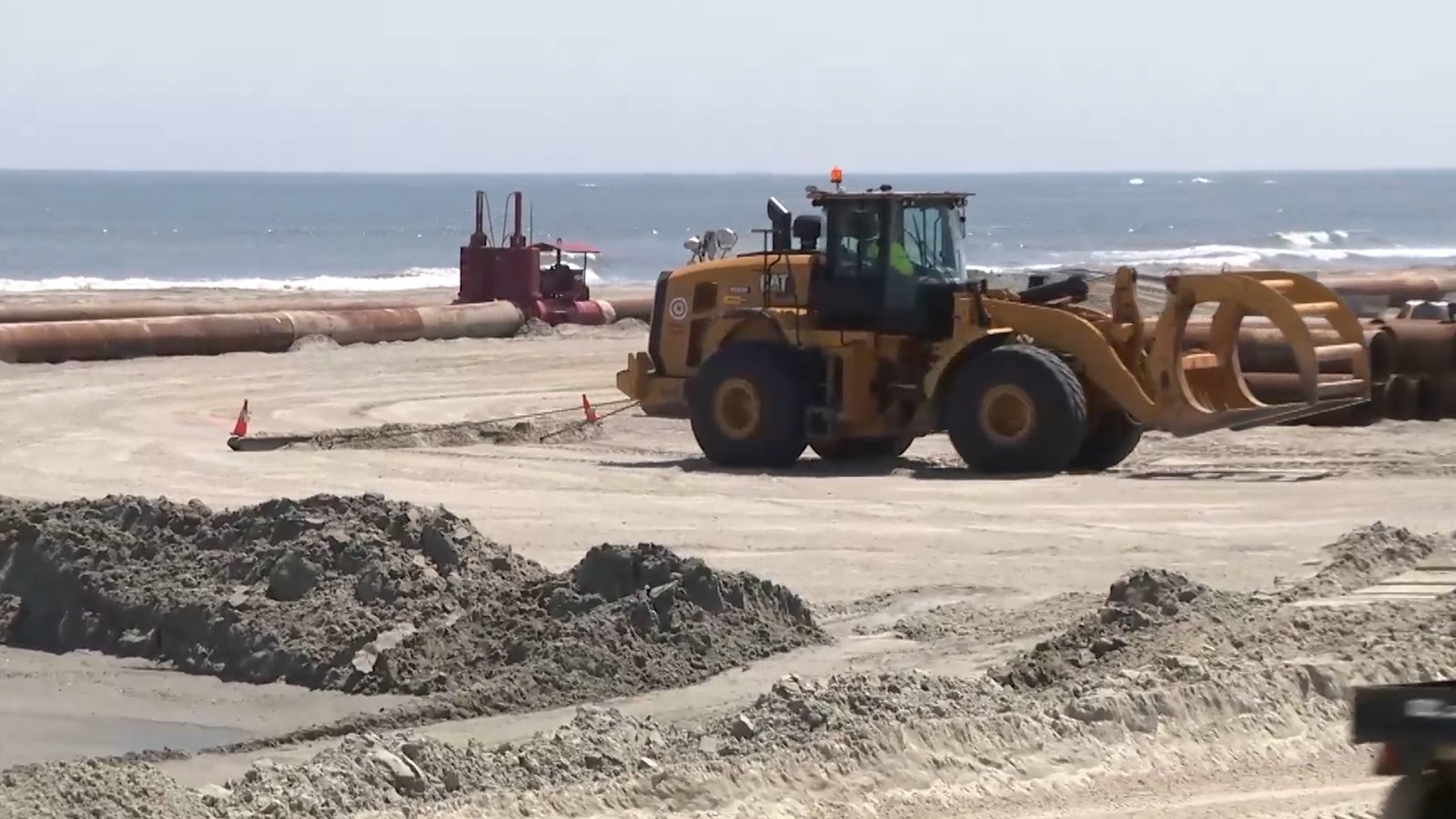
On Friday, the Corps revealed details about a “beach nourishment” project in Cape May County. The project, a multipronged effort of dune and berm construction, plus dredging, would occur at Strathmere and Sea Isle City.
Workers would dig about 1.16 million cubic yards of material from the ocean floor, and assemble berms, dunes and “crossovers” — or access paths for pedestrians, people with disabilities and vehicles, plan sketches show.
Atlantic City received the first beach nourishment project in 1936. Since then, 333 more have been undertaken in the state, according to a federal database maintained by the National Oceanic and Atmospheric Administration.
More than $3 billion has been spent on beach nourishment in New Jersey, the most of any state, according to data from the Program for the Study of Developed Shorelines at Western Carolina University.
As human-driven climate change makes extreme weather, like hurricanes, stronger, beach nourishment has gotten more expensive in recent years. New Jersey’ coastal erosion is eating beach towns faster than the Corps can replenish.
A 2024 bipartisan federal law requires the Corps to study “hot spot” erosion — sediment loss more swiftly from a small area than the surrounding area.
“Almost all of Delaware and New Jersey has become a giant hot spot,” Rob Young, director of the shorelines program, said in a 2024 interview with NJ Spotlight News. “Everybody’s having a problem, and everybody wants a new beach, and everybody has hot spots.”



