
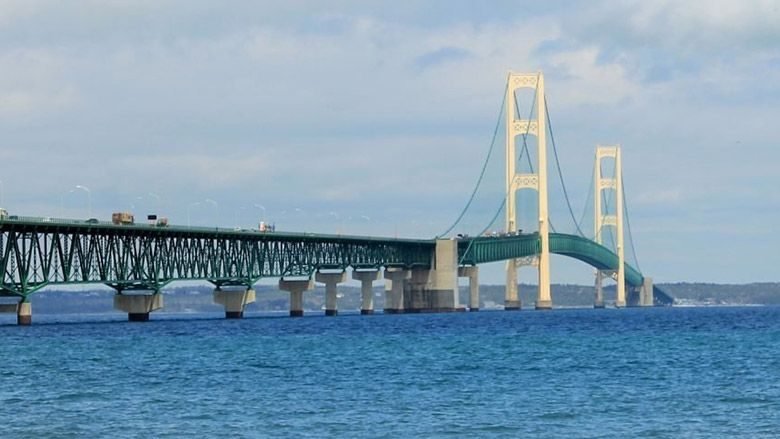
The U.S. Army Corps of Engineers issued a permit Aug. 12 to Canadian energy giant Enbridge for construction of Line 5, a controversial, four-mile-long tunnel along the bottom of the Straits of Mackinac to fully enclose twin oil and gas pipelines.
Even with the federal permit in hand, the project, part of a 645-mile pipeline that extends between Superior, Wis., and Sarnia, Ontario, will not start right away. The Michigan Supreme Court on July 31 vacated the Michigan Public Service Commission’s December 2023 approval asserting that the commission had not properly applied the Michigan Environmental Protection Act when reviewing the proposed project.
The Corps stated in its 54-page decision that that the tunnel’s construction complies with all applicable federal laws and regulations, including environmental, cultural, engineering and community requirements, and authorizes Enbridge to work within federally-regulated waters. The Corps does not regulate the design or operation of the pipeline itself or anything transported within it.
The permit was granted under the Trump administration’s “Building Infrastructure, Not Paperwork” initiative, which Assistant Secretary of the Army for Civil Works Adam Telle said in a statement is “cutting unneeded red tape” and “accelerates the delivery of critical infrastructure.”
“The approval of this key federal permit for the Great Lakes Tunnel Project is a significant step forward and reflects the U.S. Army Corps of Engineers’ more than six years of rigorous, comprehensive review,” Enbridge spokesperson Ryan Duffy said in an email.
Bay Mills Indian Community President
Whitney Gravelle, whose Tribal organization has been fighting the project for over six years, called the decision “shameful” and “a profound breach of the United States’ treaty trust responsibility to Tribal Nations.”
She referenced the 1836 Treaty of Washington in which the Ottawa and Chippewa (Ojibwe) nations ceded nearly 14 million acres, about 40% of the Michigan Territory to the U.S., which enabled Michigan to become a state in 1837. In exchange, the U.S. promised money, goods, and continued hunting and fishing rights.
“They disregarded our treaty rights, ignored the information we provided through consultation, and pushed past cultural resource obligations under the manufactured excuse of an ‘energy emergency,'” said Gravelle.
Earthjustice, a nonprofit organization proving legal representation to the tribe on the project, calls the project a danger to the environment.
“Enbridge’s proposal to run a hazardous liquids pipeline through a confined underground tunnel has never been attempted anywhere else in the world. It would turn the Straits of Mackinac—a sacred site of creation for Anishinaabe tribes–into a construction zone for more than six years, threatening permanent destruction.”
The overall pipeline project, which was estimated to cost $500 million in 2019, has soared in costs to more than $750-million according to earlier ENR reporting.
Source: www.enr.com



