
Ten years ago, after a gunman stormed an LGBTQ+ nightclub in Orlando, mourners plastered the shuttered bar with tributes to the victims and messages of hope.
Four years ago, as state leaders approved what came to be known as the “Don’t Say Gay” bill, hundreds of teenagers staged walkouts in protest.
And last year, when state crews painted over rainbow street murals in St. Petersburg and across Florida, neighbors covered the pavement with colorful chalk art of their own.
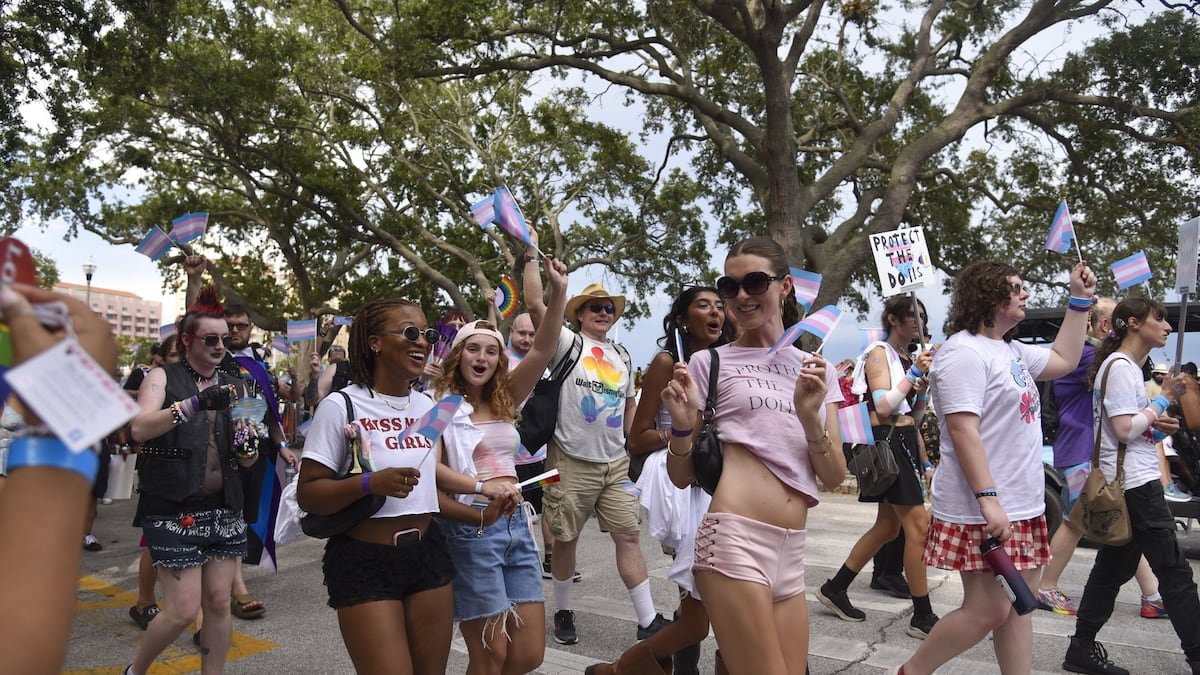
On Saturday, as throngs of rainbow-clad revelers partied in the streets, the St. Pete Pride festival pulsed with all of it: the joy and pain, the protest and resilience. Organizers and parade-goers said the event felt like a moment of resistance amid a yearslong spate of anti-LGBTQ+ rhetoric and legislation.
“We were built for moments like this,” said St. Pete Pride president Byron Green-Calisch, who helps organize the annual festival and parade along St. Petersburg’s waterfront. “Anytime the state legislature gets aggressive in talking about queer people, more people show up to the parade.”
And show up they did: Couples and kids, dogs and drag queens, draped in flags, tutus and strings of shiny beads.
Wearing a matching rainbow suit jacket and shorts, Kristopher McCullough and his husband, Wesley, traveled from Gainesville for the celebration. Atop McCullough’s head was a plush rainbow unicorn head that he found at Goodwill years ago.
It’s the outfit he’s worn to Pride for the last four years — his “annual ritual to spread joy,” he said.

Gabby Rosa, of Miami, towered above the crowd on a pair of aluminum stilts, wearing a pink outfit inspired by Chappell Roan.
“I want to let people know that queer people exist,” Rosa said.
“We genuinely had to fight for this and to be out like we are,” said attendee Emily Esser, who was covered in rainbow from her eye contacts to the colorful butterfly wings on her back.
This year more than ever, Green-Calisch said, the festival felt like a return to the roots of Pride.
Saturday’s celebration fell on the 57th anniversary of the Stonewall uprising, when LGBTQ+ protesters and advocates rioted for days after police raided the Stonewall Inn in New York City.
“Pride is the celebration of a riot that was started over an oppressive government that was restricting how queer people showed up in public discourse and public spaces,” Green-Calisch said. “We are still facing horrible, aggressive policies from our governments that don’t allow us to show up.”
In recent years, Gov. Ron DeSantis and state lawmakers have taken aim at LGBTQ+ issues, following a national trend among Republican-led legislatures.
They have passed measures that restrict children’s access to puberty blockers and hormone therapies and made it a criminal offense for some people to use restrooms that don’t match their sex at birth.
State and federal leaders have also cracked down on efforts to promote diversity, equity and inclusion.
Last year, following a directive to keep roads “free and clear of political ideologies,” state crews painted over St. Petersburg’s Progressive Pride street mural. This month, St. Petersburg raised a Pride flag above City Hall for the last time before a law banning local governments from funding diversity, equity and inclusion efforts takes effect in 2027.
During the parade, as crowds belted Gloria Gaylor’s “I Will Survive” and Jennifer Lopez’s “Let’s Get Loud,” St. Petersburg Mayor Ken Welch said, “I’m proud to be here.”
Jade Fukunaka, who traveled from Sarasota, said Pride is a “reminder of the people who came before us.”
Beside her were bottles of colored dye and a sign that read, “Paint me your favorite color.” She braced herself as a child squeezed yellow dye all over her clothes.
Fukunaka started the project alone in 2023 — the same year she came out as lesbian. On Saturday, her partner stood with her, drenched in color.
Though attendees may not have noticed a shift, organizers said Tampa Bay’s Pride landscape looked different this year.
St. Pete Pride faced funding challenges after losing money from corporate sponsors, Green-Calisch said. As of Thursday, the nonprofit was around $146,000 short of its roughly $700,000 Pride Month budget. Green-Calisch said he urged attendees to donate at least $1 during the event.
Across the bay, Tampa Pride announced in December that it would take a one-year hiatus due to “the current political and economic climate.” A Facebook post that month cited challenges with corporate sponsorships, reductions in public grant funding and restrictions on diversity, equity and inclusion programs under DeSantis.
One constant was the presence of private security and city police — a point of tension for some LGBTQ+ groups.
The People’s Pride Coalition, made up of local grassroots organizations, demanded that St. Pete Pride end its partnership with the city’s police department and cut ties with corporate sponsors. Organizers decried the police department’s 287(g) agreement, an Immigration and Customs Enforcement initiative that lets local officers perform limited immigration agent functions.
In past years, coalition members have met with St. Pete Pride leaders and marched in the parade. This year, however, they say they have been ignored. Green-Calisch said he is available to coalition members and that St. Pete Pride has worked to meet a chunk of their demands.
On Friday, the coalition hosted its second annual People’s Pride Night with music, vendors and drag performances with the aim of bringing Pride “back to its roots.”
For Sarah Woodham, Saturday’s festivities were a relief.
Woodham brought her daughter and colleagues, all of whom are neurodivergent and queer, she said.
“When everyone around us is telling us to be quiet and shut up, we are loud and proud and happy,” Woodham said, cheering as a firetruck rolled past. “That’s gonna piss people off, and I’m glad it does.”



