
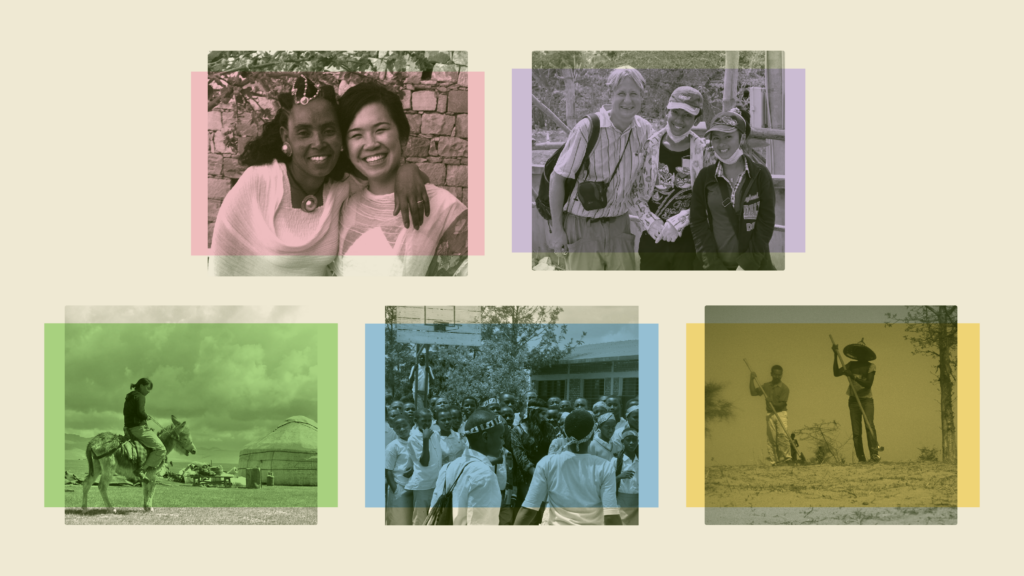
For some UC Berkeley alums, volunteering in the Peace Corps is a chance to take what they learned in the classroom and apply it around the world, from disease prevention in Rwanda to English instruction in Ethiopia. For others, service abroad sets them on a new professional path entirely. And for more than six decades, that drive to support others has shaped individual lives and Berkeley’s identity as a powerhouse for public service.
Berkeley has generated more Peace Corps volunteers than any other college or university in the country — a distinction the campus maintained this year, according to Peace Corps data. In all, some 3,807 Berkeley alums have deployed to landscapes ranging from tropical jungles to parched deserts. The types of service trips have evolved, as has the federal program itself, yet Berkeley has retained its spot as the top producer of total volunteers since the program started in 1961.
Historical Peace Corps volunteers by the numbers
- UC Berkeley: 3,807
- UW-Madison: 3,466
- University of Washington: 3,175
- University of Michigan: 2,851
- University of Colorado Boulder: 2,653
*Rankings are calculated based on fiscal year 2025 data, as self-reported by Peace Corps volunteers.
Returned volunteers and campus leaders said that legacy is partly a reflection of the service-oriented student who’s long been drawn to Berkeley and partly a result of a campus culture oriented around improving the world.
“Our students are very bright, and it’s within them to want to make change,” said Sue Harbour, associate dean and executive director of Berkeley Career Engagement, which links the federally organized Peace Corps to campus and hosts the corps at career fairs. “They’re not cool with the status quo of what’s going on in the world, and if they have an opportunity to do something that’s going to impact change, they’re going to do that.”
Berkeley was quick out the gate when former President John F. Kennedy called for students to promote peace by volunteering in developing countries. The message ricocheted across college campuses, and a new federal government agency was quickly established. Since then, more than 240,000 Peace Corps volunteers have served in 144 host countries.
Berkeley’s size only partly explains why it has held the No. 1 spot for alum volunteers for so long.
“It’s so in alignment with how Berkeley students think of themselves and, in the 1960s, how Berkeley thought of itself,” said Sandra Bass, director of Berkeley’s Public Service Center, a campus launchpad for all kinds of volunteerism, including with the Peace Corps. While times have changed and recent federal policy has transformed some types of international service, Bass said that spirit still motivates students she speaks with daily.
Today, Bass said, the Peace Corps answers another need as well.
“Across the globe, there is this fear of the other,” Bass said. “We need to do what we can to dissipate that fear.”
National Archives and Records Administration via Wikimedia Commons
‘An attitude of curiosity‘
For some students, Peace Corps service was always part of the plan.
Ursula Kajani was 12 years old when she knew she wanted to join. Growing up in suburban Sacramento, Kajani was fascinated by how other communities experienced the world in ways different from her own. An interest in health care and curiosity about culture shaped her time at Berkeley from the moment she arrived on campus in 2015.
Kajani majored in public health, studied anthropology and connected with both a Peace Corps recruiter and the Public Service Center. But it was a public health course that introduced her to health system reconstruction initiatives in Rwanda after the 1994 genocide against the Tutsi and led her to volunteer with the Peace Corps in a health clinic in the Southern Province of Rwanda
She took what she learned in class and worked to apply it in the community, especially at the health center, where Kajani supported digitization of health records, updated child vaccination registries and assisted with food distribution. It took time for Kajani to learn how to navigate her new community. At Berkeley, Kajani learned about the importance of working with communities and collaborating with local leaders. With that as a guiding principle, she spent weeks organizing a youth-focused event intended to make young people feel comfortable with the health center and the staff who worked there. Despite the positive engagement leading up to it, no one showed up — she later learned there was a wedding in town on the same day.
“I didn’t actually understand my community yet. And I hadn’t built rapport in an authentic, meaningful way,” Kajani said. “I should have been getting to know people, because they were my community.”

Courtesy of Ursula Kajani
It was a hard lesson, but one she took to heart. Instead of focusing on interventions, she focused on understanding and building community in her new home. The events that followed, including a multi-phase hygiene campaign, drew far better turnout. After her Peace Corps service concluded, Kajani remained in Rwanda for an additional four years. She now works as a senior program associate for the Rosalynn Carter Mental Health and Caregiver Program at The Carter Center, a nonprofit that promotes peace and health equity around the world.
She believes her courses at Berkeley pushed her worldview in just the right way.
“An attitude of curiosity can take you a long way,” Kajani said.
A similar kind of curiosity drove Francesca Po, who started at Berkeley in 2000. But while Kajani focused on physical health, Po focused on social harmony, conflict mediation and international peacekeeping.

Courtesy of Francesca Po
As a religious studies major, Po met Michael Nagler, a professor emeritus of classics and comparative literature. Nagler founded the Department of Peace and Conflict Studies and was also the founder-president of The Metta Center for Nonviolence. Through conversations with him, coupled with her family’s history in social movements, Po became interested in the Peace Corps. And with a longstanding interest in the Romani culture of Eastern Europe — she studied the accordion, a traditional instrument for the region, while minoring in music — she was placed in Kazakhstan.
“Berkeley just attracts very socially aware people, and I think that’s why people like doing the Peace Corps,” Po said. “Why wouldn’t you want to learn about other cultures and help them out in the process?”
In Kazakhstan she taught curriculum development, and the lessons she learned while abroad stayed with her. Back in the Bay Area in 2008, Po learned of tension brewing on the other side of the border of her host country, in Kyrgyzstan. With her local knowledge, she co-wrote a piece with Nagler offering recommendations for how to calm tensions amid a potential civil war. She didn’t know who would read it. Soon, though, she learned that Kyrgyzstan’s president had seen the report — and employed its recommendations to avert conflict.
“That’s my fun fact,” she said. “I helped defuse a civil war.”

Courtesy of Sue Harbour
Service creates a ‘self-generating cycle’
While Po’s story of contributing to a civil peace process is unique, she is just one of a vast number of alums who have volunteered — including those currently serving in Armenia, Zambia and beyond.
Instead of speaking with a recruiter on Sproul Plaza, prospective volunteers who have questions now can book a video call with Sean Murphy, a recruiter for Northern California. A returned volunteer himself, Murphy said Berkeley has created a sort of “self-generating cycle” where volunteers return to campus to work or teach.
Greg Cera is part of that cycle. An adviser in the College of Letters and Science, Cera served in Cambodia with his spouse from 2012 to 2014. He was older than most volunteers — 38 when he boarded the plane — but said building peer support networks and helping villagers learn about prenatal and child health care was some of the most meaningful work of his life.

Courtesy of Greg Cera
In his 11 years at Berkeley, Cera said, he’s talked with hundreds of students about the Peace Corps. More than a dozen went on to serve, some of whom he’s kept in contact with. He said he regularly encourages students who are considering a service-oriented graduate program, like public health or law, to consider the Peace Corps, both for the experience and the potential financial benefits; the Paul D. Coverdell Fellows Program provides substantial funding for returning volunteers attending some graduate programs.
“I think there is a culture at each of the top institutions generating volunteers, including at Berkeley, that is globally focused and — this may sound trite — focused on making the world a better place,” Cera said.
For alums like Kirsten Kuwatani, the Peace Corps led somewhere unexpected.
Kuwatani’s time at Berkeley taught her to “be willing to look at the bigger picture” around the world, she said. She started in 2009 with an interest in English, a major in political economy and a gap on her resume when it came to international experience. So she turned to the Peace Corps.

Courtesy of Kirsten Kuwatani
Kuwatani taught English in Ethiopia, and her days were busy. When she had time to pop into the local market, produce was limited. There was, however, a bounty of spices. She began experimenting, first with meals for herself, then for friends and dinner parties. Cooking became a hobby, and slim pickings at the market made for a fresh challenge.
“I actually loved the limitation of it because then I could think about being creative with what I had,” she said.
After her service ended, she stayed in Ethiopia for two more years, briefly lived in France and then returned to the U.S. and enrolled in culinary school to fully embrace the cooking spark that her service lit.
Kuwatani is now a cook at one of the Bay Area’s most famous restaurants: Chez Panisse.
‘UC Berkeley and Peace Corps match perfectly.’
For some volunteers, service shaped a career. For others, like Patrick Gonzalez, the Peace Corps reshaped his Berkeley research and his life.
Gonzalez, a climate change scientist, forest ecologist and associate adjunct professor at Berkeley, took a leave to join the Peace Corps barely one year after starting his Ph.D. program.
“I knew that if I didn’t do it then, I’d never do it,” he said of his long-held dream of volunteering.
Gonzalez’s time in Senegal transformed his graduate research, as well as how he thought about using his research and experience to inspire others. Gonzalez was a forestry volunteer in a rural village in the Sahel, a hot and dry savanna in Senegal. While there, he helped lead an effort to revive traditional local landscapes and tree regeneration, working with farmers to grow 15 hectares of trees. When he returned to Berkeley, he had planned to study the impacts of acid rain in the Sierra Nevada, but he pivoted. Instead, he chose to study the cause of the tree death in Senegal — and sought a solution.

Courtesy of Patrick Gonzalez
After hiking 1,900 kilometers, counting trees and interviewing locals, he learned the scale of the die-off: one out of five trees had died in the previous 50 years, and one out of three species had disappeared locally. The culprit: higher temperatures caused by carbon pollution from half a world away that was driving human-caused climate change.
Gonzalez earned his Ph.D. in 1997 at Berkeley in the Energy and Resources Group and has been an associate adjunct professor since 2017 in the Department of Environmental Science, Policy, and Management.
“Peace Corps changed my perspective on the world. It gave me another family — I keep in touch with them,” Gonzalez said. “And so Peace Corps changed my whole life for the better.”
In one class he teaches, Climate Change, Ecosystems and Solutions, he often discusses the people and environment of the African Sahel. He talks about climate change and solutions and the value of natural regeneration of trees. He shows photos from his time in Africa.
Students ask him about his service “all the time,” Gonzalez said, and he’s always glad to tell them about it.
“Berkeley cultivates in students an aspiration to help make the world a better place. That’s the exact same aspiration of Peace Corps volunteers,” Gonzalez said. “So Berkeley and Peace Corps match perfectly. It just makes perfect sense.”



