
Guarente, L. & Kenyon, C. Genetic pathways that regulate ageing in model organisms. Nature 408, 255–262 (2000).
Lopez-Otin, C., Blasco, M. A., Partridge, L., Serrano, M. & Kroemer, G. The hallmarks of aging. Cell 153, 1194–1217 (2013).
Melzer, D., Pilling, L. & Ferrucci, L. The genetics of human ageing. Nat. Rev. Genet. 21, 88–101 (2020).
Schaum, N. et al. Ageing hallmarks exhibit organ-specific temporal signatures. Nature 583, 596–602 (2020).
Zhang, Z. et al. A panoramic view of cell population dynamics in mammalian aging. Science 387, eadn3949 (2025).
Ding, Y. et al. Comprehensive human proteome profiles across a 50-year lifespan reveal aging trajectories and signatures. Cell 188, 5763–5784 (2025).
Lopez-Otin, C. & Kroemer, G. Hallmarks of health. Cell 184, 33–63 (2021).
Ji, S. et al. Cellular rejuvenation: molecular mechanisms and potential therapeutic interventions for diseases. Signal Transduct. Target. Ther. 8, 116 (2023).
Kuo, P. L. et al. Longitudinal phenotypic aging metrics in the Baltimore longitudinal study of aging. Nat. Aging 2, 635–643 (2022).
Herndon, L. A. et al. Stochastic and genetic factors influence tissue-specific decline in ageing C. elegans. Nature 419, 808–814 (2002).
Horvath, S. DNA methylation age of human tissues and cell types. Genome Biol. 14, R115 (2013).
Tabula Muris, C. A single-cell transcriptomic atlas characterizes ageing tissues in the mouse. Nature 583, 590–595 (2020).
Palovics, R. et al. Molecular hallmarks of heterochronic parabiosis at single-cell resolution. Nature 603, 309–314 (2022).
Zhang, B. et al. Multi-omic rejuvenation and life span extension on exposure to youthful circulation. Nat. Aging 3, 948–964 (2023).
Ma, S. et al. Heterochronic parabiosis induces stem cell revitalization and systemic rejuvenation across aged tissues. Cell Stem Cell 29, 990–1005 (2022).
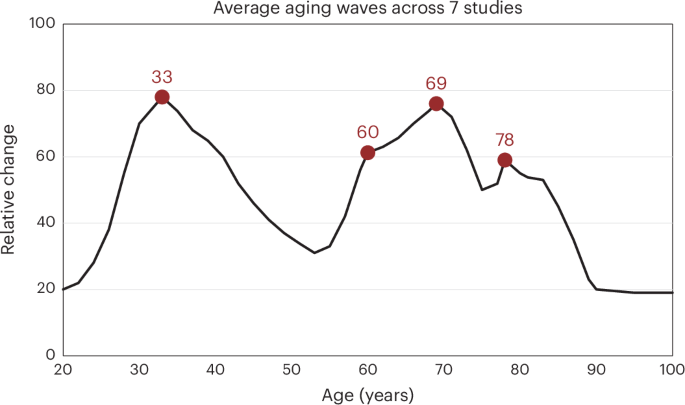
Lehallier, B. et al. Undulating changes in human plasma proteome profiles across the lifespan. Nat. Med. 25, 1843–1850 (2019).
Marquez, E. J. et al. Sexual-dimorphism in human immune system aging. Nat. Commun. 11, 751 (2020).
Shen, X. et al. Nonlinear dynamics of multi-omics profiles during human aging. Nat. Aging 4, 1619–1634 (2024).
Liu, W.-S. et al. Plasma proteomics identify biomarkers and undulating changes of brain aging. Nat. Aging 5, 99–112 (2025).
Edde, M., Leroux, G., Altena, E. & Chanraud, S. Functional brain connectivity changes across the human life span: from fetal development to old age. J. Neurosci. Res. 99, 236–262 (2021).
Mousley, A., Bethlehem, R. A. I., Yeh, F. C. & Astle, D. E. Topological turning points across the human lifespan. Nat. Commun. 16, 10055 (2025).
Bethlehem, R. A. I. et al. Brain charts for the human lifespan. Nature 604, 525–533 (2022).
Takahashi, K. & Yamanaka, S. Induction of pluripotent stem cells from mouse embryonic and adult fibroblast cultures by defined factors. Cell 126, 663–676 (2006).
Takahashi, K. et al. Induction of pluripotent stem cells from adult human fibroblasts by defined factors. Cell 131, 861–872 (2007).
Thomas, L. et al. The emerging promise of induced pluripotent stem cells in clinical studies: a systematic scoping review of the literature and registered clinical trials. Cytotherapy 28, 101985 (2026).
Sugita, S. et al. HLA-matched allogeneic iPS cells-derived RPE transplantation for macular degeneration. J. Clin. Med. 9, 2217 (2020).
Sawamoto, N. et al. Phase I/II trial of iPS-cell-derived dopaminergic cells for Parkinson’s disease. Nature 641, 971–977 (2025).
Jo, B. K., Lee, S. Y., Eom, H. J., Kim, J. & Cha, H. J. Organ-specific dedifferentiation and epigenetic remodeling in in vivo reprogramming. Aging Cell 24, e70268 (2025).
Ocampo, A. et al. In vivo amelioration of age-associated hallmarks by partial reprogramming. Cell 167, 1719–1733 (2016).
Browder, K. C. et al. In vivo partial reprogramming alters age-associated molecular changes during physiological aging in mice. Nat. Aging 2, 243–253 (2022).
Gill, D. et al. Multi-omic rejuvenation of human cells by maturation phase transient reprogramming. eLife 11, e71624 (2022).
Conboy, I. M. et al. Rejuvenation of aged progenitor cells by exposure to a young systemic environment. Nature 433, 760–764 (2005).
Villeda, S. A. et al. The ageing systemic milieu negatively regulates neurogenesis and cognitive function. Nature 477, 90–94 (2011).
Villeda, S. A. et al. Young blood reverses age-related impairments in cognitive function and synaptic plasticity in mice. Nat. Med. 20, 659–663 (2014).
Hannestad, J. et al. Safety and tolerability of GRF6019 infusions in severe Alzheimer’s disease: a phase II double-blind placebo-controlled trial. J. Alzheimers Dis. 81, 1649–1662 (2021).
Gaudilliere, B. et al. Infusion of young donor plasma components in older patients modifies the immune and inflammatory response to surgical tissue injury: a randomized clinical trial. J. Transl. Med. 23, 183 (2025).
Boada, M. et al. Neuropsychological, neuropsychiatric, and quality-of-life assessments in Alzheimer’s disease patients treated with plasma exchange with albumin replacement from the randomized AMBAR study. Alzheimers Dement. 18, 1314–1324 (2022).
Fuentealba, M. et al. Multi-omics analysis reveals biomarkers that contribute to biological age rejuvenation in response to single-blinded randomized placebo-controlled therapeutic plasma exchange. Aging Cell 24, e70103 (2025).
Partridge, L., Fuentealba, M. & Kennedy, B. K. The quest to slow ageing through drug discovery. Nat. Rev. Drug Discov. 19, 513–532 (2020).
Keys, M. T., Hallas, J., Miller, R. A., Suissa, S. & Christensen, K. Emerging uncertainty on the anti-aging potential of metformin. Ageing Res. Rev. 111, 102817 (2025).
Bischoff-Ferrari, H. A. et al. Individual and additive effects of vitamin D, omega-3 and exercise on DNA methylation clocks of biological aging in older adults from the DO-HEALTH trial. Nat. Aging 5, 376–385 (2025).
Guarente, L., Sinclair, D. A. & Kroemer, G. Human trials exploring anti-aging medicines. Cell Metab. 36, 354–376 (2024).
Delrue, C., Speeckaert, R. & Speeckaert, M. M. Rewinding the clock: emerging pharmacological strategies for human anti-aging therapy. Int. J. Mol. Sci. 26, 9372 (2025).
Herzog, C. M. S. et al. Challenges and recommendations for the translation of biomarkers of aging. Nat. Aging 4, 1372–1383 (2024).
Wu, Z. et al. Biomarkers of ageing of humans and non-human primates. Nat. Rev. Mol. Cell Biol. 26, 826–847 (2025).
Ying, K. et al. Causality-enriched epigenetic age uncouples damage and adaptation. Nat. Aging 4, 231–246 (2024).
Ying, K. et al. An open competition for biomarkers of aging. Nat. Aging 6, 1193–1195 (2026).
Horvath, S. et al. Epigenetic clock for skin and blood cells applied to Hutchinson–Gilford progeria syndrome and ex vivo studies. Aging 10, 1758–1775 (2018).
Levine, M. E. et al. An epigenetic biomarker of aging for lifespan and healthspan. Aging 10, 573–591 (2018).
Lu, A. T. et al. DNA methylation GrimAge version 2. Aging 14, 9484–9549 (2022).
Belsky, D. W. et al. DunedinPACE, a DNA methylation biomarker of the pace of aging. eLife 11, e73420 (2022).
Horvath, S. et al. Decreased epigenetic age of PBMCs from Italian semi-supercentenarians and their offspring. Aging 7, 1159–1170 (2015).
Li, C. Z. et al. Epigenetic predictors of species maximum life span and other life-history traits in mammals. Sci. Adv. 10, eadm7273 (2024).
Lu, A. T. et al. Universal DNA methylation age across mammalian tissues. Nat. Aging 3, 1144–1166 (2023).
Mulder, R. H., Neumann, A., Felix, J. F., Suderman, M. & Cecil, C. A. M. Characterising developmental dynamics of adult epigenetic clock sites. eBioMedicine 109, 105425 (2024).
Lu, A. T. et al. DNA methylation GrimAge strongly predicts lifespan and healthspan. Aging 11, 303–327 (2019).
Tay, J. H., Barros, D., Wang, W., Wazny, V. K. & Maier, A. B. Biological age measured by DNA methylation clocks and frailty: a systematic review and meta-analysis. Lancet Healthy Longev. 6, 100773 (2025).
Mavrommatis, C. et al. An unbiased comparison of 14 epigenetic clocks in relation to 174 incident disease outcomes. Nat. Commun. 16, 11164 (2025).
Li, P. et al. Decoding disease-specific ageing mechanisms through pathway-level epigenetic clock: insights from multi-cohort validation. eBioMedicine 118, 105829 (2025).
Fuentealba, M. et al. A blood-based epigenetic clock for intrinsic capacity predicts mortality and is associated with clinical, immunological and lifestyle factors. Nat. Aging 5, 1207–1216 (2025).
Liu, Z. et al. Interferon-related inflammaging links epigenetic age acceleration to multimorbidity. Cell Genom. 6, 101218 (2026).
Ying, K. et al. A unified framework for systematic curation and evaluation of aging biomarkers. Nat. Aging 5, 2323–2339 (2025).
Srivatsa, S. et al. Epigenetic aging clocks and incident cardiovascular outcomes: results from the MESA. J. Am. Heart Assoc. 14, e044946 (2025).
Conole, E. L. S., Robertson, J. A., Smith, H. M., Cox, S. R. & Marioni, R. E. Epigenetic clocks and DNA methylation biomarkers of brain health and disease. Nat. Rev. Neurol. 21, 411–421 (2025).
Pomirchy, M., Chung, S., Bommer, C., Strobel, S. & Geldsetzer, P. Herpes zoster vaccination and incident dementia in Canada: an analysis of natural experiments. Lancet Neurol. 25, 170–180 (2026).
Kim, J. K. & Crimmins, E. M. Association between shingles vaccination and slower biological aging: evidence from a U.S. population-based cohort study. J. Gerontol. A Biol. Sci. Med. Sci. 81, glag008 (2026).
Li, S. et al. Effects of daily multivitamin–multimineral and cocoa extract supplementation on epigenetic aging clocks in the COSMOS randomized clinical trial. Nat. Med. 32, 1012–1022 (2026).
Lopes de Oliveira, T., Pedersen, N. L., Deelen, J. & Hägg, S. Epidemiological approaches to refine biomarkers of aging. Nat. Aging 6, 291–294 (2026).
Kuo, P.-L. et al. Longitudinal changes in epigenetic clocks predict survival in the InCHIANTI cohort. Nat. Aging 6, 534–540 (2026).
Lowe, R. et al. Ageing-associated DNA methylation dynamics are a molecular readout of lifespan variation among mammalian species. Genome Biol. 19, 22 (2018).
Topol, E. J. The revolution in high-throughput proteomics and AI. Science 385, eads5749 (2024).
Oh, H. S. et al. Organ aging signatures in the plasma proteome track health and disease. Nature 624, 164–172 (2023).
Goeminne, L. J. E. et al. Plasma protein-based organ-specific aging and mortality models unveil diseases as accelerated aging of organismal systems. Cell Metab. 37, 205–222 (2025).
Oh, H. S. et al. Plasma proteomics links brain and immune system aging with healthspan and longevity. Nat. Med. 31, 2703–2711 (2025).
Kivimäki, M. et al. Proteomic organ-specific ageing signatures and 20-year risk of age-related diseases: the Whitehall II observational cohort study. Lancet Digit. Health7, e195–e204 (2025).
Kivimäki, M. et al. Social disadvantage accelerates aging. Nat. Med. 31, 1635–1643 (2025).
Wen, J. Refining the generation, interpretation and application of multi-organ, multi-omics biological aging clocks. Nat. Aging 5, 1897–1913 (2025).
Carrasco-Zanini, J. et al. Mapping biological influences on the human plasma proteome beyond the genome. Nat. Metab. 6, 2010–2023 (2024).
Deng, Y.-T. et al. Atlas of the plasma proteome in health and disease in 53,026 adults. Cell 188, 253–271 (2025).
Tang, J. et al. Longitudinal serum proteome mapping reveals biomarkers for healthy ageing and related cardiometabolic diseases. Nat. Metab. 7, 166–181 (2025).
Groves, J. W. et al. Eight decades of follow-up link life course exposures to proteomic organ ageing and longevity. Preprint at medRxiv https://doi.org/10.1101/2025.09.07.25335188 (2025).
Ding, D. et al. Plasma proteomic signatures of cellular aging predict human disease. Nat. Med. 32, 2060–2072 (2026).
Argentieri, M. A. et al. Proteomic aging clock predicts mortality and risk of common age-related diseases in diverse populations. Nat. Med. 30, 2450–2460 (2024).
Carrasco-Zanini, J. et al. Proteomic prediction of diverse incident diseases: a machine learning-guided biomarker discovery study using data from a prospective cohort study. Lancet Digit. Health 6, e470–e479 (2024).
Álvez, M. B. et al. A human pan-disease blood atlas of the circulating proteome. Science 390, eadx2678 (2025).
Duggan, M. R. et al. The Dementia SomaSignal Test (dSST): a plasma proteomic predictor of 20-year dementia risk. Alzheimer’s Dement. 21, e14549 (2025).
Kuo, C.-L. et al. A proteomic signature of healthspan. Proc. Natl Acad. Sci. USA 122, e2414086122 (2025).
Min, M., Egli, C., Dulai, A. S. & Sivamani, R. K. Critical review of aging clocks and factors that may influence the pace of aging. Front. Aging 5, 1487260 (2024).
Tyshkovskiy, A. et al. Universal transcriptomic hallmarks of mammalian ageing and mortality. Nature 654, 173–188 (2026).
Klopack, E. T. et al. Development of a novel transcriptomic measure of aging: Transcriptomic Mortality-risk Age (TraMA). Aging 17, 1521–1543 (2025).
Mutz, J., Iniesta, R. & Lewis, C. M. Metabolomic age (MileAge) predicts health and life span: a comparison of multiple machine learning algorithms. Sci. Adv. 10, eadp3743 (2024).
Shi, J. et al. Conserved shifts in sperm small non-coding RNA profiles during mouse and human aging. EMBO J. 45, 1362–1380 (2026).
Xiong, J. et al. Multi-omic underpinnings of heterogeneous aging across multiple organ systems. Cell Genom. 5, 101032 (2025).
Alpert, A. et al. A clinically meaningful metric of immune age derived from high-dimensional longitudinal monitoring. Nat. Med. 25, 487–495 (2019).
Sayed, N. et al. An inflammatory aging clock (iAge) based on deep learning tracks multimorbidity, immunosenescence, frailty and cardiovascular aging. Nat. Aging 1, 598–615 (2021).
Ahuja, S. K. et al. Immune resilience despite inflammatory stress promotes longevity and favorable health outcomes including resistance to infection. Nat. Commun. 14, 3286 (2023).
Sparks, R. et al. A unified metric of human immune health. Nat. Med. 30, 2461–2472 (2024).
Wang, Y. et al. Integrating single-cell RNA and T cell/B cell receptor sequencing with mass cytometry reveals dynamic trajectories of human peripheral immune cells from birth to old age. Nat. Immunol. 26, 308–322 (2025).
Li, W. et al. Single-cell immune aging clocks reveal inter-individual heterogeneity during infection and vaccination. Nat. Aging 5, 607–621 (2025).
Riemann, L. et al. Integrative deep immune profiling of the elderly reveals systems-level signatures of aging, sex, smoking, and clinical traits. eBioMedicine 112, 105558 (2025).
Gong, Q. et al. Multi-omic profiling reveals age-related immune cell dynamics in healthy adults. Nature 648, 696–706 (2025).
Metcalf, C. J. E., Graham, A. L., Yates, A. J. & Cummings, D. A. T. Convergence and divergence of individual immune responses over the life course. Science 389, 604–609 (2025).
Jang, I. H., Niedernhofer, L. J., Robbins, P. D. & Camell, C. D. The ageing immune system as a driver of systemic ageing. Nat. Rev. Immunol. 26, 489–506 (2026).
The immune system offers a window into aging. Nat. Aging 5, 1377 (2025).
Ganesan, A. et al. A conserved immune dysregulation signature is associated with infection severity, risk factors prior to infection, and treatment response. Immunity 58, 2104–2119 (2025).
Basurco, L., Abellanas, M. A., Purnapatre, M., Antonello, P. & Schwartz, M. Chronological versus immunological aging: immune rejuvenation to arrest cognitive decline. Neuron 113, 140–153 (2025).
Schwartz, M. & Croese, T. Treating the immune system to repair the brain. Sci. Transl. Med. 18, eaeb1677 (2026).
Balachandran, A. et al. Pace of aging analysis of healthspan and lifespan in older adults in the US and UK. Nat. Aging 5, 1132–1142 (2025).
Wang, K. et al. A full life cycle biological clock based on routine clinical data and its impact in health and diseases. Nat. Med. 31, 4225–4235 (2025).
Li, Y. et al. Large language model-based biological age prediction in large-scale populations. Nat. Med. 31, 2977–2990 (2025).
Li, R. & Lin, H. A retinal biomarker of biological age based on composite clinical phenotypic information. Lancet Healthy Longev. 5, 100603 (2024).
Pavluk, D. et al. AI-ECG-derived biological age as a predictor of mortality in cardiovascular and acute care patients. Eur. Heart J. Digit. Health 6, 1204–1215 (2025).
Assadi, H. S. et al. Cardiovascular magnetic resonance imaging markers of ageing: a multi-centre, cross-sectional cohort study. Eur. Heart J. Open 5, oeaf032 (2025).
Kobelyatskaya, A. A. et al. EchoAGE: echocardiography-based neural network model forecasting heart biological age. Aging Dis. 16, 2383–2397 (2024).
Haugg, F. et al. Imaging biomarkers of ageing: a review of artificial intelligence-based approaches for age estimation. Lancet Healthy Longev. 6, 100728 (2025).
Jones, D. T., Lee, J. & Topol, E. J. Digitising brain age. Lancet 400, 988 (2022).
Moguilner, S. et al. Brain clocks capture diversity and disparities in aging and dementia across geographically diverse populations. Nat. Med. 30, 3646–3657 (2024).
Miller, A. C. et al. A wearable-based aging clock associates with disease and behavior. Nat. Commun. 16, 9264 (2025).
Lind, L., Mazidi, M., Clarke, R., Bennett, D. A. & Zheng, R. Measured and genetically predicted protein levels and cardiovascular diseases in UK Biobank and China Kadoorie Biobank. Nat. Cardiovasc. Res. 3, 1189–1198 (2024).
Ying, K. Causal inference for epigenetic ageing. Nat. Rev. Genet. 26, 3 (2025).
Schuermans, A. et al. Integrative proteomic analyses across common cardiac diseases yield mechanistic insights and enhanced prediction. Nat. Cardiovasc. Res. 3, 1516–1530 (2024).
Michaëlsson, K. et al. Cardio-metabolic-related plasma proteins reveal biological links between cardiovascular diseases and fragility fractures: a cohort and Mendelian randomisation investigation. eBioMedicine 113, 105580 (2025).
Yao, M. et al. Deciphering proteins in Alzheimer’s disease: a new Mendelian randomization method integrated with AlphaFold3 for 3D structure prediction. Cell Genom. 4, 100700 (2024).
Asefa, N. G. et al. Mid- and late-life cardiovascular health indicators and changes in biological ageing markers; a multi-cohort study. eBioMedicine 122, 106016 (2025).
Sehgal, R. et al. DNAm aging biomarkers are responsive: insights from 51 longevity interventional studies in humans. Preprint at bioRxiv https://doi.org/10.1101/2024.10.22.619522 (2024).
You, Y. et al. Relationship between physical activity and DNA methylation-predicted epigenetic clocks. NPJ Aging 11, 27 (2025).
Corley, M. J. et al. Semaglutide slows epigenetic aging in a randomized trial of HIV-associated lipohypertrophy Nature Communications https://www.nature.com/articles/s41467-026-72861-3 (2026)
Maretty, L. et al. Proteomic changes upon treatment with semaglutide in individuals with obesity. Nat. Med. 31, 267–277 (2025).
De Lima Camillo, L. P. et al. CpgGPT: a foundation model for DNA methylation. Preprint at bioRxiv https://doi.org/10.1101/2024.10.24.619766 (2025).
Ying, K. et al. MethylGPT: a foundation model for the DNA methylome. Preprint at bioRxiv https://doi.org/10.1101/2024.10.30.621013 (2024).
Shmatko, A. et al. Learning the natural history of human disease with generative transformers. Nature 647, 248–256 (2025).
Kim, S. A. et al. Physical activity, Alzheimer plasma biomarkers, and cognition. JAMA Netw. Open 8, e250096–e250096 (2025).
Topol, E. Spotlight on the shingles vaccine—again! https://erictopol.substack.com/p/spotlight-on-the-shingles-vaccineagain
Topol, E. AI-enabled opportunistic medical scan interpretation. Lancet 403, 1842 (2024).
Ying, K. et al. Autonomous AI agents discover aging interventions from millions of molecular profiles. Preprint at bioRxiv https://doi.org/10.1101/2023.02.28.530532 (2025).
Ikram, M. A. The use and misuse of ‘biological aging’ in health research. Nat. Med. 30, 3045–3045 (2024).
Lee, M. G. The age illusion—limitations of chronologic age in medicine. N. Engl. J. Med. 394, 1251–1253 (2026).



