
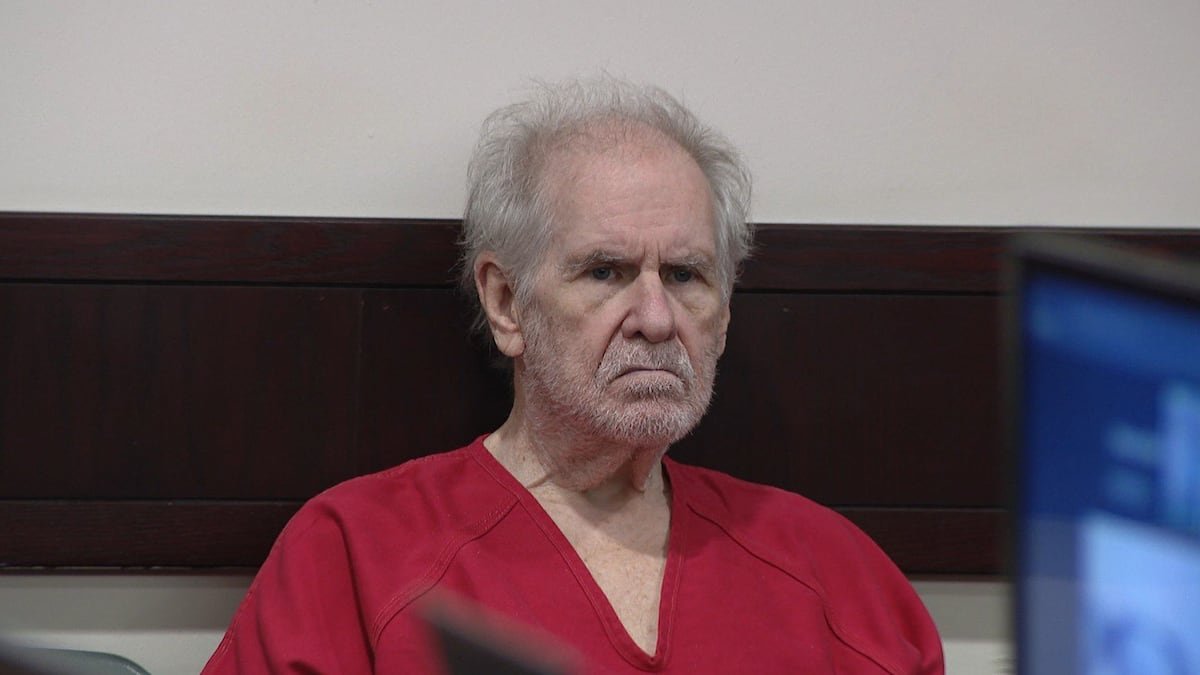
Robert Kessler has lingered in the Falkenburg Road Jail for nearly five years, longer than almost any other defendant awaiting trial. After half a decade incarcerated, the 74-year-old is blind, pale and frail.
Last week, he wore jailhouse red and carried a white walking stick as he entered a Tampa courtroom on the arm of a sheriff’s deputy. Wearing a perpetual frown, his thinning gray hair unkempt, he listened to a daylong preview of a murder trial that is weeks away.
Kessler is accused of killing Stephanie Crone-Overholts, whose dismembered remains washed up in McKay Bay, east of downtown Tampa, in November 2021.
Crone-Overholts, 47, had vanished days earlier while staying in Kessler’s North Tampa home.
The case, which has been delayed partly due to concerns over Kessler’s mental fitness to proceed in court, is set to go before a jury in late October.
As attorneys for the state and Kessler’s defense ready for trial, they appeared Thursday before a judge to argue about whether certain pieces of evidence and testimony should be thrown out.
Among the evidence were the words of three fishermen who told police they saw a man tossing items off the bridge in the days before the body parts surfaced.
Lazaro Castro had been fishing from a canoe with a friend Nov. 11, 2021. Near sunset, they noticed a car on the eastbound side of the 22nd Street Causeway bridge. A man sat in the car watching them from 20 to 30 yards away, he said.
“I turned the trolling motor on and I kind of get out of his line of sight,” Castro said in a recording of an interview with investigators that was played in court. “Because I was kind of weirded out.”
The man got out of the car and opened the trunk, Castro said. He pulled out plastic containers and black trash bags and tossed them into the water. They thought he was disposing of trash. Castro shouted at the man, but his friend told him to be quiet.
“I didn’t have protection on me and neither did he,” he told police.
The man rested his elbows on the side of the bridge, waiting for the items to sink, Castro said. But they floated. He got in his car and drove off.
Castro said he’d floated past one of the bins, glanced inside and saw “black gunk.” He went home. He didn’t think much of the incident until days later, when news reports surfaced about body parts in the bay.
Two other men who’d been out on the water similarly described seeing a man dropping objects from the bridge. When interviewing them, Tampa police Detective Matthew Kirkpatrick showed them each a single photo of Kessler. He asked if it looked like the man they’d seen.
Each said Kessler vaguely resembled the man. But in court, five years later, Castro identified Kessler with certainty as the man he’d seen.
Assistant Public Defender Maria Dunker argued the identification procedure was unduly suggestive. The fishermen didn’t get a detailed look at the man, she said, and the detective’s use of a single photo, rather than a lineup, was improper.
Kessler’s defense also argued that all evidence obtained in a search of his home should be tossed. When Tampa police first went to the small home off Bruce B. Downs Boulevard, they carried a search warrant allowing them to seize a specific cellphone tied to the case.
Body camera videos played in court showed the officers going to the home late one night after Crone-Overholts disappeared. They encountered Kessler in a van outside. His young daughter, whom he just picked up from a gymnastics class, was in the van with him. When the officers explained they had a warrant for his phone, he told them they could go inside, into a bedroom, where they’d find the phone on a nightstand.
The cameras recorded the officers and crime scene technician entering the home. They looked around. They found two cellphones, but not the one mentioned in the warrant.
As they lingered inside, looking at the clutter and playing with Kessler’s cats, they noticed small red stains on the wall. They believed the spots were blood.
Calls were made to detectives and prosecutors. Officers decided to back out of the home and await a new search warrant that would give them the authority to look for more than just the one phone.
The defense argued that the officers exceeded the scope of the warrant, while the state maintained the officers handled the search appropriately.
Other points of contention in Thursday’s hearing concerned whether the jury should hear that Kessler was a drug dealer or that Crone-Overholts used drugs.
There was also the issue of a text message she sent to her mother shortly before she disappeared. In the message, according to prosecutors, she wrote that she wanted to get away from Kessler.
“The guy I’m staying with suddenly had a change of heart because I won’t agree to let him teach me how to make meth,” she wrote. “I’m not joking. I need to leave here asap before something goes terribly wrong. He’s been on me for days (and) I’m not agreeing to do anything that’s going to put me in prison.”
Assistant State Attorney Scott Harmon told the judge he wanted the text to be part of the evidence. He said it would show that Crone-Overholts was afraid of Kessler and could rebut any claim that her death was a suicide or the result of self-defense.
Yet, the prosecutor acknowledged, Florida law regards such evidence to be hearsay, and thus inadmissible.
Hillsborough Circuit Judge Nick Nazaretian said he would rule on all the outstanding pretrial matters by the end of this week.
At the outset of Thursday’s hearing, Nazaretian said he was curious why the case had taken so long to get to trial. Attorneys for the state and defense explained that they had been ready to take it to a jury in 2023 when concerns arose about Kessler’s mental state.
After being examined by doctors, he was declared incompetent to proceed in court, a legal designation that essentially means a defendant does not have a rational understanding of the proceedings and is unable to assist in their own defense. He spent time in a state hospital before being deemed restored to competency.
Dunker explained that she continues to have concerns about Kessler’s competency, but a different judge, having listened to the input of psychological experts, ruled about a year ago that he was fit for trial.
Since then, no new concerns have arisen. Dunker noted, though, that Kessler has lost his eyesight since his arrest. She explained that his vision began to decline about a year after he was jailed. His hearing is “not the best,” Dunker said, but he can hear what is being said.
The defense attorney said she was trying to determine the appropriate accommodations for Kessler so that he could exercise his right to confront witnesses and challenge evidence in his trial. That might mean he will have assistance from a person who could quietly tell him about photos and other visual evidence being shown in court.
Kessler sat slouched and quiet throughout Thursday’s hearing. He appeared to tremble and placed his hands on his face amid the discussion about his blindness and mental state. During testimony, he occasionally rested his chin on the end of his walking stick.
He is charged with first-degree murder and abuse of a dead human body. If convicted, he will be sentenced to life in prison.
The trial is set to start Oct. 26.



