
Stay informed with free updates
Simply sign up to the Electric vehicles myFT Digest — delivered directly to your inbox.
CATL has developed a battery capable of allowing an electric vehicle to drive 1,500km on a single charge, the Chinese group claimed on Tuesday, as it challenges BYD for supremacy on range and charging speed.
The company’s latest version of its condensed Qilin battery has a greater range than the distance by road from London to Barcelona and marks a leap from the 1,000km limit of its previous edition.
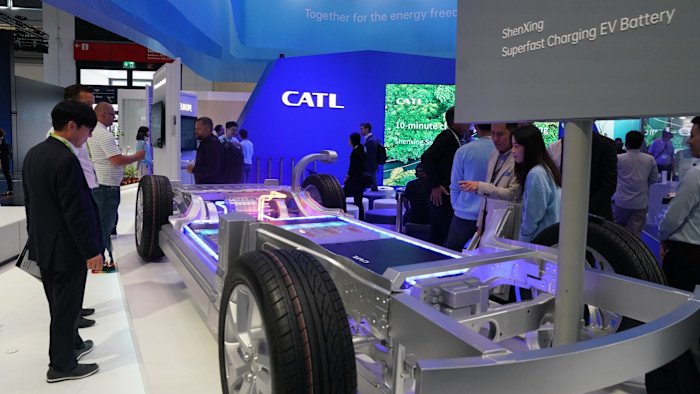
CATL also released an upgrade to its Shenxing, which can charge from 10 per cent to 98 per cent in six-and-a-half minutes, an improvement from the previous edition which charged from 5 per cent to 80 per cent in 15 minutes. It is also considerably faster than the nine minutes taken for BYD’s latest Blade battery, which was unveiled last month, to charge from 10 to 97 per cent.
CATL and BYD, which together account for more than half of the global EV battery market, are pouring billions of dollars into research and development, targeting innovations in cell chemistry and manufacturing.
“The boundaries of electrochemistry are still far from being reached, and the possibilities of materials science are still far from being exhausted,” Robin Zeng, CATL’s billionaire founder, told reporters and investors in Beijing on Tuesday.
The companies hope their technological advancements will help eliminate persistent consumer concern that EV batteries can take too long to charge, die on a long journey or fail to work in extreme heat and cold.
However, a sharp fall in battery costs, along with CATL and BYD’s rapid advancements, is helping to cement China’s dominance over the technology that is key to both EVs and energy storage systems.
CATL said it would expand investment to support the government’s build-out of battery swapping and charging infrastructure across China.
The company plans to build 100,000 charging and swapping stations, working with a group of Chinese carmakers, by the end of 2028. And it promised to better integrate charging and swapping stations into China’s electrical system.
CATL also said it would by the end of the year start mass producing sodium-ion batteries, a new cell technology that will help reduce reliance on lithium, cobalt and nickel.
CATL made the announcements ahead of the Beijing auto show, where 1,400 new car models will be on display.
Despite US-China tensions and concerns over the state of the Chinese economy, CATL has attracted renewed investor interest in recent weeks after the US and Israel’s attacks on Iran strengthened expectations of a long-term boost for clean energy.
Its Hong Kong-listed shares have risen more than 40 per cent this year and are up almost 140 per cent over the past 12 months.
Additional reporting by William Sandlund in Hong Kong



