
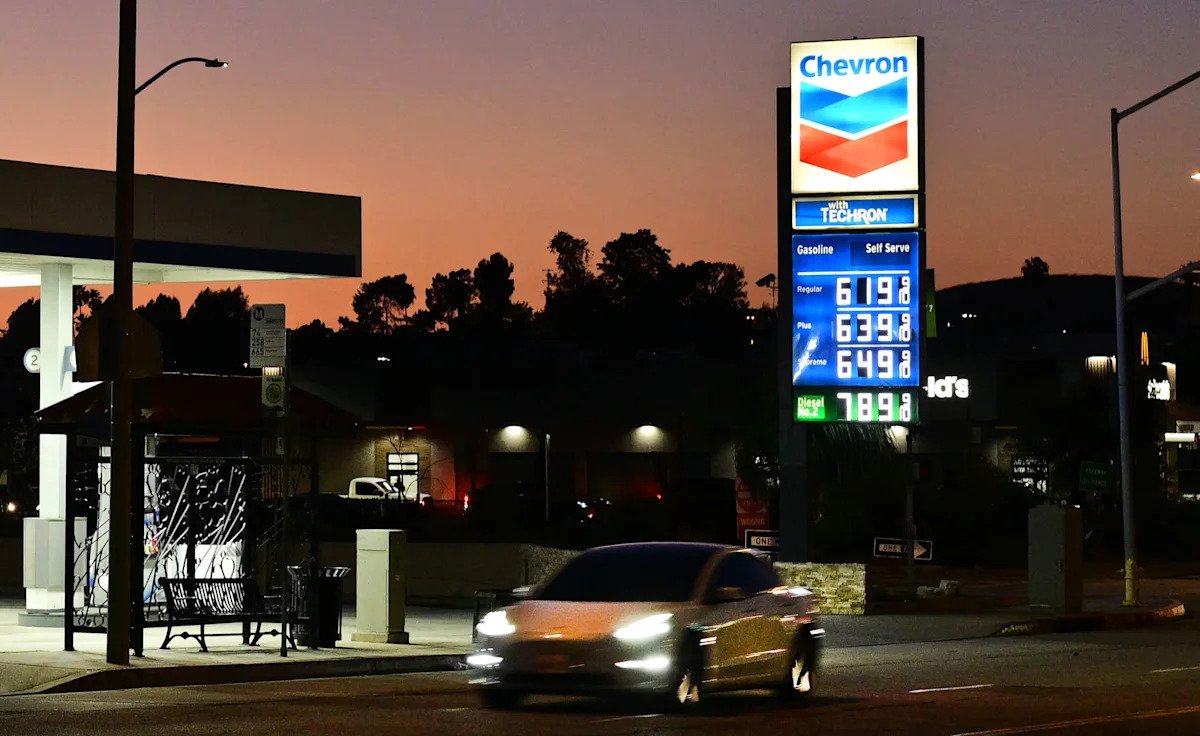
Americans have paid about $97 billion more for fuel since the Iran war started in late February, roughly $740 extra per household, according to CNN. President Trump says prices will come down after the midterms. The CEO of Chevron just said publicly he does not see how that happens quickly.
Mike Wirth, Chevron’s chairman and chief executive, spoke at a University of Texas at Austin energy conference on September 11. He told the audience that the mechanisms that helped absorb the oil supply shock earlier in the conflict have largely been used up, and that prices are more likely to rise than fall over the next few months.
What Wirth said about the oil market’s shrinking buffers
When the U.S.-Iran conflict began, the oil market had several ways to handle the disruption. Countries could release crude from strategic reserves. Commercial inventories could be drawn down. The U.S. eased restrictions on sanctioned crude stored on vessels at sea. Those measures helped limit the initial price spike.
“Those have largely now played out,” Wirth said. The energy system no longer has the buffers it had when the war began.
The loss of flexibility became more acute after attacks knocked out a major Saudi crude pipeline that had been bypassing the Strait of Hormuz. That single disruption put an estimated 2.5 million barrels of oil per day in limbo, tightening a market that was already running short on supply.
More Oil & Gas:
“It’s harder to envision a scenario where prices soften and quickly,” Wirth added. “I think the risks remain to the upside over the next few months.”
Wirth also said the Trump administration had discussed Ukraine’s strikes on Russian energy infrastructure and that Chevron had since seen fewer disruptions to its operations at Kazakhstan’s Tengiz oilfield, one of the company’s largest producing assets.
What prices look like at the pump right now
The average U.S. diesel price crossed $6 per gallon for the first time on September 10, as TheStreet reported. The Iran war squeezed supplies from the Middle East. Ukrainian drone strikes on Russian refineries took out more. By the time Wirth spoke on September 11, the national retail diesel price had hit a record $6.23 a gallon.
Gasoline prices came back up to about $4.32 a gallon. They had slipped below $4 for a stretch during the summer when oil pulled back from its March 2026 peak near $120 a barrel. That pullback is now over. Crude has been moving higher for weeks as attacks on shipping and energy infrastructure picked back up.



