
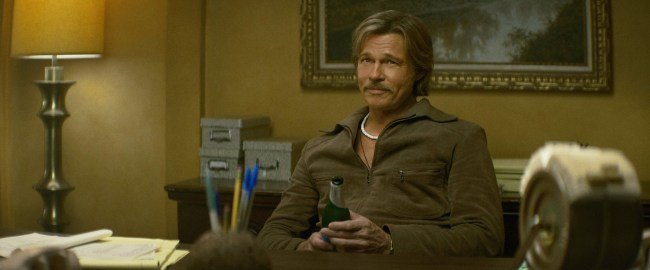
It cost a reported $200 million. It starred Brad Pitt, one of the last true movie stars. It was directed by David Fincher, a legendary auteur. It was written by Quentin Tarantino, one of the only cinema gods greater than Fincher. And it was released over the Thanksgiving holiday, one of the busiest times for moviegoing. Yet, “The Further Mis-Adventures of Cliff Booth” opened to just $4.16 million from 252 theaters domestically, all of them IMAX. That’s for the five-day Thanksgiving holiday period — its opening weekend number was $2.65 million. Globally, “Cliff Booth” earned $5.8 million from 528 locations.
On the one hand, that’s a respectable result given that “Cliff Booth” was playing on so few screens. (Regal and Cinemark refused to play the movie in their IMAX venues because it’s only available for two weeks.) It’s also true that Netflix doesn’t run on ticket sales — its fuel is subscribers, and a splashy film like “Cliff Booth,” which hits the service Dec. 23, helps Netflix retain customers and maybe, just maybe, attract a few new ones. But if movie theaters are important to Netflix and if Ted Sarandos’ newfound enthusiasm for them is sincere, why give “Cliff Booth” such a listless theatrical release?

Surely, Netflix was leaving money on the table. To extrapolate out from its IMAX grosses, “Cliff Booth” would have easily earned $20 million or more if it had a traditional wide release across more than 2,000 screens. And it doesn’t seem like it would have been so hard for Netflix to offer cinemas a longer window given its desire to have the film ready to stream on Christmas. (It’s nearly a month away.) If it had, Regal and Cinemark might have come on board, freeing up more screens. And when you look at where the overall box office was this holiday period — in the $220 million range, reportedly down roughly 25 percent year-over-year — a wider release of “Cliff Booth” could have helped the exhibition industry make up important ground.
For Netflix, putting “Cliff Booth” in IMAX was opportunistic. The film slid into a slot that was supposed to be occupied by Greta Gerwig’s “Narnia: The Magician’s Nephew,” which originally was slated to open in 1,000 IMAX screens. Instead, “Narnia” will debut in February, becoming Netflix’s first wide theatrical release and staying in cinemas for a minimum of 45 days. Moving Gerwig’s film left Netflix with IMAX screens that everyone else wanted. So why not put them to work for “Cliff Booth”?
Netflix has softened in its approach to theatrical exhibition, which is a good thing for the overall health of the business. It used to treat them as a grudging concession to awards rules mandating a theatrical run or as a way to lure over cinema purists like Scorsese and Cuaron, who needed Netflix’s money but weren’t ready to fully plunge into streaming. Now, it’s giving films like “La Bola Negra,” “The Mosquito Bowl,” and “Ink” exclusive theatrical releases of anywhere from 26 to 46 days. And future Netflix releases like “Narnia” and “Charlie and the Chocolate Factory” will get even longer theatrical runs that are equivalent to ones major studios are offering. It’s also reporting box office numbers for the first time, giving the movie business much-needed transparency. But there hasn’t been uniformity in the company’s release strategies, which creates confusion and makes the enterprise feel, well, half-hearted.
That’s a shame. “Cliff Booth” has the goods. It’s the sequel to “Once Upon a Time in Hollywood,” a classic. It earned solid reviews from critics and audiences. It’s got real star power behind it. In short, it’s a shaggy, darkly comic, brutally violent love letter to cinema — the kind of movie that is best enjoyed on the big screen. If only a few more theaters had been showing it.



