
Symons, T. L. et al. Projected impacts of climate change on malaria in Africa. Nature 651, 390–396 (2026).
Mukhtar, M. Pakistan’s lessons learned on climate change, malaria, and vector-borne disease transmission. APMEN https://apmen.org/resources/pakistans-lessons-learned-climate-change-malaria-and-vector-borne-disease-transmission (26 August 2023).
World Health Organization. World malaria report 2024: addressing inequity in the global malaria response. https://www.who.int/teams/global-malaria-programme/reports/world-malaria-report-2024 (2024).
World Health Organization. World malaria report 2025: addressing the threat of antimalarial drug resistance. https://www.who.int/teams/global-malaria-programme/reports/world-malaria-report-2025 (2025).
Laydon, D. J. et al. Climate change and malaria: a call for robust analytics. Preprint at medRxiv https://doi.org/10.1101/2024.09.16.24313623 (2025).
Romanello, M. et al. The 2024 report of the Lancet Countdown on health and climate change: facing record-breaking threats from delayed action. Lancet 404, 1847–1896 (2024).
Caminade, C. et al. Impact of climate change on global malaria distribution. Proc. Natl Acad. Sci. USA 111, 3286–3291 (2014).
Rice, B. L. et al. Vaccination to mitigate climate-driven disruptions to malaria control in Madagascar. Science 389, eadp5365 (2025).
Searle, K. M. et al. Long-lasting household damage from Cyclone Idai increases malaria risk in rural western Mozambique. Sci. Rep. 13, 21590 (2023).
Jones, N. & Sullivan, J. P. Climate change and global security. J. Strateg. Secur. 13, i–iv (2020).
Cohen, J. M. et al. Malaria resurgence: a systematic review and assessment of its causes. Malar. J. 11, 122 (2012).
Nissan, H., Ukawuba, I. & Thomson, M. Climate-proofing a malaria eradication strategy. Malar. J. 20, 190 (2021).
United Nations Environment Programme. Building resilience to disasters and conflicts: moving Asia Pacific towards resilience. UN environment programme https://www.unep.org/regions/asia-and-pacific/regional-initiatives/building-resilience-disasters-and-conflicts (2025).
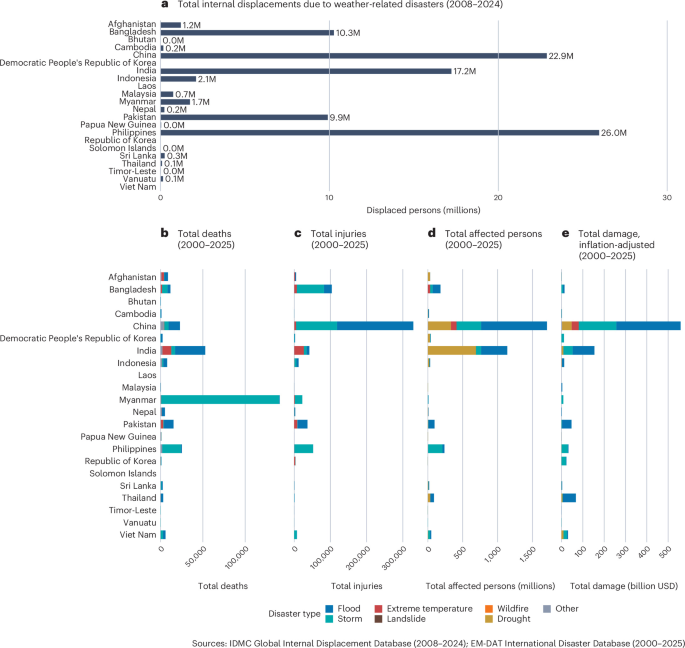
Internal Displacement Monitoring Centre & Norwegian Refugee Council. GRID 2023: internal displacement and food insecurity. iDMC https://www.internal-displacement.org/global-report/grid2023/ (2023).
Weiss, D. J. et al. Mapping the global prevalence, incidence, and mortality of Plasmodium falciparum and Plasmodium vivax malaria, 2000–22: a spatial and temporal modelling study. Lancet 405, 979–990 (2025).
Lek, D. et al. Malaria elimination challenges in countries approaching the last mile: a discussion among regional stakeholders. Malar. J. 23, 401 (2024).
Core Writing Team, Lee, H. & Romero, J. (eds.) Climate change 2023: synthesis report. ipcc https://www.ipcc.ch/report/ar6/syr/downloads/report/IPCC_AR6_SYR_FullVolume.pdf (2023).
Alcayna, T., Rao, V. B. & Lowe, R. Identifying the climate sensitivity of infectious diseases: a conceptual framework. Lancet Planet. Health 9, 101291 (2025).
Thomson, M. C. & Stanberry, L. R. Climate change and vectorborne diseases. N. Engl. J. Med. 387, 1969–1978 (2022).
Campagnolo, L., Campoleoni, G. A., Bosello, F. & Raitzer, D. A. Quantifying the economic costs of climate change inaction for Asia and the Pacific. SSRN https://doi.org/10.2139/ssrn.5184309 (2025).
Chen, S. et al. Review of drivers of forest degradation and deforestation in Southeast Asia. Remote Sens. Appl. 33, 101129 (2024).
Chu, Y. et al. Increasing climate variability makes Southeast Asian forests more vulnerable to anthropogenic and environmental stressors. Glob. Planet. Change 256, 105138 (2026).
Semenza, J. C., Rocklöv, J. & Ebi, K. L. Climate change and cascading risks from infectious disease. Infect. Dis. Ther. 11, 1371–1390 (2022).
Huning, L. S. & Brunner, M. I. Cascading impacts of natural disasters in a connected world. Science 391, 1320–1322 (2026).
Marlier, M. E., Connolly, R., Ma, Y., Jerrett, M. & Benmarhnia, T. Compound climate exposures and public health: a synthesis of research and future directions. Annu. Rev. Public Health 47, 305–323 (2026).
Nanditha, J. S. et al. The Pakistan flood of August 2022: causes and implications. Earths Future 11, e2022EF003230 (2023).
Devi, S. Pakistan floods: impact on food security and health systems. Lancet 400, 799–800 (2022).
Jan, R., Jan, M. & Jan, N. From 2022 to 2025: preventing the escalating health crisis of Pakistan’s floods. Ann. Glob. Health 91, 82 (2025).
Common Management Unit AIDS, TB & Malaria, Ministry of National Health Services, Regulations and Coordination. Malaria Technical Unit. CMU https://www.cmu.gov.pk/directorate-of-malaria-control/ (Ministry of National Health Services, Regulations and Coordination of Pakistan, 2025).
Seneviratne, S. I. et al. Weather and climate extreme events in a changing climate. In Climate Change 2021: The Physical Science Basis. Contribution of Working Group I to the Sixth Assessment Report of the Intergovernmental Panel on Climate Change (eds. Masson-Delmotte, V. et al.) 1513–1766 (Cambridge Univ. Press, 2021).
Espallardo, N. et al. A snapshot of catastrophic post-disaster health expenses after Typhoon Haiyan. Western Pac. Surveill. Response J. 6, 76–81 (2015).
Warr, P. & Aung, L. L. Poverty and inequality impact of a natural disaster: Myanmar’s 2008 cyclone Nargis. World Dev. 122, 446–461 (2019).
Dewi, S. P., Kasim, R., Sutarsa, I. N. & Dykgraaf, S. H. A scoping review of the impact of extreme weather events on health outcomes and healthcare utilization in rural and remote areas. BMC Health Serv. Res. 24, 1333 (2024).
Megersa, D. M. & Luo, X.-S. Effects of climate change on malaria risk to human health: a review. Atmosphere 16, 71 (2025).
Valente, M. et al. The impacts of extreme weather events on health services and systems: a systematic review of reviews. Public Health 250, 106049 (2026).
Wen, S. et al. Targeting populations at higher risk for malaria: a survey of national malaria elimination programmes in the Asia Pacific. Malar. J. 15, 271 (2016).
Matias, D. M. Local adaptation to climate change: a case study among the indigenous Palaw’ans in the Philippines. In Climate Change in the Asia-Pacific Region (ed. Leal Filho, W.) 173–187 (Springer International Publishing, 2015).
Boege, V. & Rakova, U. Relocation of Carteret Islanders to Bougainville: a special case of climate change adaptation. In Climate Change and Conflict in the Pacific (eds. Shibata, R. et al.) 85–101 (Routledge, 2023).
Aung, P. L. et al. Malaria among migrant populations in the Greater Mekong Subregion: a scoping review of evidence and implications for malaria elimination. Int. J. Equity Health https://doi.org/10.1186/s12939-026-02953-5 (2026).
Inthitanon, N. et al. Malaria control among Myanmar migrants in Thailand: a qualitative study of healthcare providers. Malar. J. 24, 160 (2025).
World Meteorological Organization. State of the climate in Asia 2024. https://library.wmo.int/viewer/69575/download?file=WMO-1373-2025_en.pdf&type=pdf&navigator=1 (2025).
Habibi, P., Moradi, G., Dehghan, H., Moradi, A. & Heydari, A. The impacts of climate change on occupational heat strain in outdoor workers: a systematic review. Urban Clim. 36, 100770 (2021).
Pooseesod, K. et al. Ownership and utilization of bed nets and reasons for use or non-use of bed nets among community members at risk of malaria along the Thai–Myanmar border. Malar. J. 20, 305 (2021).
Pulford, J., Hetzel, M. W., Bryant, M., Siba, P. M. & Mueller, I. Reported reasons for not using a mosquito net when one is available: a review of the published literature. Malar. J. 10, 83 (2011).
von Seidlein, L. et al. Airflow attenuation and bed net utilization: observations from Africa and Asia. Malar. J. 11, 200 (2012).
Thomas, S. et al. Overhead tank is the potential breeding habitat of Anopheles stephensi in an urban transmission setting of Chennai, India. Malar. J. 15, 274 (2016).
Pang, S. E. H., Slik, J. W. F., Chisholm, R. A. & Webb, E. L. Conserving Southeast Asian trees requires mitigating both climate and land-use change. Nat. Sustain. 7, 1313–1323 (2024).
Guerra, C. A., Snow, R. W. & Hay, S. I. A global assessment of closed forests, deforestation and malaria risk. Ann. Trop. Med. Parasitol. 100, 189–204 (2006).
Trew, B. T. et al. Novel temperatures are already widespread beneath the world’s tropical forest canopies. Nat. Clim. Chang. 14, 753–759 (2024).
Davidson, G. et al. Forest restoration and the zoonotic vector Anopheles balabacensis in Sabah, Malaysia. EcoHealth 21, 21–37 (2024).
Fornace, K. M. et al. Association between landscape factors and spatial patterns of Plasmodium knowlesi infections in Sabah, Malaysia. Emerg. Infect. Dis. 22, 201–208 (2016).
Fornace, K. M. et al. Environmental risk factors and exposure to the zoonotic malaria parasite Plasmodium knowlesi across northern Sabah, Malaysia: a population-based cross-sectional survey. Lancet Planet. Health 3, e179–e186 (2019).
Fornace, K. M. et al. Simian malaria: a narrative review on emergence, epidemiology and threat to global malaria elimination. Lancet Infect. Dis. 23, e520–e532 (2023).
Cuenca, P. R. et al. Epidemiology of the zoonotic malaria Plasmodium knowlesi in changing landscapes. Adv. Parasitol. 113, 225–286 (2021).
Fornace, K. M., Drakeley, C. J., Lindblade, K. A., Jelip, J. & Ahmed, K. Zoonotic malaria requires new policy approaches to malaria elimination. Nat. Commun. 14, 5750 (2023).
Maurel, M. & Tuccio, M. Climate instability, urbanisation and international migration. J. Dev. Stud. 52, 735–752 (2016).
Bharati, K. & Ganguly, N. K. Tackling the malaria problem in the South-East Asia Region: need for a change in policy? Indian J. Med. Res. 137, 36–47 (2013).
Santos-Vega, M. et al. Quantifying climatic and socioeconomic drivers of urban malaria in Surat, India: a statistical spatiotemporal modelling study. Lancet Planet. Health 7, e985–e998 (2023).
Kripa, P. K. et al. Impact of climate change on temperature variations and extrinsic incubation period of malaria parasites in Chennai, India: implications for its disease transmission potential. Parasit. Vectors 17, 134 (2024).
Surendra, H. et al. Mitigating risks of malaria and other vector-borne diseases in the new capital city of Indonesia. Nat. Commun. 15, 10575 (2024).
Ministry of Natural Resources and Environmental Sustainability. Malaysia’s climate commitments post-COP28. Malaysia Pavilion COP28 https://cop28.malaysiapavilion-cop.com/medias/press-release/8-feb-malaysias-climate-commitments-post-cop28 (8 February 2024).
Meankaew, P. et al. Application of mobile-technology for disease and treatment monitoring of malaria in the “Better Border Healthcare Programme”. Malar. J. 9, 237 (2010).
Sahavechaphan, N. et al. TanRabad: software suite for dengue epidemic surveillance and control. Int. J. Infect. Dis. 53, 118 (2016).
Rotejanaprasert, C. et al. Malaria epidemiology, surveillance and response for elimination in Lao PDR. Infect. Dis. Poverty 13, 35 (2024).
National Disaster Management Authority of Pakistan. NDMA disaster alert mobile app. (2025).
Myanmar Climate Change Alliance. Building capacities to address climate change in Myanmar: needs assessment and strategic actions. United Nations Myanmar https://myanmar.un.org/sites/default/files/2019-11/5_Building-capacities_Needs-Assessments-and-Strategic-Actions_ENG.pdf (2018).
Finch, E., Kucharski, A., Sim, S., Ng, L.-C. & Lowe, R. Climate variation and serotype competition drive dengue outbreak dynamics in Singapore. Preprint at medRxiv https://doi.org/10.1101/2024.09.17.24313793 (2024).
Jongdeepaisal, M. et al. Expanded roles of community health workers beyond malaria in the Asia-Pacific: a systematic review. PLOS Glob. Public Health 4, e0003113 (2024).
Ullah, W., Haijun, D., Shah, A. A., Alotaibi, B. A. & Rauf, A. Behind the floodwaters: violence against women, and disaster management capacities in flood-affected areas of Pakistan. Clim. Risk Manag. 46, 100653 (2024).
Chareonviriyaphap, T. et al. Report of the 2023 Asia Pacific Conference on Mosquito and Vector Control: “reimagining vector control—innovations for a changed world”. Malar. J. 23, 247 (2024).
Samsudin, N. A., Othman, H., Siau, C. S. & Zaini, Z. I. Exploring community needs in combating aedes mosquitoes and dengue fever: a study with urban community in the recurrent hotspot area. BMC Public Health 24, 1651 (2024).
Saeung, M. et al. Estimating malaria risk behaviours and their determinants among at-risk populations in a pre-elimination setting, Sisaket Province, Thailand–Cambodia border. Malar. J. 24, 293 (2025).
Alcayna, T. et al. Integrating anticipatory action in disease outbreak preparedness and response in the humanitarian sector. BMJ Glob. Health 10, e017721 (2025).
World Health Organization. Malaria surveillance, monitoring and evaluation: a reference manual. https://www.who.int/publications/i/item/9789240112476 (2025).
Messenger, L. A. et al. Vector control for malaria prevention during humanitarian emergencies: a systematic review and meta-analysis. Lancet Glob. Health 11, e534–e545 (2023).
Li, X. et al. Border malaria: defining the problem to address the challenge of malaria elimination. Malar. J. 22, 239 (2023).
Castro, M. C. et al. Examples of coupled human and environmental systems from the extractive industry and hydropower sector interfaces. Proc. Natl Acad. Sci. USA 113, 14528–14535 (2016).
The Global Fund Office of the Inspector General. Audit report: global fund grants to the Republic of Mozambique. The Global Fund https://www.theglobalfund.org/media/s3rmvrpb/oig_gf-oig-25-001_report_en.pdf (16 April 2025).
Directorate General of Disease Prevention and Control, Ministry of Health of the Republic of Indonesia. National action plan for acceleration of malaria elimination 2020–2026 (revision). MESA https://mesamalaria.org/wp-content/uploads/2024/08/Indonesia-National-Plan-for-Acceleration-of-Malaria-Elimination-2020-2026-Revision.pdf (2023).
Mimura, N. et al. Adaptation planning and implementation. In Climate Change 2014: Impacts, Adaptation and Vulnerability. Part A: Global and Sectoral Aspects. Contribution of Working Group II to the Fifth Assessment Report of the Intergovernmental Panel on Climate Change (eds Field, C. B. et al.) 869–898 (Cambridge Univ. Press, 2014).
Fornace, K. M., Diaz, A. V., Lines, J. & Drakeley, C. J. Achieving global malaria eradication in changing landscapes. Malar. J. 20, 69 (2021).
Ebi, K. L. Understanding the risks of compound climate events and cascading risks. Dialogues Clim. Change 2, 33–37 (2025).
Internal Displacement Monitoring Centre. Global Internal Displacement Database (GIDD). iDMC https://www.internal-displacement.org/database/displacement-data/ (accessed 11 May 2026).
Centre for Research on the Epidemiology of Disasters. EM-DAT: The International Disaster Database. emdat https://www.emdat.be/ (accessed 11 May 2026).
Government of Canada. The CMIP6 multi-model ensembles technical documentation. Canadian Climate Data and Scenarios https://climate-scenarios.canada.ca/?page=cmip6-technical-notes (2023).
Fornace, K. M. et al. No evidence of sustained nonzoonotic Plasmodium knowlesi transmission in Malaysia from modelling malaria case data. Nat. Commun. 14, 2945 (2023).
Hansen, M. C. et al. High-resolution global maps of 21st-century forest cover change. Science 342, 850–853 (2013).
Muñoz-Sabater, J. et al. ERA5-Land: a state-of-the-art global reanalysis dataset for land applications. Earth Syst. Sci. Data 13, 4349–4383 (2021).



