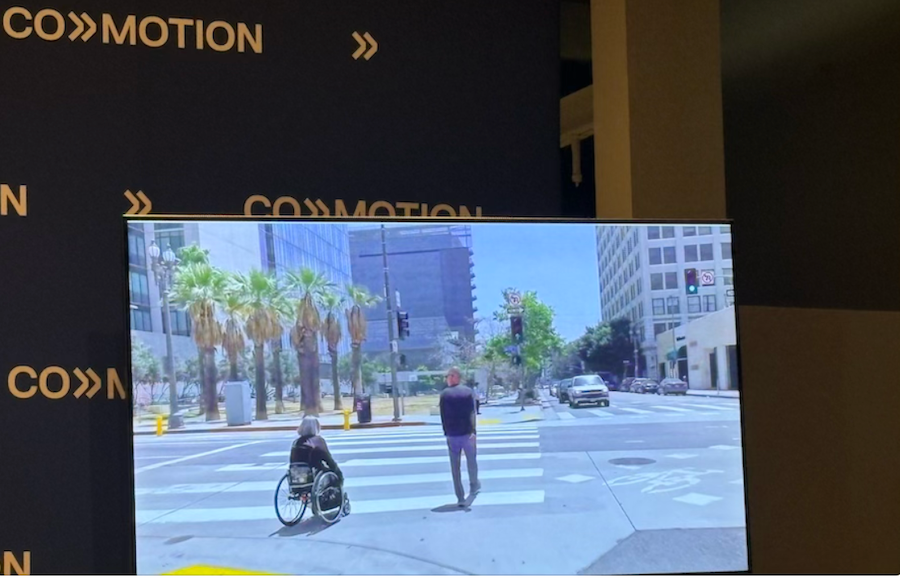
Mobility advocates hope that better inclusivity and accessibility to infrastructure in Los Angeles will last long after the 2028 Olympic and Paralympic Games are over—from modifying city streets to accommodate people with disabilities, to integrating housing with transportation hubs and linking neighborhoods via trails, transit and public spaces.
“The International Olympics Committee requires that all sidewalks within a mile of Olympic venues be in working order,” said Candace Cable, a consultant and Paralympian medalist in Games held in 1980, 1988 and 1992. “Will LA fulfill that mandate?”
Cable showed a video at CoMotion LA, held Nov. 18-19, of how she navigated LA city streets in her wheelchair. Often there were no curb ramps for getting on and off sidewalks. Other ramps forced her to face street traffic.
People with disabilities “should be central to the design story” of improving city infrastructure, she said.
Hilary Norton, executive director of FastLinkDTLA and former California Transportation Commission chair, noted that such solutions as lighted curbs or solar street lights are used in other countries. She also noted that the city spends millions every year dealing with lawsuits from people who suffered injuries due to inadequate street infrastructure.
Norton also spoke in a session about the Festival Trail, which would connect 14 Olympic venues and create 11 neighborhood hubs through a network of bus rapid transit, public spaces with amenities and walking/biking trails.
Many speakers emphasized lessons learned from the World Cup games that can inform both the Super Bowl and the Games in LA—and those also included discussions about creating public spaces.
Looking for quick answers on construction and engineering topics?
Try Ask ENR, our new smart AI search tool.
Ask ENR →
In Seattle, the sometimes indirect walk between the World Cup match and the train station was turned into a community experience by “activating” egress from the stadium, noted Reed Alvarado, WSP vice president for major event development—which could be as simple as having a DJ play music.
“We saw the World Cup as a test,” said Sam Morrissey, vice president of transportation for LA28. He and other panelists at the conference emphasized that collaboration with multiple agencies and tech partners such as Uber was vital for scenario planning for things like freeway messaging, transit connections and planning rideshare pickup and drop-off zones.
Balancing accessibility to venues with the necessary wide security perimeters is challenging, but also opens up opportunities for more “activation” of spaces they create, Morrissey added. Bike paths, street vendors and other street activities could take place in those spaces.
Heightened collaboration and inclusion of once and future stakeholders permeated the conference. HNTB Senior Vice President Phil Washington, former head of LA Metro, Denver International Airport and the Denver Eagle P3 project, noted an example of a bus turnaround road where the actual bus operators were not consulted about the radius needed to make it work. Operations and maintenance stakeholders of an infrastructure asset should sign off on the design, he said.
In public-private partnerships, the public sector always has some risk, even if the private partner agrees to take on some risks, Washington said.
Parag Agrawal, Mid-Ohio Regional Planning Commission senior director, added that “we have to modernize the procurement process … the public sector should focus on desired outcomes and let the private partner set the specifications.”
Mariah Ray, senior vice president of government affairs for Glydways, added that allowing for unsolicited proposals and holding industry knowledge-share sessions are ways to encourage innovation. “Delivery models are part of innovation, not just technology,” she said.
Transiting to the Future
Stacey Matlen, senior vice president of innovation at the Partnership for New York City, added that “challenge-based” procurements can also enable integration of technology into transportation systems. The Transit Tech Lab, which it launched with the Metropolitan Transportation Authority in 2018, has transit agencies identify specific issues and invite tech providers to offer solutions.
One challenge, to allow buses to travel faster in their lanes, led to adoption of three proposals: automated ticketing, digital simulation and predictive maintenance, which are all being used to this day, she said.
Along with ways to better procure contracts, the next federal infrastructure bill could also improve its grant programs, according to Andrew Rogers, managing partner at Boundary Stone Partners and a former deputy administrator and chief counsel of the Federal Highway Administration. An architect of the 2021 Infrastructure Investment and Jobs Act, he noted: “The focus of the next iteration should be less on having [a plethora] of new discreet funding programs.”
An issue with IIJA grant programs was that despite their specific requirements to qualify, months of negotiations might still follow the award, Rogers said. The funded project, which might be a simple bike lane or an EV charging station, “shouldn’t take six months to build.”
Specific regulations surrounding construction, such as the Davis-Bacon Act related to prevailing wages and the Buy America provision on material and equipment purchases, can accumulate to also hinder project progress, he noted, suggesting that occasional waivers of such rules be considered for the sake of the greater good.
Referring to the midterms, Rogers noted: “Affordability is a perfect parallel to transportation.”
Source: www.enr.com