
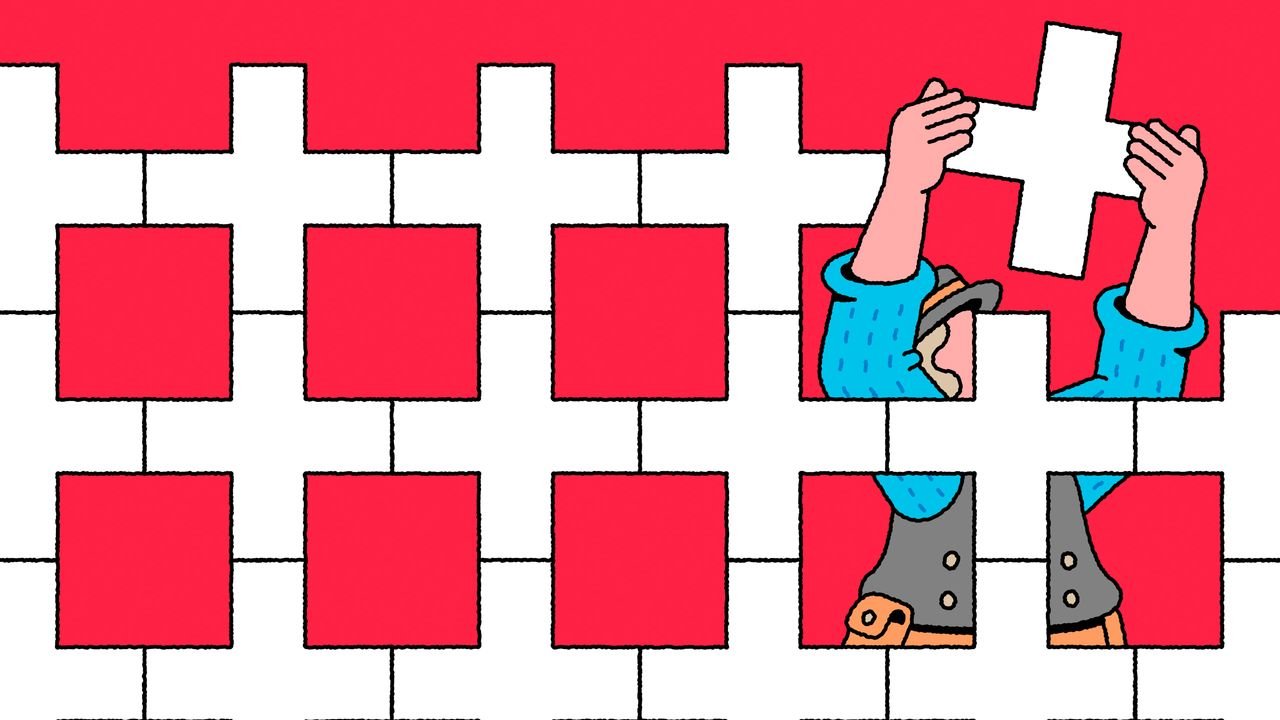
Switzerland is a direct democracy, in which every federal law is subject to popular vote. Like all of the country’s political parties, the S.V.P. convenes several times a year to define its positions on upcoming initiatives—including those which it has proposed itself, like the population measure. In the Maienfeld sports hall, rows of tables extended the length of a basketball court, and waiters weaved among them, balancing trays of coffee and nut torte. The seating arrangement was by canton (the equivalent, in Switzerland’s intensely federal system, of an American state), and centerpieces bore the coat of arms of each. Next to Geneva’s emblem of an eagle and a St. Peter key, three delegates shared a midmorning bottle of red wine.
Jars of honey that were being sold for a Party fund-raiser came with a warning label: “The EU wants in on our honey pots!” A hundred and twenty thousand Europeans moved to Switzerland last year, drawn by its high wages and quality of life, and four hundred thousand more commute from France, Germany, Austria, Italy, and Liechtenstein. It is this abundant migration which the S.V.P., a right-wing party, hopes to stop.
A brass band accompanied the singing of the national anthem, and then the Party’s vice-president, Thomas Matter, widely regarded as the pioneer of the population cap, took the stage. “Our citizens,” he announced, “have finally had enough.”
In a country as prosperous as Switzerland, one could be forgiven for asking, Enough of what?
The alpine traditionalism on display at Heididorf notwithstanding, Switzerland is among the most cosmopolitan nations in Europe. More than thirty per cent of its permanent residents were born abroad. The working-age population is increasing, owing to consistent employment growth and a steady flow of migrants who are often highly skilled and actively recruited, and tend to come from bordering countries that have significant cultural and linguistic overlaps with Switzerland. In 2002, these people gained the right to work and study in the country without a visa, and since then the nation’s population has swelled by nearly two million. Globally, Switzerland now has the sixth-highest G.D.P. per capita, according to the World Bank. (The United States ranks twelfth.) “Most countries in Europe are concerned about the other issue—depopulation,” Emilio Zagheni, the director of the Max Planck Institute for Demographic Research, told me.
The initiative, whose other official name is the Nachhaltigkeitsinitiative (Sustainability Initiative), is couched in the language of environmentalism. The S.V.P. proposes it as a solution to the consequences of unchecked growth: housing shortages and rising rents in cities, overcrowded trains, clogged roads and highways, and the loss of green space to new construction. In towns such as Maienfeld, the influx of mass tourism gives the impression that even remote valleys have become overrun. “Every major problem in our country,” Matter said from the stage, “is directly or indirectly linked to the incredible explosion of the population.”
Matter, who is sixty, comes from the medieval town of Sissach, twenty minutes by train from Basel. A career banker, he told me that he’d worked at Merrill Lynch in New York and London before returning to Switzerland, in 1994, where he co-founded a private bank. After he was implicated in an investigation into insider trading, he resigned. (Both Matter and the bank denied any wrongdoing, and the investigation into Matter was eventually dropped.) He later co-founded another bank.
Today, Matter is reportedly among the three hundred wealthiest individuals in Switzerland. On his YouTube series, “In the Swamps of Bern,” he sends out dispatches from the Swiss capital, where he serves in Parliament. In a recent episode (titled “Fake News About Mass Immigration”), he stood at a gleaming white enamel desk, like a news anchor, with printed notes before a green screen, and claimed that countries such as Ukraine, Bosnia, Georgia, and Albania were preparing to join the E.U., which would allow their citizens to move to Switzerland. Broad-shouldered and barrel-chested, he wears loose dark suits, with no tie, and carries himself with the confidence of someone used to reassuring clients with large fortunes.
Matter got into politics in the early twenty-tens, almost on a dare. During the lunch break at Maienfeld, as the waiters swapped nut torte for cheesy spätzle, he told me, “A lot of entrepreneurs, friends of mine, they always said, ‘Those politicians, they’re doing only stupid things.’ ” One day, he suggested sending one of their cohort to Bern. “And they said, ‘O.K., O.K., but not me. I have no time.’ And finally I said, ‘O.K., I will run for Parliament.’ And then I got elected.” Earlier this year, Matter helped lead another controversial initiative, to defund public media, which was defeated. His goal with the population cap, he said, is “quite simple”: “I know if we continue like this for the next twenty-five years, compared with the last twenty-five years, our country is kaputt.” He added, “My motivation in politics is really that my children can have the same country that I had.”
The S.V.P. represents a segment of the population which is straining against the very economic and international legal order that has underwritten the country’s extraordinary success. In Maienfeld, the Party’s president, Marcel Dettling, announced, “We don’t want to become a second Singapore!” Supporters of the initiative, rather than presenting Switzerland as a nation in terminal decline, describe a homeland that has been rendered unrecognizable—like a landscape after a heavy snowfall—by rapid growth. The quality of life was already world-class, so the benefits of the recent economic windfall can feel obscure. “There are no apartments anymore,” a woman named Sabrina told me, at another S.V.P. event. “And if there are they’re hardly affordable.” She was born in 1986, when the population was 6.5 million. Since then, life has simply become more challenging. “Things aren’t so carefree anymore,” she said. “Let’s put it this way.”



