
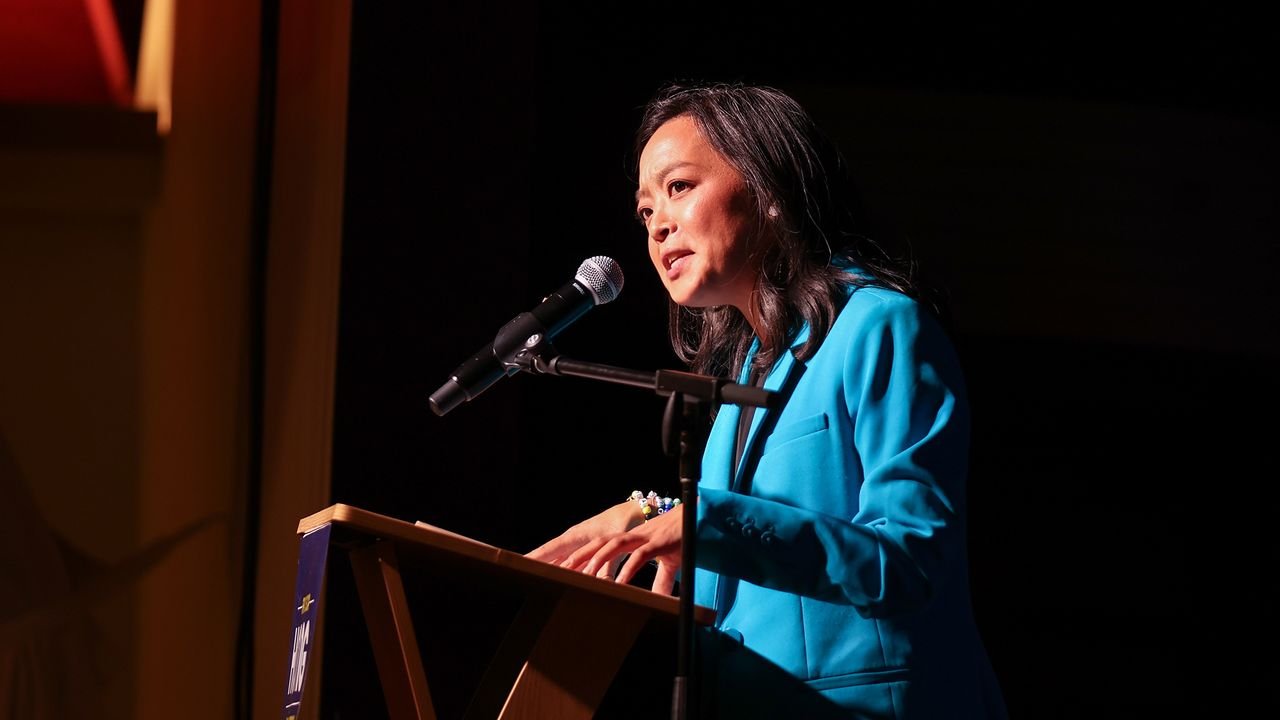
Outside of Presidential elections, most political races—even those on which the future of a party is said to hinge—are fiercely contested by only a small number of people. Last night, in Madison, Wisconsin, I pulled up a little late to what was supposed to be a victory party for Francesca Hong, a democratic-socialist state legislator whose rise in the state’s gubernatorial primary was understood to portend a major breakthrough for the left. There was no trouble getting inside. A music venue had been rented for a crowd of around seven hundred people, and the event had the scale, and the feel, of a punk show in a college town. An activist I was talking with sounded a little amazed that there were so many reporters in the press section. Then, as the results came in, the crowd thinned.
That Hong’s candidacy was treated as a big political-news event reflected the momentum generated by left-wing candidates this year, and the electoral risks that they are sometimes said to pose for the Democratic Party. The left had built on Zohran Mamdani’s victory in New York’s mayoral race, with victories by democratic socialists over incumbents in a few congressional primaries this summer, in districts in New York City and Denver. The question this month was whether the left could also win statewide primaries in less progressive states, and polls showed both Abdul El-Sayed, running for the Democratic nomination for Senate in Michigan, and Hong winning handily. Last Tuesday, El-Sayed, who is not a democratic socialist but who had campaigned with Bernie Sanders, Alexandria Ocasio-Cortez, and Elizabeth Warren, narrowly won his primary. Yesterday, Hong, who is a democratic socialist but had none of those endorsements, narrowly lost her race to David Crowley, the Milwaukee County Executive.
The final days of the Wisconsin contest were dominated by the presence of Tony Evers, the sitting governor who declined to seek another term. He travelled the state, saying loudly and a little grouchily that Democrats were on the verge of a huge mistake and that their voters needed to get their acts together. (To be fair to the voters, the Party’s elected officials had struggled to get their own act together; Crowley had initially dropped out of the race, after drawing little support, only to reënter as two other candidates who had been running well ahead of him—Sara Rodriguez and Mandela Barnes—dropped out.) Evers, a seventy-four-year-old former science teacher, is not normally the loudest or most confrontational of politicians, so his forcefulness got attention. When a reporter with the Milwaukee Journal Sentinel asked Evers whether Hong, then seen as the front-runner, would be able to beat the Republican Tom Tiffany, a pro-Trump congressman, in the general election, the governor eschewed partisan protocol and said, “Probably not.”
Was Hong, who lost to Crowley by a few thousand votes, unelectable? She had an interesting mix of strengths and weaknesses that made her a little different from a generic left-wing candidate. Raised in Madison by Korean-immigrant parents, she had dropped out of the University of Wisconsin and worked her way up in restaurants, from a dishwasher to the owner of a ramen shop, before running for the state legislature on a progressive platform supporting expanded unionization and a more skeptical view of the police. Early in the gubernatorial campaign, Hong had proposed a moratorium on data centers in the state, a politically perceptive choice that took advantage of public antipathy toward Silicon Valley billionaires and which reached far beyond her left-wing audience. (Politicians from the centrist Democratic governor of New York, Kathy Hochul, to the very conservative governor of Texas, Greg Abbott, have since taken up the anti-data-center banner.) But, unlike Mamdani, or El-Sayed, Hong wasn’t a natural on broadcast media, and, when reporters raised what seemed like performative old tweets of hers (she had denounced both Thanksgiving and fireworks), she could not straightforwardly explain or dismiss them. Instead, she wound up in the reduced and defensive position of insisting to Politico that, in fact, she loved Thanksgiving.
That the upper echelon of the Democratic Party’s left wing mostly stayed away from this race makes Hong’s defeat a little less significant; it also shows some savvy on the part of Ocasio-Cortez and Sanders. And the remarkably strong turnout of Democratic voters across these primaries is a very good sign for the Party’s prospects in November. Even so, the final stages of the race in Wisconsin this week offered some clarity about why neither part of the Democratic Party has yet been able to decisively beat the other.



