
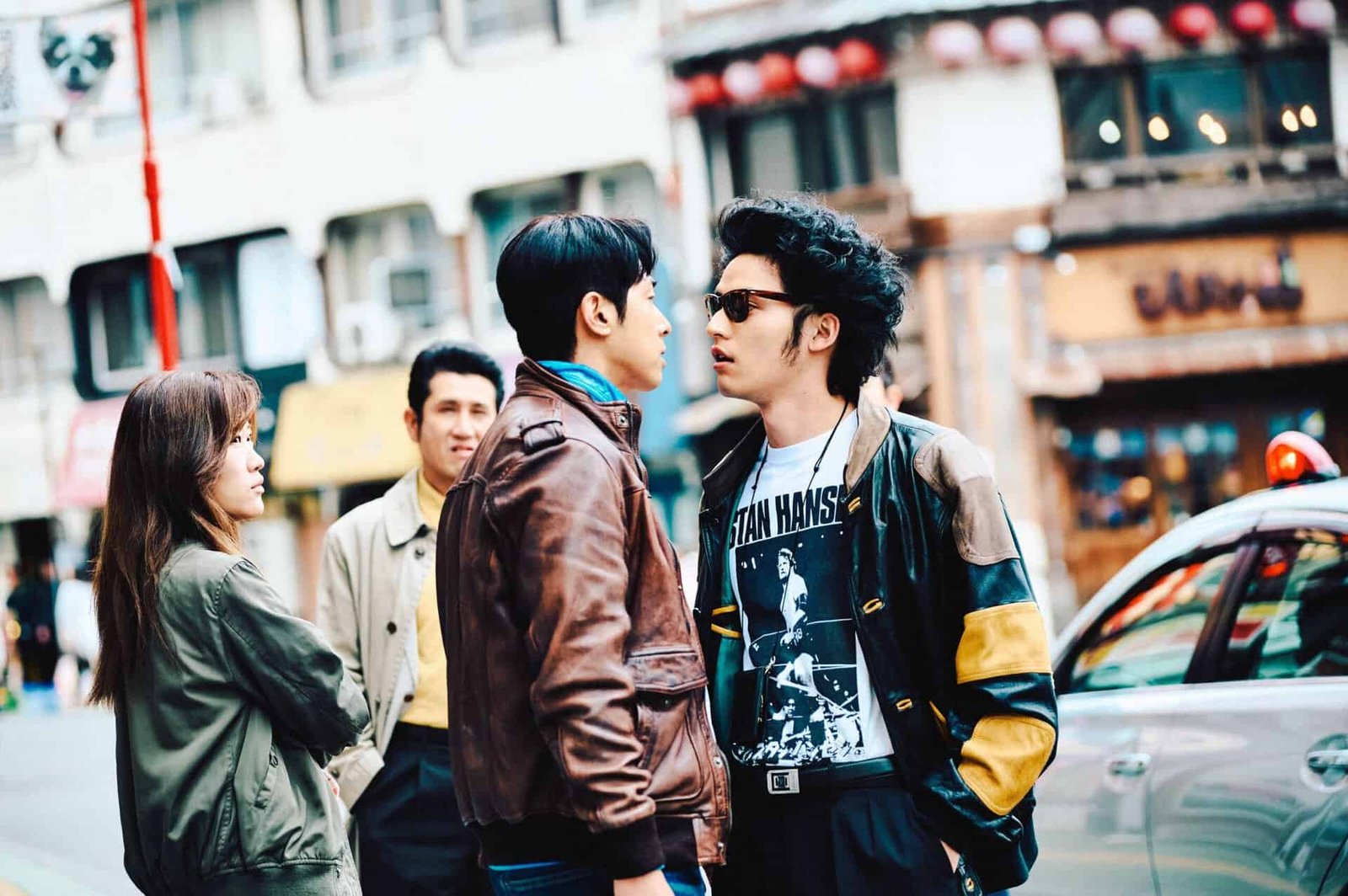
“TOKYO BURST: Crime City” is a 2026 action crime production from Japan and South Korea that extends the universe of the Korean “The Roundup” franchise through an original story set in Tokyo. Directed by Eiji Uchida and written by Uchida and Tatsuro Mishima, the feature runs for 116 minutes. Daisuke Miyachi and Andy J. Kim were involved in its planning and production, with Hidetomo Sugaya and Shuji Hayashi credited as producers. “The Roundup” star and producer Don Lee served as an associate producer. KADOKAWA and BY4M Studio handled distribution in Japan, while THE RAMPAGE performed the theme song, “BLACK TOKYO”. The production brought Japanese and Korean actors together for large scale location shooting across Shinjuku and Kabukicho.
“TOKYO BURST: Crime City” opened in Japan on May 29, 2026, before screening at the Fantasia International Film Festival.
Shiro Aiba is a rookie detective assigned to the Organized Crime Control Division of Shinjuku Central Police Station. Born and raised in Kabukicho, he grew up among the district’s shopkeepers, residents and yakuza groups before becoming the leader of a motorcycle gang. His familiarity with the area and his tendency to rely on physical force repeatedly create problems for his colleagues, some of whom suspect that his connections to the neighbourhood’s criminal organisations may compromise his loyalty.
When internationally wanted criminal Renji Murata is reported to be hiding in Kabukicho, Seoul police detective Choi Siwoo travels to Japan to assist with the investigation. Aiba and Choi initially clash but are ordered to work together as a series of organised robberies triggers a conflict between a violent yakuza group and Kabukicho’s largest host club organisation. Murata, his associate Kim Hoon, and an international criminal network become involved in the confrontation, while evidence gradually connects the violence to influential political figures and a broader conspiracy involving state power.
Shiro Aiba is a rookie detective assigned to the Organized Crime Control Division of Shinjuku Central Police Station. Born and raised in Kabukicho, he grew up among the district’s shopkeepers, residents and yakuza groups before becoming the leader of a motorcycle gang. His familiarity with the area and his tendency to rely on physical force repeatedly create problems for his colleagues. Some even suspect that his connections to the neighbourhood’s criminal organisations may compromise his loyalty.
When internationally wanted criminal Renji Murata is reported to be hiding in Kabukicho, Seoul police detective Choi Siwoo travels to Japan to assist with the investigation. Aiba and Choi initially clash but are ordered to work together after information suggests that Murata’s organisation is operating in the district. Meanwhile, a series of organised robberies triggers a conflict between a violent yakuza group and Kabukicho’s largest host club organisation. Murata, his associate Kim Hoon and an international criminal network become involved in the confrontation, while evidence gradually connects the violence to influential political figures and a broader conspiracy involving state power.
Allow me to start with a political undertone that is actually hidden beneath all the slapstick. In an era when tensions between Korea and Japan remain quite intense, with productions from the former occasionally adopting a rather accusatory stance, Eiji Uchida attempts to present a form of reconciliation. The inclusion of one of Korea’s most popular franchises is indicative of this approach. Admittedly, the impact would probably have been even more intense if Don Lee had appeared on screen, although U-KNOW Yunho is evidently more fitting as Koshi Mizukami’s partner.
Nevertheless, the way the two protagonists begin with an antagonistic relationship but soon become dedicated partners highlights this approach. The scene in which they both sing the theme song from “Linda Linda Linda”, a Japanese production starring Korean superstar Bae Doona, is the prime example. Lastly, the fact that both the villains and the heroes consist of one Japanese and one Korean character cements this element.
Beyond this aspect, the combination of Takashi Miike’s anime like style of cop comedy, although tamer in its presentation, and the intricate case carries the movie from beginning to end. The investigation eventually involves politicians, chaebols, authorities, hosts and casinos. The presence of the Korean detective Choi Siwoo helps restrain the first element, since the production frequently comes close to going overboard but never actually crosses the line.
At the same time, corruption gradually becomes a central part of the story. This includes the frequently dubious connections between the Japanese police and the yakuza, adding more depth to the narrative. Furthermore, the case allows for the presence of several appealing cast members, including Kiyohiko Shibukawa and Pierre Taki, who definitely add to the entertainment the movie offers.
Apart from that, the combination of comedy and action works particularly well, additionally because several extraordinarily powerful individuals appear on both sides. Their clashes are nothing less than impressive. In particular, the confrontations between the two protagonists and the two villains, which occur twice, are among the highlights. One of them also takes place in a rather meaningful location. Both sequences are as intricate as they are brutal.
In general, the presence of the four central actors is among the movie’s strongest traits. Koshi Mizukami as Shiro Aiba, U-KNOW Yunho as Choi Siwoo, Sota Fukushi as Renji Murata and Uhm Ki-joon as Kim Hoon all deliver convincing performances. The chemistry within both duos is impressive, while the scenes featuring all four performers are particularly enjoyable to watch. Overall, the casting is definitely among the production’s best qualities.
Hideo Yamamoto’s cinematography captures the various settings in Shinjuku and Kabukicho with gusto, while also contributing to the slapstick approach. His work benefits significantly from the excellent production design, particularly in the presentation of Kabukicho and the increasingly chaotic action settings. The editing, meanwhile, expectedly results in a frantic pace that suits the story perfectly.
“TOKYO BURST: Crime City” is action comedy at its best, with the collaboration between the Japanese and Korean cast and crew proving ideal. At the same time, the production perhaps presents one possible direction for the mainstream cinema of both countries.



