
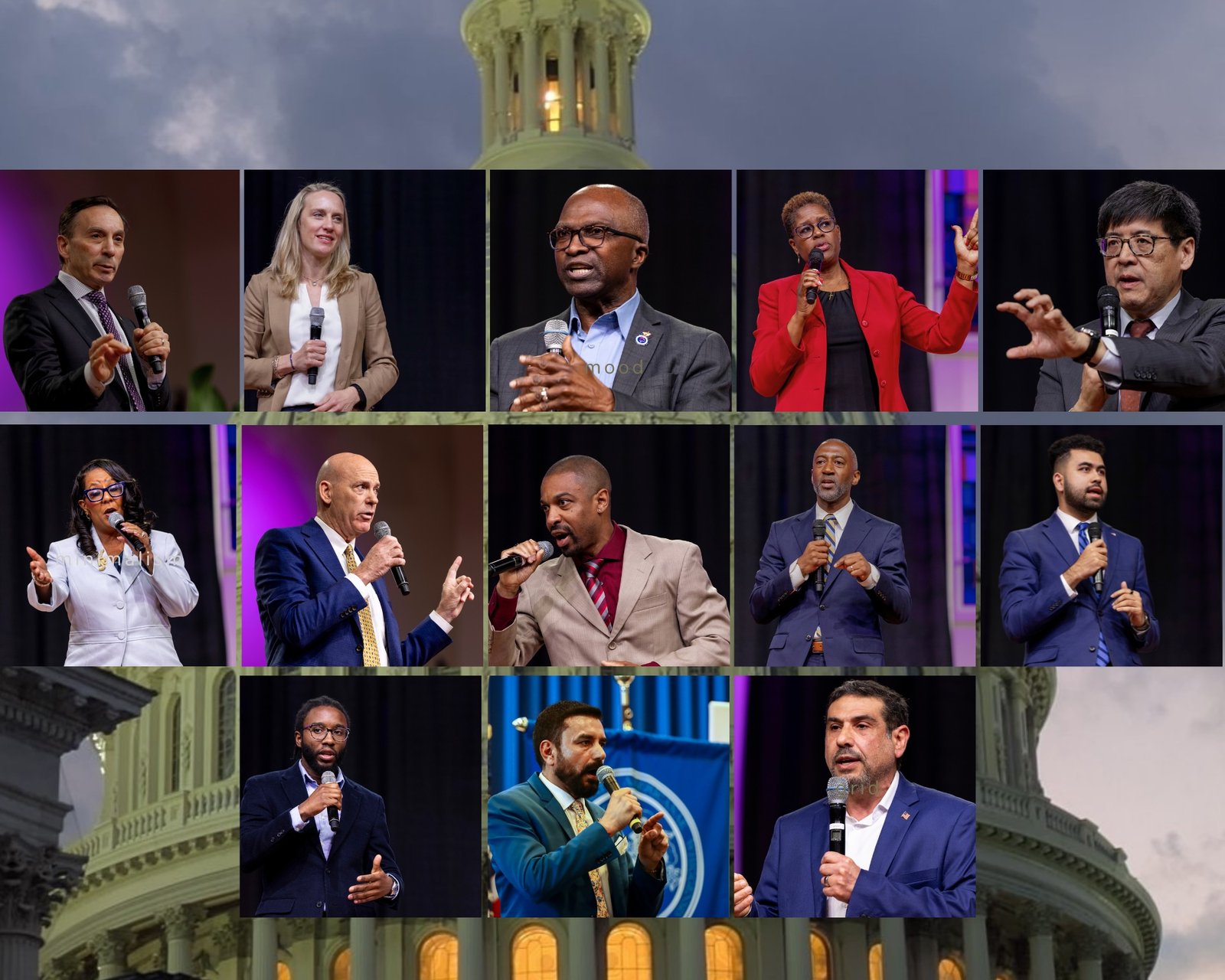
PRINCETON — Eleven of the 13 Democrats running to replace the retiring Rep. Bonnie Watson Coleman in the 12th Congressional District squared off Monday night for a debate at Princeton University, where the questions reflected the youthful priorities of the moderators and packed audience at the student-led event.
Candidates fielded questions on how they would fend off federal interference in campus protests, protect undocumented students from federal immigration enforcement in schools, boost voter turnout in a country where teens and twentysomethings consistently have the lowest voting rates, and expand affordable housing at a time where the high cost of living and student debt keep young adults living longer with their parents.
Over 90 minutes, moderators got just eight questions in, an unusual debate dilemma in a state where most incumbents have no primary challengers and those that do have just a few. The race in the 12th District, though, is so crowded that organizers joked they could barely fit everyone on stage, with the 11 candidates sitting in two rows.
The loaded field of candidates prompted a unique question from the audience: “If not yourself, is there another candidate on this stage that you would vote for?”
Most candidates dodged, with some insisting they were the best choice and others diplomatically applauding the entire roster of rivals.
The debate was sponsored by the American Whig-Cliosophic Society, the university’s NAACP chapter, and Vote100. You can watch it here. Two candidates — Assemblywoman Verlina Reynolds-Jackson and East Brunswick Mayor Brad Cohen — did not attend.
June 2 is primary day, with a six-day early voting period starting May 26. Republican Gregg Mele, an attorney, is running unopposed in the district’s GOP primary.
Watson Coleman, a Democrat, is retiring in January after serving six terms in Congress.


Affordable housing
Most candidates agreed the federal government should play a more active role to spur more construction of affordable housing.
Adam Hamawy, a plastic surgeon, said the Faircloth Amendment should be repealed. That’s a 1998 federal law that capped how many public housing units federal authorities could build.
Squire Servance, a patent and life sciences attorney, suggested withholding federal funds from municipalities that flout their affordable housing requirements.
Several candidates said they support expanding tax credits such as for first-time homebuyers, including Plainfield Mayor Adrian O. Mapp, fitness business owner Kyle Little, former Middlesex Councilman Matt Adams, and Samuel Wang, a neuroscientist and Princeton University professor.
Wang and Shanel Robinson, a Somerset County commissioner, said they’d enlist faith-based groups to help build affordable housing in their communities.
Jay Vaingankar, an energy adviser in the Biden White House, said he would repeal President Donald Trump’s tariffs on things like steel and lumber that make construction difficult and costlier, prevent private investment companies from buying properties, and stop deporting immigrant workers who are part of the construction industry’s labor pool.
Sue Altman, former head of the New Jersey Working Families Alliance who was Sen. Andy Kim’s state director until January, seconded banning corporations from snapping up housing as investment properties. She also supports building on vacant or underused sites and incentivizing affordable housing near shopping centers and transit hubs.
Sujit Singh, a technology consultant, supports creating incentives to reduce building costs, such as by expanding modular housing.
Trenton entrepreneur Elijah Dixon said he supports the government itself building more affordable housing.
“All across the world, there are systems called social housing where places in Europe, Asia, Africa, you have federal governments that are not only subsidizing but they are directly building housing units, and it’s at a much more affordable rate because they’re cutting out the profit incentive that many of the developers and corporate landlords and others within the industry have essentially entrenched within the process,” Dixon said.

Voter turnout
The candidates had plenty of ideas to increase voter participation and turnout.
Several blasted the Safeguard American Voter Eligibility Act, which is known as the SAVE Act. That’s a GOP-led federal bill that would expand voter identification requirements.
Adams said he would fight gerrymandering, pointing to the zigzagging borders of the 12th District, which includes towns in Mercer, Middlesex, and Somerset counties, plus Plainfield.
“Why is it like that? I wonder, right?” he said, as the audience chuckled. “We kind of got to think about why that is, and what we’ve done, and what we can do to correct it, because are we giving everyone one vote?”
Adams and Hamawy said they would make Election Day a federal holiday to remove barriers to voting. Hamawy and Singh said they would also make voter registration automatic at age 18.
Many said they would work to reduce money in politics, complaining that the system now favors wealthy, well-connected candidates.
“We should also explore programs like democracy vouchers, where every American citizen is mailed a check that’s funded by taxes on the billionaires, where they can decide where their small dollar investments go, because that’s the better way to fund campaigns, through public financing,” Vaingankar said.
Artificial intelligence
All of the candidates agreed that regulating artificial intelligence would be a top priority.
“Food is regulated by the federal government. Drugs are regulated by the federal government, flights, roads, all these are regulated by the federal government,” Wang said. “We need a department of the federal government that will look ahead and find ways to regulate AI in a responsible manner, to make it serve us.”
Singh called for more AI regulations in school, so that students’ reliance on technology doesn’t cause them to lose basic skills. He also supports requiring companies to build and cover the costs of energy sources for their data centers.
Adams, a retired U.S. Army Reserves lieutenant colonel, warned inaction on AI would have dire consequences.
“We need human intervention at all spaces, because the end of humanity is a possibility,” Adams said.

One thing
Asked to name one core policy they would implement if elected, the candidates offered a wide range of priorities.
Singh and Robinson said rising housing costs and increasing unaffordability are their top concerns. Altman supports Medicare for all, while Adams said AI regulation is his top concern.
Servance listed more aggressive oversight of the Trump administration, and Wang said he would work to restore Congress’ legislative authority and power.
“A lot of the difficulties that we’re seeing, a lot of the attacks on our system, all stem from a runaway executive or a runaway judiciary,” Wang said.
Little listed his core goal as revitalizing Trenton. Dixon said attacking structural inequities is his driving mission.
Vaingankar said he would abolish U.S. Immigration and Customs Enforcement.
Mapp called education “the great equalizer” and said he would work to eliminate educational inequities.
Hamawy pledged to “unrig the economy” by taxing billionaires more and “restoring the middle class.”
GET THE MORNING HEADLINES.



