
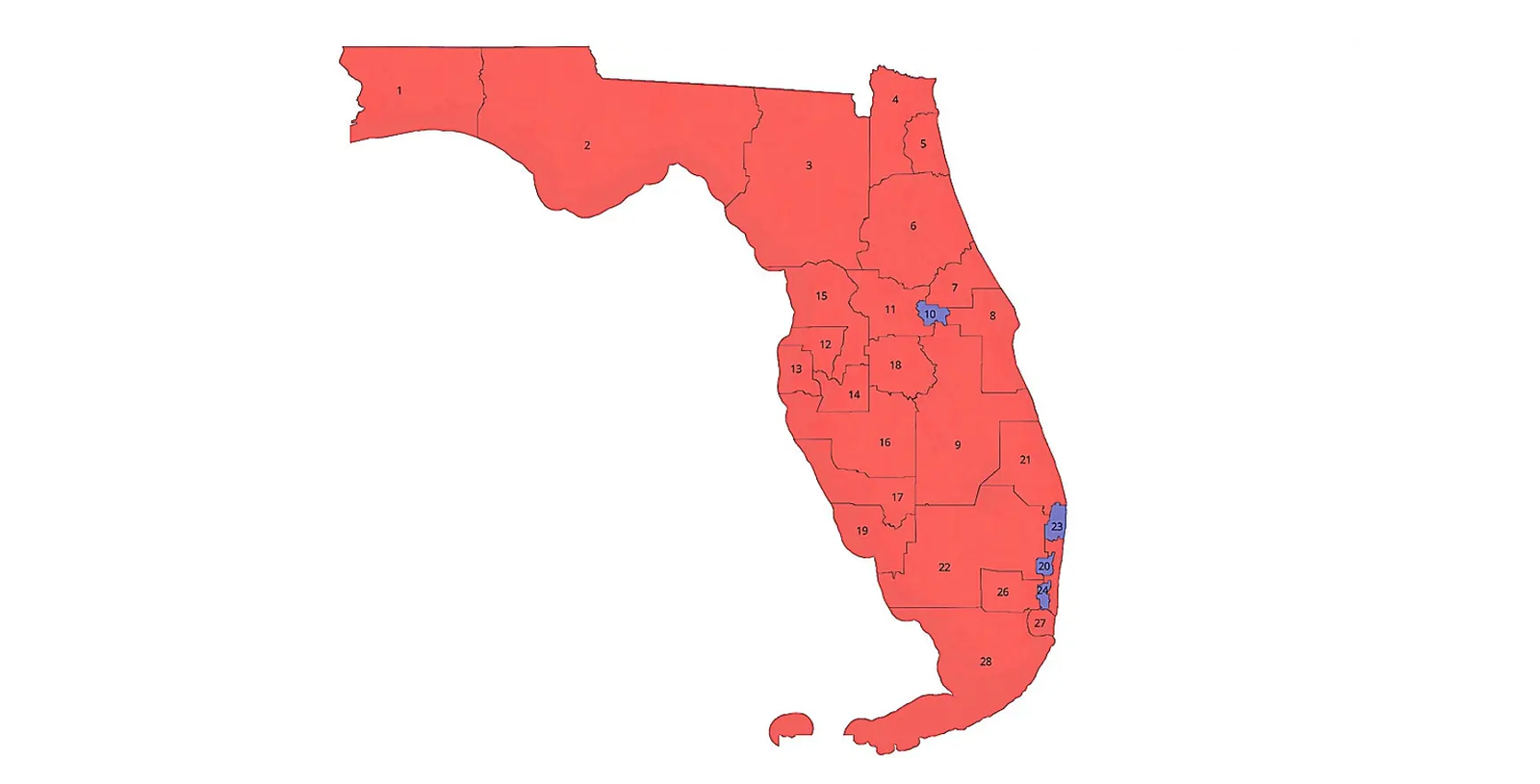
Gov. Ron DeSantis and the groups suing him over Florida’s new congressional map can agree on one thing: The DeSantis-drawn districts violate parts of the state Constitution — but they sharply disagree about what that means.
DeSantis says those portions of the Constitution are invalid. His challengers say otherwise.
“We believe the [Fair Districts Amendment] does not apply,” the governor’s top elections lawyer, Mohammad Jazil, told senators during a committee hearing last week. They argue the state’s anti-gerrymandering amendments, overwhelmingly adopted by voters in 2010, are void because of a recent U.S. Supreme Court ruling and a legal theory pushed by the governor.
The argument features hesitant Republican lawmakers, an explosion of litigation, and the strange agreement between the governor’s office and the plaintiffs decrying them that Florida’s Constitution is being flouted.
But the main controversy surrounds the partisan nature of the redrawn districts, which Florida’s Fair Districts Amendments ban:
- A mysteriously colored red-and-blue proposal leaked to Fox News,
- Four extra GOP seats,
- The sole map-maker admitting to employing partisan data,
- The map evolving from President Trump’s partisan call for mid-decade redistricting.
In hopes of padding the GOP’s slim congressional majority, Trump kicked off the unusual mid-decade redistricting debate by telling Texas Republicans to redraw their map — setting off a nationwide political cascade. At least eight other states have since announced or passed new maps to either bolster or counteract Trump’s Republican movement.
Although the battle began over the legality of redrawing lines ahead of new Census data, in Florida, it’s morphed into a war over whether the state Constitution’s Fair Districts Amendments can be fully ignored.
What are the Fair Districts Amendments? What’s the argument?
Adopted by 63% of voters, these anti-gerrymandering amendments ban drawing lines to favor a political party, require racial minorities to be considered in redistricting, and demand compact districts.
But a U.S. Supreme Court decision last week threw that second prong into sharp relief. In the landmark Louisiana v. Callais ruling, the justices raised the bar for race-based redistricting — reworking federal language in the 1965 Voting Rights Act mirrored in the Fair Districts’ racial requirements.
This is what DeSantis’ argument hinges on.
Claiming “nonseverability,” DeSantis believes that because one provision of Fair Districts could be voided (although a court has yet to decide on that), the entire amendment is invalid.
“Our assessment … is [the prongs] work together, they can’t be severed,” Jazil said. “You’ve got a provision that was conceived, approved, and structured in a way where it all works together.”
Elections attorneys aren’t so sure.
“The provisions have to be inextricably intertwined,” Barry Richard, a top attorney who helped put the Fair Districts Amendments on the 2010 ballot, told the Phoenix.
Richard, best known for representing George W. Bush during the 2000 presidential recount, referenced one of the key requirements for a court to trash the entirety of a statute or amendment.
“And those provisions [in the FDA] are all independent,” he continued. “The first thing in Fair Districts is, you can’t pass a map which is intended to favor or disfavor a political party — that has nothing to do with racial gerrymandering.”
Elections law attorney Marc Burton, former general counsel to the Miami-Dade Democratic Party, echoed Richard. He pointed to a similar 1999 Florida Supreme Court case in which one provision of a citizen-led amendment to impose term limits was federally struck down. State officials wanted the whole thing to be tossed out.
The court refused.
“When voters approve a constitutional amendment, courts give that amendment heightened deference and try to save as much of it as possible,” Burton said. The governor’s office has a tall task ahead of it: Proving the race provisions of the FDA are unlawful, and that the partisan gerrymandering ban depends on that race provision, he continued.
“In my view, it clearly doesn’t.”
DeSantis isn’t the first governor to try and strike down a citizen-passed ballot initiative. The 1999 case erupted under Democratic Gov. Lawton Chiles, and Republican Gov. Jeb Bush attempted three times to subvert citizen-passed amendments: once through a separate and contradictory initiative petition — which passed — and twice through the legislative process, which failed.
Jazil and the governor’s office directed the Phoenix’s questions to the Florida Department of State, which declined to comment on pending litigation. The DOS secretary is appointed by the governor.
‘Unconstitutional’
Elections attorneys aren’t the only skeptics. The DeSantis map, which enjoyed party-line support in the state House, eked through the Republican-dominated Senate on a 21-17 vote.
The most vocal GOP critic was state Sen. Jennifer Bradley, a Fleming Island Republican.
“[The map] rests on a legal theory that the Supreme Court has not even opined on or heard, that the Fair Districts Amendments would be entirely voided,” Bradley said during a committee hearing. She added that while she’d like to wait for an advisory opinion on the amendments’ effects, right now she sees it as illegal.
“That’s a big deal,” she said. “I can’t do it. It’s just unconstitutional.”
State Sen. Don Gaetz, the Crestview Republican who sponsored the map in the upper chamber, expressed similar concerns — namely, that the map violates Fair Districts, which he believes should remain in effect.
“I think it does [run up against the Fair Districts Amendment],” he told a Phoenix reporter, responding to questions about the partisan nature of the map. “The governor’s argument is that the Fair Districts Amendment ought to be considered as inconsistent with the Equal Protection Clause of the [U.S.] Constitution.”
But he doesn’t think the issue “obviates” all of Fair Districts.
Advocacy organizations have filed three lawsuits against the DeSantis administration over the governor’s map. All allege violation of Fair Districts, all have been brought in state trial court in Tallahassee, and all were filed within two days of the governor signing the measure into law.
The lawsuits are asking for the map — which takes effect for this year’s congressional elections — to be found unconstitutional. They want the map approved in 2022 to be used instead.
The plaintiffs, including Common Cause, the League of Women Voters, the UCLA Voting Rights Project, and Equal Ground, say they violate all three prongs of the FDA: the partisan, racial, and compactness provisions.
Independent Journalism for All
As a nonprofit newsroom, our articles are free for everyone to access. Readers like you make that possible. Can you help sustain our watchdog reporting today?



