
Ever since I was a kid, I’ve always loved those TV shows that tell us what a wild place nature can be. Jacques Cousteau, Marlin Perkins, the “National Geographic” specials — those were all appointment TV in my parents’ house.
Just the other day, one of my friends passed along a really wild Florida nature story. It’s about a type of moth, a rare one. It’s so rare that the only scientist to study it considered it to be long extinct.
But then it turned out that the winged insect he’d dubbed “Cicinnus albarenicolus” or “white sand dweller,” isn’t extinct after all. That’s the good news.
This moth has been here for millions of years. They were here long before most of our 23 million residents arrived.
“It’s a cool moth,” the moth’s discoverer, Ryan St. Laurent of the University of Colorado Boulder, told me. “And it’s definitely something that’s unique to Florida.”
The bad news is that the habitat where the moth lives is just about as endangered as can be.
“It’s the rarest ecosystem in Florida,” said Clay Henderson, a longtime Florida conservation activist and author of THE history of Florida conservation programs, “Forces of Nature.” “And there’s no real protection for it.”
Remarkably oddball creatures
Just as Florida has a lot of oddball humans — guys who will toss a gator through a drive-through window — it has a lot of strange-looking animals. The roseate spoonbill, for instance, with its pink feathers and a bill that looks like a table utensil.
We also have a lot of unusual insects. And no, I am not talking about flying cockroaches. Well, not ONLY the flying cockroaches.
The antlion, for instance, is pretty weird. So is the giant water bug, aka “the toe biter.” And of course, we can’t forget the ever amorous lovebug, cursed by millions of motorists and beloved by car wash proprietors.
To see something truly amazing, though, look at our butterflies and moths.
Take the Schaus’ swallowtail butterfly, for instance. It’s as big as a man’s hand. Its wings are a deep chocolate brown, striped in yellow with a dramatic dash of blue. And it has the rare ability to stop suddenly in midair, then fly backwards to flee from predators, sort of like a Florida politician fleeing reporters.

The white sand dweller moth isn’t nearly as spectacular a specimen. It most closely resembles a fragment of an autumn leaf or a shred of tree bark. But that’s the key to its success: It knows how to hide.
“It’s a pretty big moth,” said Akita Kawahara, director of the McGuire Center for Lepidoptera and Biodiversity at the Florida Museum of Natural History in Gainesville. “For it to have gone undiscovered for so long is pretty remarkable.”
St. Laurent began a dozen years ago looking at museum specimens of the moth. There weren’t a lot of them — just 20 or so, the last one collected in the 1960s.
After doing his own examinations, he arranged a genetic analysis. That proved that these moths were a distinct species, not part of a more common one.
Because no one had collected one in 60 years, he thought they must be extinct. He wrote up a formal scientific description and sent it around to colleagues for comments prior to publication.
Then a Tavares ophthalmologist opened his eyes.
Not dead yet
Dr. Scott Wehrly has performed more than 22,600 successful state-of-the-art cataract surgeries, 12,000 refractive surgeries, and thousands of other ocular and laser procedures.

But his real passion is for collecting moths and butterflies. And he had collected a live white sand dweller moth in the Ocala National Forest in 2023.
Another butterfly and moth collector, a retired Palatka dentist named Jeff Slotkin, heard about it. Thus, when he heard about St. Laurent’s paper, he told the scientist that they were most definitely not extinct.
“I’ve known Jeff since grad school because he’s an affiliate of the McGuire Center at the University of Florida,” St. Laurent told me. “It was Scott’s specimen via Jeff that led me to the current population.”
St. Laurent was stunned to hear that his extinct moth was not, in fact, extinct.
The scientist booked a flight to Florida to see for himself. Based on his search of the state’s records, he tried one spot, but struck out. The next night, he tried finding his moths in Seminole State Forest in Eustis.

He set up four traps resembling tall, narrow tents with a specialized moth-attractive LED inside, He placed the traps in a spot where the trees open to an expanse of sandy soil and scrubby plants.
A little before 9 p.m., “I’m standing there and this kind of pinkish moth comes out of the darkness, and it was very recognizable. Nothing else really looks like that, moth-wise.”
And then two more joined it. He couldn’t contain his excitement.
“I was just like, ‘Wow, I was right! It is here!”
The three moths were all females. St. Laurent collected them and rushed them to the McGuire Center hoping his colleagues there could harvest any eggs and begin raising them in captivity.
This moth “is part of Florida’s multimillion-year history, and Florida is the only place in the world where it occurs,” St. Laurent said in a press release from his college.
Of course, the real problem would occur when it was time to return the captive-reared moths to the wild. Where would they go?
No scrub
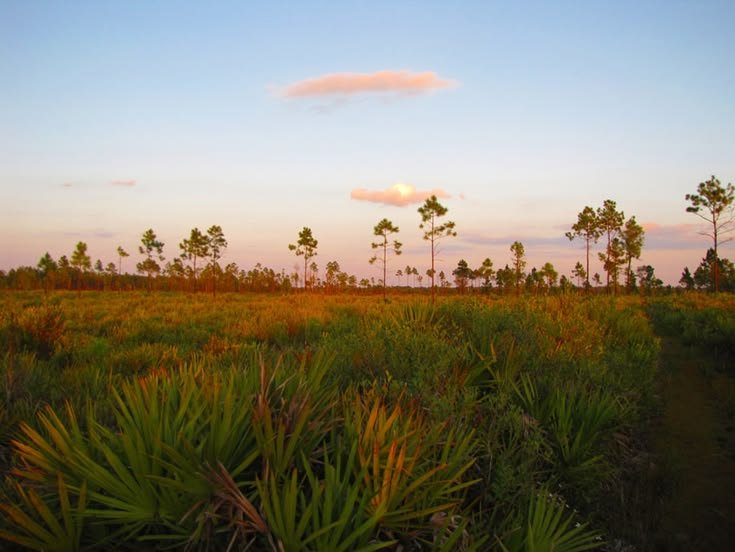
The name “white sand dweller” should give you a good clue about where these moths live: the scrub.
If your concept of Florida contains only pictures of beaches and theme parks, you need to know about the scrub.
It consists of sandy hills covered with twisted, stubby pines, oaks, and palmettos, where the animal population includes the homely but important gopher tortoise and the cute but imperiled Florida scrub jay. There are frequent fires, often sparked by lightning strikes, which are essential to the refreshment of the ecosystem.
Much of the scrub in Florida is found in what’s left of some ancient sand dunes dubbed the Lake Wales Ridge. The ridge runs right down the spine of the state. The state’s own website on the ridge says it’s “home to one of the highest number of rare plants and animals in the United States.”

“Scrub habitat is important in terms of the life that’s in it,” said Kawahara of the McGuire Center.
Yet there’s not nearly as much of it as there used to be.
As the state website admits, “85% of the original, dry uplands habitat on the Lake Wales Ridge has been lost to agriculture and development.”
“The scrub that does still exist is super isolated,” St. Laurent said. “We don’t know if those little pockets can support this moth at all.”
Florida used to do a great job of buying up precious parcels of scrub to preserve it. But then, in spite of how popular it was with the public, the Legislature started siphoning off the annual allotment of $300 million from the Florida Forever preservation fund.
The Legislature allocated a mere $18 million for it last year. This year the House wants to defund it entirely, a move that to me makes no sense whatsoever. If that happens, then sorry, scrubbies, looks like you’re on your own!
Where no one has preserved the scrub, here’s what’s happened. First, the citrus industry showed up to plunk down a grove of non-native trees growing a juicy fruit that was once worth big bucks. Now, not so much.
Next came the homebuilders, racing to take over this easily drained soil and cover it with pavement. They have been flocking to the ridge in Imperial Polk County, where the urban sprawl has been roaring along as fast as a runaway Brightline train.
More recently, the inland scrub is being carried off for use as coastal beaches — ancient dunes dug up and carried hundreds of miles for the purpose of bolstering modern ones.
Resting beach face
One big reason tourists come to Florida is to enjoy our beaches.
But just as we expect the tourists to eventually leave, the beaches aren’t supposed to stick around either. They’re on barrier islands, which wax and wane according to the tides. The sand shifts this way and that.
This wasn’t a problem until we started building million-dollar homes and condos on top of these shifting sands.
Suddenly, we needed the beaches to stay put, and they wouldn’t do it. As the barrier islands wash away, engineers have been using new sand to rebuild them nationwide since 1922.
Take a wild guess which state requires the most taxpayer-financed rebuilding, often under the misleading name of “renourishment.”
With the rising sea level, the Florida beaches keep washing away and having to be rebuilt. Some of our beaches have been remade more often than the plastic surgery devotees known for sporting “Mar-a-Lago Face.”
One in Fort Pierce, considered the most “erosion-prone” beach in the state, has been subjected to multi-million-dollar rebuilding projects 14 times since 1971.
You’re probably thinking, “What does this have to do with a moth?” Just this: Florida used to obtain all its sand for rebuilding beaches from offshore dredging sites — but not anymore.
Now, according to Nicole Elko, executive director of the American Shore and Beach Preservation Association, many Florida beaches are being rebuilt using sand hauled in from the Lake Wales Ridge. We’re turning ancient dunes into new ones, meanwhile altering the old scrub ecosystem for the worse.
The places that are digging up the Lake Wales Ridge don’t have much choice, Elko explained.
“They used up all that sand from offshore,” she told me.
Too bad about all those gopher tortoises and scrub jays that still need a home. To attract the tourists, we need to keep our beaches broad and welcoming. And when the next hurricane shows up and sweeps all that sand away, we have to “renourish” that pile of sand all over again.
It’s like we’re melting down the gold bars in Fort Knox for material to fill the potholes in the interstate. And we have to keep filling the holes over and over and over.
Make it bigger
The white sand dweller moth story is one we’ve seen repeatedly in Florida. We humans think we know everything about our world, and then something happens that shows we don’t know as much as we thought.
A scientist searching the swamps of the Panhandle for something else accidentally stumbled on a fabled creature no one believed really existed. The so-called “swamp eel” turned out to be a type of salamander with external gills on its head, a reticulated siren, hailed as the most unusual scientific discovery of 2018.
Then, in 2019, a dead whale that washed up near the Everglades turned out to be a previously unidentified species now called the Rice’s whale. The newly identified whale, the only one that lives full-time in the Gulf of Mexico, has become the focus of a huge controversy over offshore oil drilling.
That’s why, when I talked to St. Laurent, I asked him what the white sand dweller does to help out the scrub where it lives. Yes, I know he just found out it’s still around, but asking dopey questions like that is what us journalists do.
One theory, the scientist said, is that they’re important prey for the Florida scrub jay. Another is that they’re essential to the growth of oaks in the scrub.
But more importantly, he said, they show whether the scrub is healthy or not.
“This moth could be a really good indicator of habitat quality,” he told me. “If you find this moth there, you know that the land has been managed well.”
Since UF is already pursuing a captive breeding project to produce a lot more of these moths, I’d like to see the university go even further. I’d like to see the scientists try to make a few of the moths much, much bigger — say, the size of Mothra, the Japanese monster movie star.
I say this because I think that’s the only way Florida’s perpetually pro-development politicians will agree to preserve their scrub habitat. As wild as our nature can be, our politics tends even wilder.
Independent Journalism for All
As a nonprofit newsroom, our articles are free for everyone to access. Readers like you make that possible. Can you help sustain our watchdog reporting today?



