
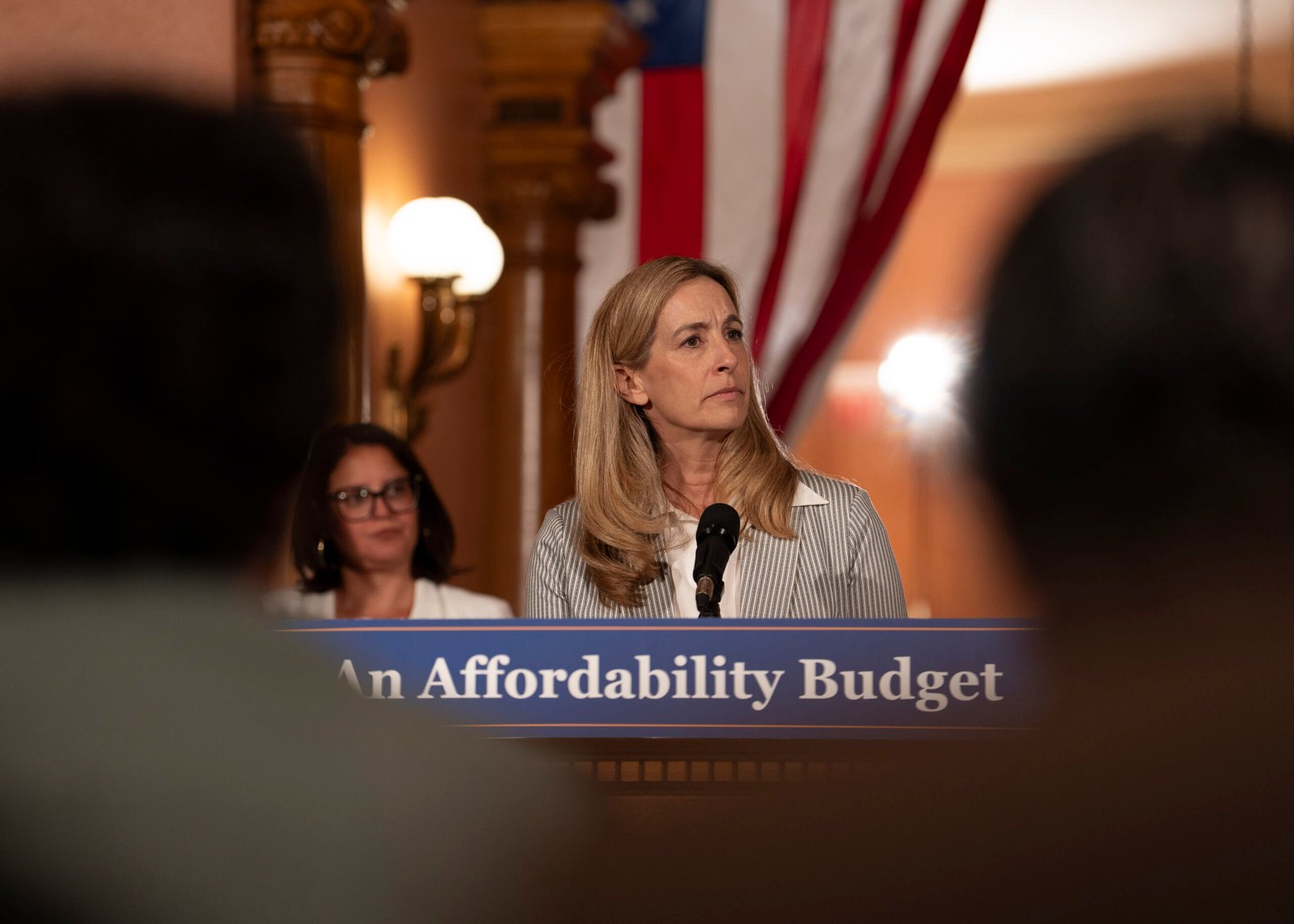
New Jersey school districts have a record-high $12.4 billion in state aid headed their way from the Sherrill administration’s newly signed 2027 budget.
Many education leaders, though, say they have no appetite to celebrate, as the cash won’t go as far as they need. Weeks from the start of the academic year, they are again facing staff and program cuts to accommodate soaring health-insurance premiums and other rising expenses.

While the state constitution requires a “thorough and efficient” education, that demand during this budget season competed with so many other costly needs, such as property tax relief, pension payments and expanded mental-health services.
One expenditure that particularly rankled some school administrators was a $120 million bailout for Jersey City, contained in supplementary legislation that Gov. Mikie Sherrill signed alongside the $60.7 budget for the fiscal year that started July 1.
“We’ve been at bare bones for a few years now,” said Michael Citta, superintendent of the Toms River regional school system, one of the state’s largest. “Politics shouldn’t bleed into public education but unfortunately, it does. It’s salt in the wound.”
Not enough time
An outdated school funding formula is only one part of the schools affordability issue. Transportation, utility and special education costs have clobbered district budgets for years. Then came soaring health insurance premiums.
“Normally, we are most concerned with the formula and the need for it to accommodate the modern cost of a thorough and efficient education,” said Betsy Ginsburg, executive director of the Garden State Coalition of Schools, a nonpartisan education advocacy organization. “But the proximate cause of anxiety for districts is really health insurance — that is what has all districts over the barrel.”
Sherrill, a Democrat who took office in January, and state Education Commissioner Lily Laux agree that the formula must be modernized, though time constraints would not allow for significant changes for the 2027 budget cycle.
Democratic and Republican lawmakers also want to update the funding formula and solve the 30%-plus premium increases in the School Employees’ Health Benefits Program. A March report from the state Treasurer’s Office identified profound structural issues in the program called for significant reform.
Meanwhile, administrators and teachers must continue to be “analytical and inventive,” said Karen Bingert, executive director of the New Jersey Principals and Supervisors Association. “The new funding formula must be nimble and responsive to changing needs to plan for the future.”
Selling a building
While almost all of New Jersey’s roughly 600 school districts are under pressure, some have unusually onerous burdens. Jefferson Township in Morris County, for example, is among the 88 towns across seven counties within North Jersey’s Highlands region, an environmentally protected area whose development is governed by the state. Likewise, more than 50 towns across seven south Jersey counties are regulated by the Pinelands Protection Act.
While school costs rise, those towns cannot encourage residential, commercial and other development to increase their tax bases.
“This is not a guaranteed or permanent solution.” — Jeanne Howe
Jefferson Township Public Schools has fewer than 3,000 pre-K-12 students and a budget hole with no resources to fill it.
“We continue to operate under financial strain and remain hopeful that the [state Education Department] and our legislators will provide long-term assistance,” Jeanne Howe, the district’s outgoing superintendent , said in an email to NJ Spotlight News on June 30. “Ultimately, relief will require a revision of the school funding formula that accounts for districts heavily impacted by the Highlands and Pinelands Acts.”
To help reduce a projected deficit to $2.9 million from $4.8 million in the 2026-27 school year, the district is counting on revenue from the future sale of its central office building.
“This is not a guaranteed or permanent solution,” Howe said.
Aid caps
After the 2008 School Funding Reform Act led to under- and overfunding in some local districts, then-Gov. Murphy enacted a law that in 2018 shifted money back to underfunded schools.
The formula’s “equalization aid” category gives greater state resources to needy districts based on demographics and tax bases. That step, though, divided Republican and Democratic lawmakers.
For 2027 school aid, Sherrill used a three-year district wealth average to determine the “local share” from property taxes. As her predecessor and fellow Democrat Murphy had done, Sherrill also capped state aid cuts at 3% and increases at 6%, to reduce wide fluctuations that further complicated school district budgeting.
The caps, though, are imperfect.
The Toms River Regional School District serves about 15,000 students from Toms River, South Toms River, Beachwood and Pine Beach. In one sense, the system got a boost this year, with $31.7 million in aid, for a 6% increase. With the maximum benefit under the cap, the district still has a projected $3 million shortfall.
Bus drivers, custodians, paraprofessionals, and teachers “have been dealing with sacrifices for a decade,” said Citta, the superintendent. Come fall, he said, one of his tasks will be to foster positive morale and energy for students and staff.
“If the government wants to solve these issues they should talk to the school leaders that have been pulling rabbits out of their hats every year,” he said. “Have real discussions about real fiscal change without hurting kids in any area of the state. I’m not blaming any party because I think it’s been like this for a long time.”
Ginsburg, of the Garden State Coalition of Schools, said the state must act first on employee health benefits — “the most immediate source of pressure” — and then turn to the funding formula immediately after.
Otherwise, she said, districts will be left to cut again next year, and that will prove costly in other ways. “Instead of 22 kids in their class, they might have 27 kids, and that’s going to have an immediate impact for both,” Ginsburg said. For teachers, “your morale going back is not going to be great.”
Lawmakers, she said, must decide “what a thorough and efficient education really costs today in 2026 for New Jersey. If we come face-to-face with the real cost of that, then we come face-to-face with some hard decisions that may not be politically palatable.”



