
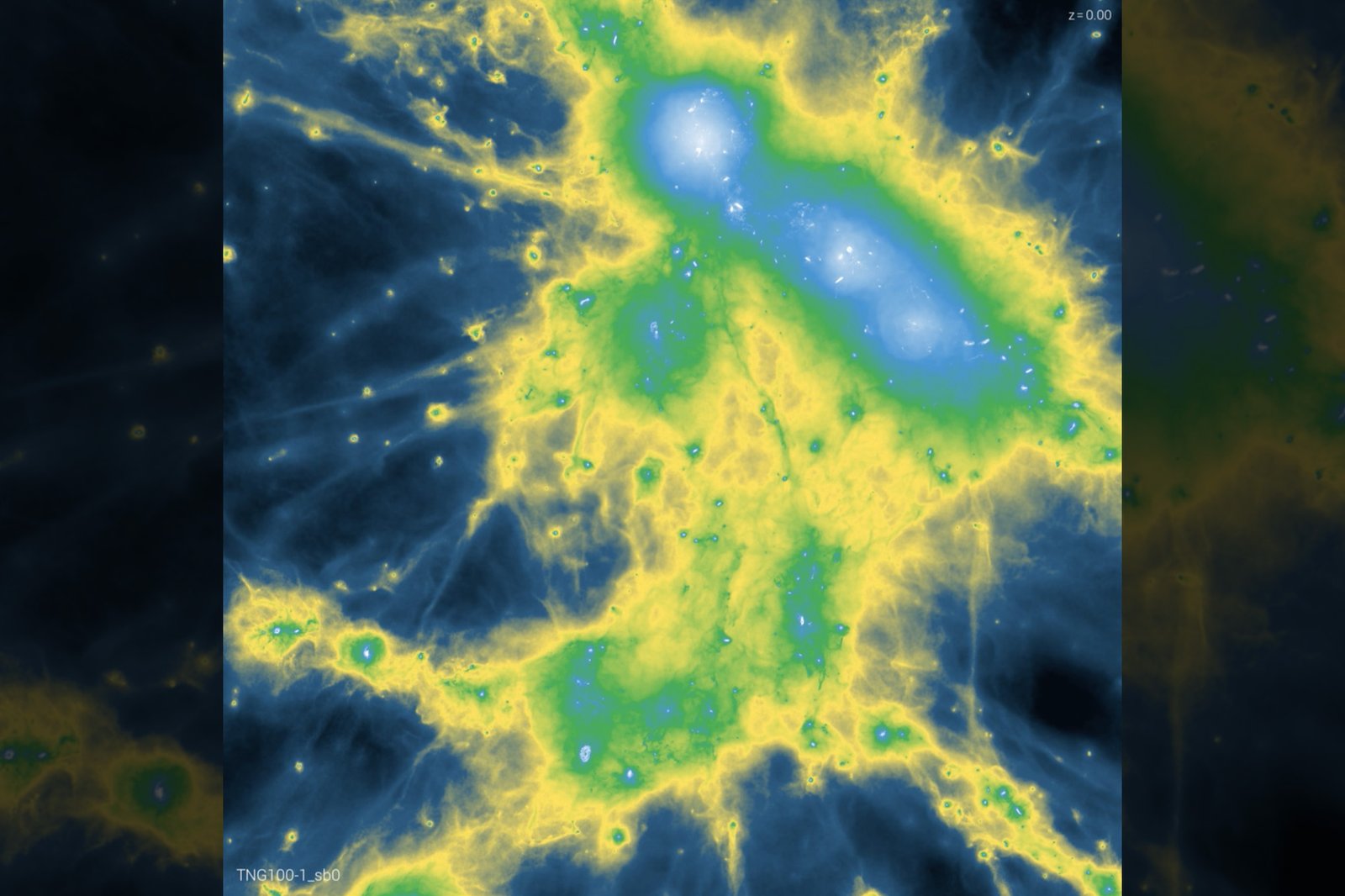
Stars and galaxies make up much of the universe’s ordinary, observable matter. But for decades, scientists have wrestled with a cosmic conflict: There should be much more.
Physicists have good estimates of how much matter was present in the early universe. Shortly after the Big Bang, roughly 83 percent of all matter in the universe was composed of invisible dark matter, with ordinary matter making up the rest. And yet, these estimates exceed the amount of ordinary matter seen in stars and galaxies today. Where, then, did all the missing ordinary matter go?
Now MIT scientists, as part of the CHIME/FRB Collaboration, are using far-off radio signals to reveal missing matter in the vast space between galaxies. The team has developed a new method to search out missing matter by combining locations of galaxies with detections of fast radio bursts.
A fast radio burst, or FRB, is an ultrabright, millisecond flash of radio waves emitted by extremely energetic phenomena in the distant universe. As it travels through space, the signal from a fast radio burst gets stretched, or “smeared,” in time. The more missing matter that it passes through, the more smeared the signal becomes.
The MIT-led team measured the degree of smearing experienced by thousands of FRB signals detected on Earth. Then they compared each FRB smear with locations of galaxies across the universe to determine how much of an FRB’s smearing was due to galaxy matter versus other, missing matter.
The new method revealed not only whether missing matter was present, but also where. Specifically, the researchers discovered that it exists in very diffuse clouds surrounding groups of galaxies. These clouds extend out from the galaxies, to much further distances than scientists had predicted.
“We find that, overall, where there are more galaxies, there tends to be more missing matter around them,” says Haochen Wang, a graduate student in MIT’s Kavli Institute for Astrophysics and Space Research.
The results, reported today in the journal Physical Review Letters, support the idea that matter is flung outside a galaxy through black hole jets, exploding stars, and other highly energetic processes within a galaxy. What’s more, the findings suggest that such processes are more energetic than scientists had thought.
“We’re finding missing matter that is pushed out to larger scales,” says Kiyoshi Masui, associate professor of physics at MIT. “These measurements indicate that star activity, and activity from black holes, is stronger and much more violent than predicted.”
Masui and Wang are co-authors of the new study, which includes Shion Andrew, Adam Lanman, Kenzie Nimmo, and Ryan Raikman from MIT, and collaborators from multiple other institutions as part of the CHIME/FRB Collaboration.
The shape of matter
The vast majority of ordinary, observable matter in the universe is built from baryons — a type of subatomic particle that includes protons and neutrons, and that makes up most of an atom’s mass. Scientists estimate that just 17 percent of the early universe was made from this “baryonic” matter, shortly after the Big Bang.
Some of that early matter was forged into every substantial thing we see today, from planets, stars, and galaxies, to our own bodies. But as scientists have realized, this matter doesn’t quite add up. The total mass of all the stars, galaxies, and galactic clouds is about a tenth of the baryonic matter that existed in the early universe. There must be more matter, likely in the spaces between galaxies. But the universe is vast. Any leftover matter likely exists at extremely low densities, of around a single proton per cubic meter, making it extremely challenging to detect.
Recently, however, Masui and others have found that such missing matter could be sussed out using fast radio bursts. FRBs were first discovered in 2007, and since then astronomers have detected several thousand of the mysterious, ultrashort signals from distant galaxies, billions of light years away.
“What makes FRBs good to probe missing matter is that they have a special property,” Wang says. “They start out as a very quick flash, and as they pass through matter, they smear out in time. And we can measure that smearing very precisely, which is directly proportional to how much missing matter the FRB passed through.”
Researchers have previously taken advantage of this smearing property of FRBs to detect missing matter around galaxies. These efforts have confirmed that tenous clouds exist in the vast spaces between galaxies. Masui and Wang wanted to go a step further.
“We’re not just probing if the gas is with the galaxy or not, but we are seeing the shape of the missing matter that’s around the galaxies,” Wang says. “By mapping the shape of missing matter, we can understand how galaxies form and how they interact with their environment.”
Galactic fountains
For their new study, the team mapped the shape of missing matter around galaxies by cross-correlating thousands of FRB measurements with locations of millions of galaxies. They used data from two sources: the Canadian Hydrogen Intensity Mapping Experiment (CHIME) and the Dark Energy Spectroscopic Instrument (DESI) survey.
CHIME is a large radio telescope located in British Columbia, Canada, that is designed to scan the entire northern sky for incoming radio waves. The telescope is sensitive to ultrashort, ultrabright radio signals, and since it began observing, CHIME has detected about 4,000 fast radio bursts across the sky.
DESI is an instrument that is mounted on the Mayall Telescope at Kitt Peak National Observatory, near Tucson, Arizona. The instrument makes detailed measurements of the light coming from over 30 million galaxies, to provide estimates of dark energy — the mysterious force that drives the expansion of the universe.
From CHIME’s catalog of detections, members of the CHIME/FRB collaboration analyzed 2,870 FRB signals. Each signal is a burst of radio waves, at multiple wavelengths, from highest to lowest energy. The higher-energy “blue” waves typically are less affected by any missing matter they travel through, and therefore should arrive at a detector before lower-energy “red” wavelengths, which are more delayed, or “smeared,” in time.
The team measured the smearing of each FRB’s various wavelengths, which they could then directly relate to the amount of matter that the FRB must have traveled through before reaching CHIME’s detectors. Masui and Wang then correlated these measurements with the locations of over 6 million galaxies provided by DESI data. In this way, they could look for an association between the missing matter and the galaxies, and measure where one is in relation to the other.
Their analysis revealed a pattern: Missing baryonic matter tended to be found around galaxies and galaxy clusters. But rather than gathering close to galaxies in a dense ball, missing matter was scattered across a large radius, similar to a diffuse puff.
“A galaxy is maybe a few 100,000 light years across, and we found missing matter out to about 4 million light years,” Masui says. “That’s further than the simulations predict, by quite a bit.”
“We are finding that the activity in galaxies is messier than we thought,” Wang says. “They’re more like fountains, and really push out gas to very large distances.”
The new results show that fast radio bursts can be a reliable method by which to search for missing matter. As CHIME continues to detect more FRBs, the team says its method can only improve.
“We got it to work for the first time, and will get it to work even more precisely as data gets better,” Masui says.
CHIME and CHIME/FRB are supported by the Canada Foundation for Innovation, the Natural Sciences and Engineering Research Council of Canada and, the provinces of British Columbia, Québec, and Ontario. This study was supported in part by the U.S. National Science Foundation.
Source: news.mit.edu



