
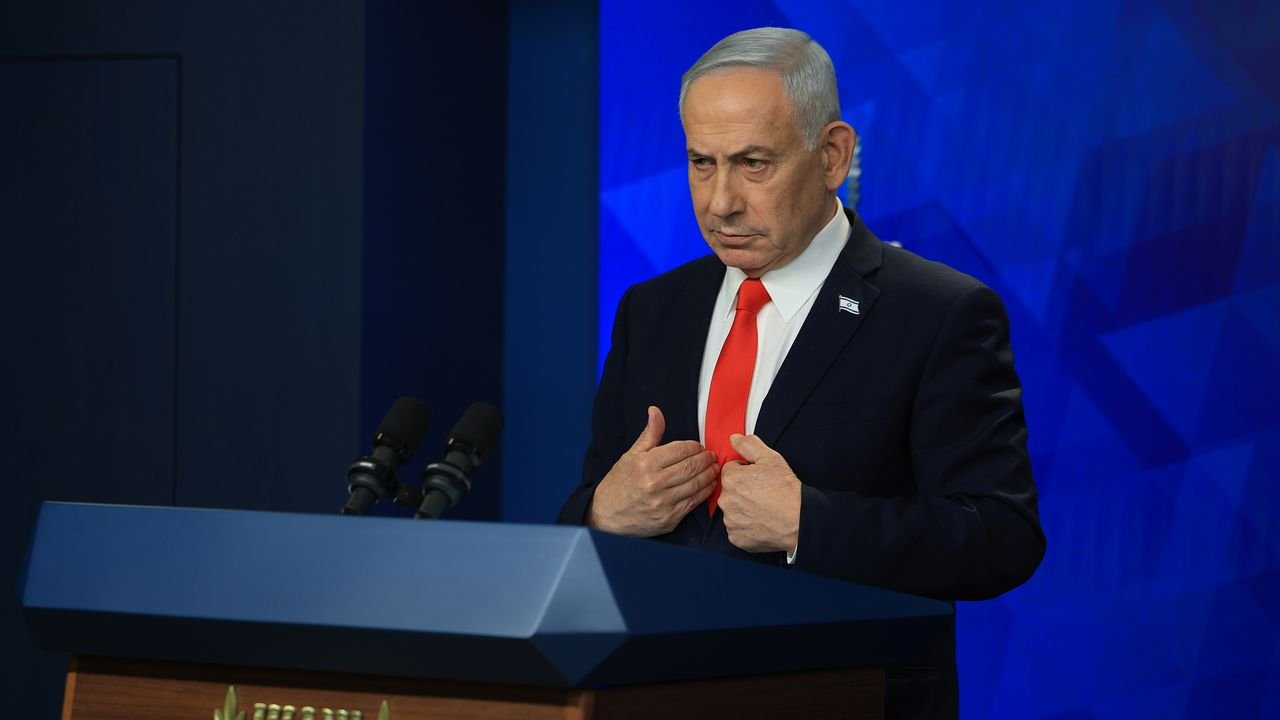
After the ceasefire deal was announced, Netanyahu gave a rare press conference. He vowed that “with an agreement or without an agreement, Iran will not have nuclear weapons—not today and not tomorrow.” But he looked physically spent. The issue he acknowledged to be his “life’s mission”—preventing Iran from obtaining the weapons—was slipping away from him, under a U.S. President whom he once called “the greatest friend Israel has ever had in the White House.” Trump and Netanyahu’s disagreements over Israel’s occupation of Lebanon may prove particularly difficult to resolve. Netanyahu announced at his press conference that Israeli forces will remain in Lebanon for “as long as required.” Trump responded by expanding on what he called his “little dispute” over Lebanon with Netanyahu. “You don’t have to knock down a building every time somebody walks into it that’s from Hezbollah,” Trump said during his G-7 news conference.
“Where did you go wrong?” an Israeli reporter asked Netanyahu. His supporters were beginning to wonder the same. Amit Segal, a senior political correspondent for Israel’s Channel 12 with close access to Netanyahu, acknowledged in a recent column that Israel had made a mistake in prioritizing regime change in Iran over eliminating its nuclear capabilities. Segal said that, though the ceasefire deal did not surprise Netanyahu, the way in which it happened came “as a shock.” Trump had shut Israel out of the peace talks. He spent the past two weeks hurling insults at Netanyahu, calling him “fucking crazy” in one phone call, as Axios first reported and Trump later confirmed. But the deal itself “looked like a total surrender wrapped in an anti-Bibi, almost anti-Israel sentiment,” Segal told me. He said of Netanyahu, “It’s something he used to preach against for many years—paying the Iranians in cash and hoping to get something in credit. It’s very similar to the Obama deal but even more dangerous because it’s temporary and because Iran isn’t really obliged to do much at all in return.”
For Netanyahu’s mouthpieces in the media, news of the ceasefire deal appeared to represent a genuine crisis. Would they publicly break with Netanyahu? Or would they turn on Trump, a leader they once lavished with near-mystic praise, comparing him to Cyrus the Great and to the Messiah? Segal told me, “It’s like when your parents divorce and you have to pick sides.”
By Tuesday, the pro-Netanyahu camp appeared to settle on an answer. Trump “came out a loser,” Yinon Magal, who hosts a popular talk show on Channel 14, a pro-Netanyahu outlet, wrote on X. Magal blamed the ceasefire on “Vice President Vance, the lowlife,” and denigrated Steve Witkoff and Jared Kushner, the President’s envoys for peace missions, calling them “two yehudonim,” or “Jewboys.” (When Vance was asked for his response to Magal and other Israeli commentators, he visibly scoffed. “They’re proposing an endless conflict,” he said.) On his radio show, Magal doubled down on the strategy of distancing Netanyahu from Trump. “Why are you blaming Netanyahu?” he said. “Netanyahu has always insisted on victory, total victory. The fact that Trump turned on him halfway there is not his fault.”
Such anti-Trump rhetoric is new in Israel, and it appears to be seeping into broader public opinion. Up until three weeks ago, fifty-eight per cent of Israelis viewed Trump favorably—rendering him the most popular politician in the country. However, in a snap poll published by Israel Hayom after the ceasefire deal was reached, Trump’s favorability rating had plummeted from plus twenty-three to negative sixteen. “I’ve never seen a shift on that scale before,” Segal told me. Among Netanyahu’s supporters, Trump’s popularity had declined by fifty points. Segal attributed the change to the “bad deal” but also, perhaps even especially, to Trump’s insults of Netanyahu.
The ceasefire went into effect as Israeli political parties ratcheted up their campaigns ahead of a fall election. (A date has not yet been determined.) According to a new poll released on Tuesday, Netanyahu’s Likud Party is projected to remain the largest, but the center-left Yashar Party, headed by Gadi Eisenkot, a former head of the military, has narrowed the gap substantially, gaining four seats in a single week. The anti-Netanyahu bloc is expected to secure a majority in parliament, according to recent polls, as Netanyahu’s coalition partners trail far behind. Segal said that he can imagine a scenario in which Netanyahu, seeing his diminished support and recognizing a “window of opportunity” in Trump’s falling approval rating in Israel, more openly breaks from him.



