
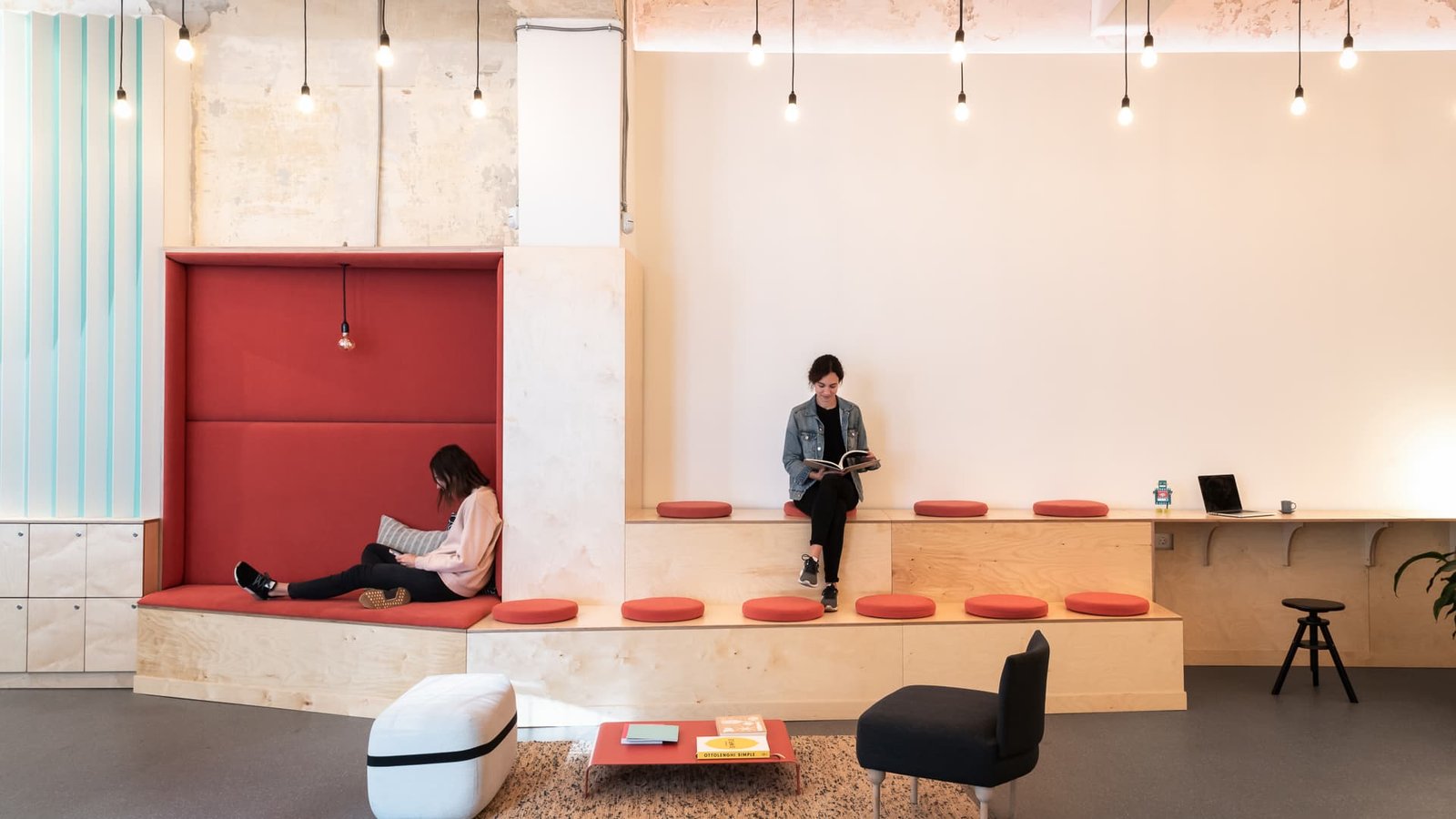
Coworking space Kaptár was founded in 2010. ‘Kaptár’ means ‘hive’ in Hungarian.
Kaptar
When mechanical engineering graduate and entrepreneur Lexi Vindisch wanted to run her business from a remote location, she didn’t pick a town in North America where she lived. Instead, Budapest was top of her list.
With its mix of grand sights, cafés, cultural events and inexpensive public transportation, the Hungarian capital has become a popular place for digital nomads — people embracing the “work from anywhere” trend that took off during the Covid-19 pandemic.
Based at co-working space Create26 in Budapest, Vindisch runs a domestic cleaning company based in Victoria, Canada, as well as overseeing Lead Machine, a marketing software firm for home service businesses.
Why Hungary is a digital nomad hotspot
Vindisch, who has worked in many European and North American cities, but has Hungarian roots, said Budapest feels different. “I’ve been in locales that are super beautiful, well organized, great facilities, but they lacked a personality … I’ve never been able to replicate the feeling that Budapest holds anywhere else,” she said.
EU citizens can work remotely from Hungary long-term if they meet certain requirements, while Hungary’s White Card scheme, which provides one- or two-year residency permits for digital nomads from outside the EU, requires a net monthly income of at least 3,000 euros ($3,370).
Coworking space Liftoff in Budapest is located in a former elevator factory, where elevators for the Hungarian Parliament Building were made.
Liftoff Coworking
There are around 35 co-working spots in central Budapest, according to the Coworking Hungary Association, several of which are in the bustling District VI, near the fashionable bars and restaurants of the Jewish Quarter. Alongside these hubs, the city offers around 35 serviced offices, including locations from larger providers such as Regus and DBH Flex.
“Budapest has its own vibe,” said Áron Levendel, a founder of co-working space Kaptar, which is within view of the city’s striking St Stephen’s Basilica. “Whoever wants to connect, make friends or meet people, has an easy job. Whoever wants to have fun, learn or get experiences in English, will have the challenge of choosing from hundreds of options every evening,” he said.
‘Community’ offices
Levendel and his co-founders are organizational developers who wanted a workplace that was both sociable and professional. In 2010, they came up with the idea for Kaptar (the word means “hive” in Hungarian).
“Gmail was already there, but most of the work was not in the cloud or online yet; people had folders and papers. Digital nomads were not a thing,” Levendel told CNBC by email. “Co-working” also wasn’t a term in common use at the time, so he called the space a “közösségi iroda,” or community office.
Since the Covid-19 pandemic, Kaptar has grown more than 30% every year, according to Levendel, including a “wave” of digital nomads who joined after the pandemic, often arriving initially for a month but staying for up to a year. Overseas members either keep an existing job and work remotely, or they are freelancers who can travel, Levendel said.
Coworking space Liftoff has an international community from central and eastern Europe as well as the U.S., the United Arab Emirates and Israel.
Liftoff Coworking
Mónika Gyurity opened co-working space Liftoff in 2019. After a career as a television executive, she wanted to expand her digital skills and bring different generations together to learn from each other.
Located in a former elevator factory close to Budapest’s central Nyugati station, Liftoff attracts a mix of professionals — including short-term visitors in need of a workspace, as well as remote employees working for international companies. One of Liftoff’s team members is also a remote worker who regularly participates in Nomad Cruise voyages, or “workation” trips that combine a conference program with land excursions.
Gyurity expects the digital nomad trend to continue, noting that AI now allows individuals to create and launch services or businesses without the resources of a large organization. “More people will be able to imagine their knowledge, skills and opportunities outside the traditional corporate world,” she said.
At the same time, she recommends that those in the corporate world spend time in a co-working environment. “Most people are there because they are trying to solve something,” she said. “Every day I meet younger people who are at a very different stage of their lives and careers, use different tools, and approach problems differently. We can learn from each other.”
Co-working challenge
A few streets north of the Hungarian Parliament building and steps from the River Danube sits Kubik, a co-working space where roughly 20% of members are digital nomads working in IT, software development, design or marketing. According to co-owner Éva Mocsár, many of these professionals split their time between Budapest and warmer climes, with some choosing to escape the Hungarian winter in Argentina, before returning in the spring.
About 20% of Kubik’s members are digital nomads, said co-owner Éva Mocsár.
Kubik
As with other co-working hubs, one of Mocsár’s primary challenges is recruiting new members, particularly as larger office spaces compete with Kubik on price. “Co-working is closely connected to the office market, and Budapest has a huge amount of office space, a lot of it empty,” she said. According to consultancy Cushman and Wakefield, 12% of the city’s office stock is vacant.
At Create26, events are a core strategy for member retention. The space regularly hosts the city’s Claude AI Community meetups and maintains a close partnership with the non-profit Startup Hungary, frequently featuring workshops on building and scaling with AI or navigating investor funding. “It’s a full package,” said Create26’s general manager Seloua Benkaid Kasbah. “So, you are here not only working alone at your desk, but you also find yourself at lunchtime talking with members from big companies … and in the evening you find yourself at an event with founders and investors,” she said.
Mocsár said that while remote work is “here to stay,” she’s not convinced a life of constantly moving around is sustainable. “What I see more is that people create a few fixed points for themselves around the world. Places they come back to from time to time, where there are familiar faces, and where they feel a little bit at home. And I think co-working spaces can play a really important role in that,” she said.
While Budapest is undoubtedly popular with digital nomads, it remains an emerging market for flexible office space, accounting for just 1.7% to 1.8% of the city’s total office stock, according to data from Cushman and Wakefield.
It ranked Hungary 31st on a list of 40 countries in its Global Trends in Flexible Office 2026 report — behind Spain and Portugal but ahead of Italy and Canada — while the Coworking Hungary Association views flexible solutions as “one of the most significant opportunities in the upcoming years.”
For those looking to explore Hungary as a digital nomad, Vindisch’s advises approaching the experience as a relocation rather than a visit, emphasizing the importance of sorting admin like banking and residency paperwork early. But, “most importantly,” she said: “With a culture that’s really uniquely beautiful, like Hungary, I would say come ready to embrace it and assimilate into it.”



