
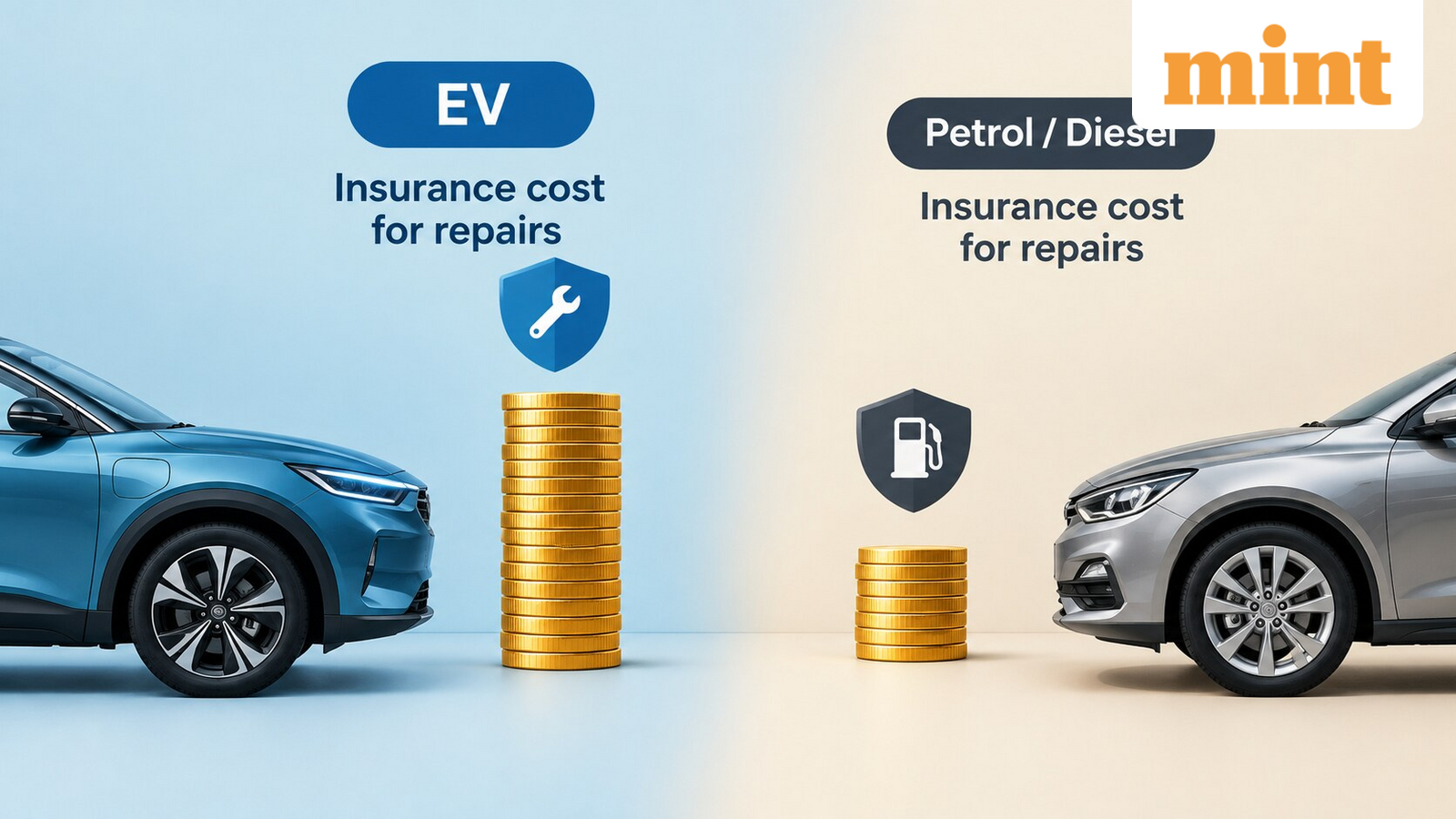
Insurance claims for repairing electric vehicles cost owners 14% more on average than for comparable petrol and diesel four-wheelers, according to the latest data released by insurance marketplace Policybazaar.
The average claim cost for an electric car stood at ₹41,543, compared with ₹36,185 for an internal combustion engine (ICE) car. The comparison covers vehicles priced between ₹10 lakh and ₹15 lakh in their first three years of ownership, excluding large-loss claims.
EV insurance claims have become pricier during the monsoon due to the impact of flooding, waterlogging and adverse weather. Average claim severity rose to nearly ₹65,000 during this period, 25% higher than the ₹52,000 average recorded during the rest of the year, as per the data.
Why are EV insurance claims more expensive?
The higher claim severity for electric cars is due to costlier battery systems, complex electronics, imported components and limited EV repair infrastructure, that make repairs and replacement more expensive.
Policybazaar data shows that battery is among the most expensive components of an electric car. Depending on the model, replacing it can cost as much as 40-50% of the vehicle’s total price.
However, repair costs extend beyond the battery and motor. Components such as battery cooling systems, advanced electronics and infotainment systems can also be expensive to replace.
This can leave EV owners exposed to major expenses if their insurance policy does not provide adequate coverage. A comprehensive motor insurance policy generally covers accidental damage to the insured vehicle, subject to its terms and conditions. However, coverage for battery-related damage varies depending on the policy and the add-ons chosen by the owner.
More EV owners are opting for battery protection
Around 80% of EV owners opt for at least two key add-ons, including battery protection, zero depreciation, roadside assistance (RSA) and consumables cover. This is higher than the corresponding share of 75% among petrol car owners and 77% for diesel car owners.
The trend reflects that electric car owners are significantly more protection-conscious than conventional vehicle owners are, reflecting awareness of higher repair costs and battery-related risks.
Adoption of battery protection cover among EV owners has also risen sharply, increasing from 51% to 70% in the last six months. This points to growing awareness of the need to protect expensive battery systems against risks such as water ingress and power surges, subject to the policy’s terms and conditions.
“As EV adoption grows beyond metros, understanding the specific risks of their vehicle, location and usage will be important for customers to choose adequate coverage rather than simply the cheapest policy,” said Paras Pasricha, Head of Motor Insurance at Policybazaar.
SUVs record the highest claim frequency
Among electric car body types, SUVs recorded 31 claims per 100 insured vehicles, followed by hatchbacks at 28 and sedans at 26.
Policybazaar attributes the higher claim frequency among SUVs partly to their use across varied road conditions and longer distances, including highway driving, where the risk of underbody, tyre, suspension and related damage can be more.
However, for hatchbacks, the reason can be greater usage in dense urban environments, where traffic, parking and minor collisions are more common.
East India leads EV insurance claims, Tier-II cities report higher frequency
Tier-II cities recorded a higher electric vehicle insurance claim frequency than Tier-I cities, at 33 claims per 100 insured EVs compared with 30, according to Policybazaar data.
Regionally, East India reported the highest claim frequency at 41 claims per 100 insured EVs, followed by North India at 34.
These figures indicate that EV claims are growing in smaller cities too, with factors like local weather, road conditions and rising electric vehicle use potentially affecting the number of claims.



