
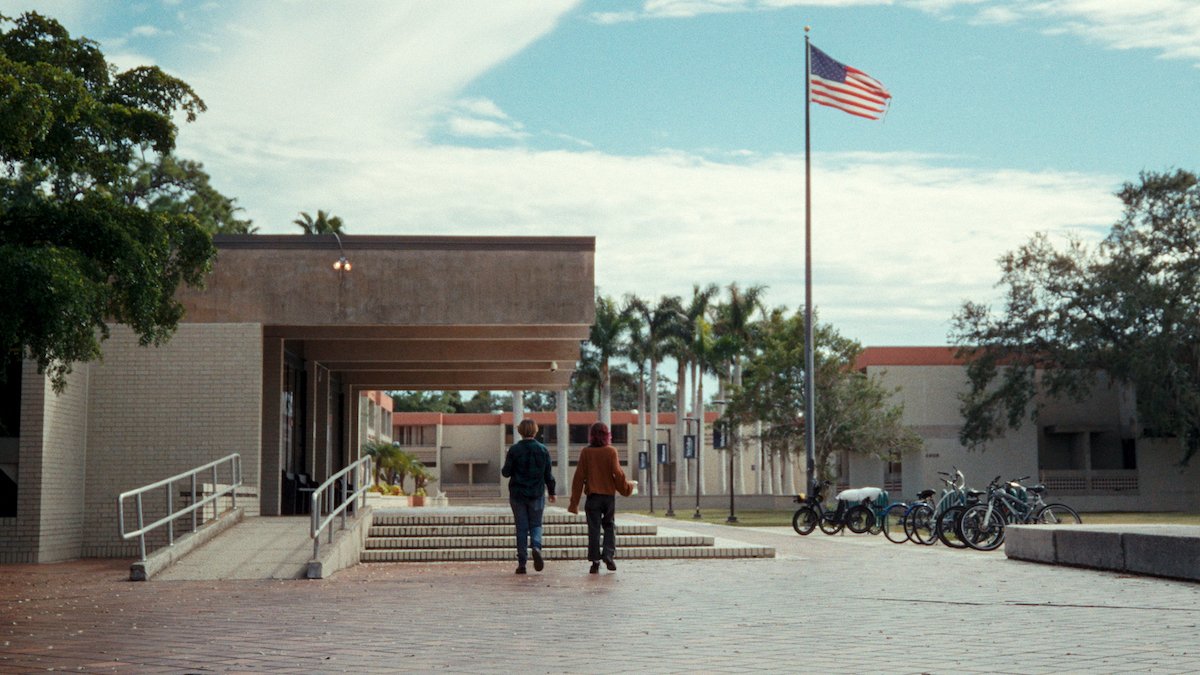
In January 2023, Florida Gov. Ron DeSantis, while plotting his presidential run, instituted sweeping changes at the New College of Florida, a small liberal arts college he likened to a “Marxist commune.”
He appointed six new members to the school’s 13-member Board of Trustees, all of whom, according to The Associated Press, were “Republican allies and insiders.” Soon after, a seventh new trustee, a president of a conservative think tank, joined the board.
At the end of the month, the new board fired the school’s president and replaced her with Richard Corcoran, a former Republican speaker of the Florida State House, and awarded him a base salary of $699,000, more than double the previous president’s salary. He later received large bonuses.
Documentarian Patrick Bresnan saw many of the changes firsthand while filming First They Came for My College, his new documentary about the New College of Florida. It plays Sunday at the Houston Cinema Arts Festival. Bresnan will also speak at a panel entitled How Do We Step Into a World on Fire?: Documenting Crisis.
MovieMaker reached out to the New College press team for comment on the documentary, and Bresnan’s description of spending months unsuccessfully seeking an interview with Corcoran. We have not heard back from them, but will share their comments if we do. Here is a photo Bresnan provided of himself and Corcoran:
In a previous statement, James Miller, vice president of communications and marketing at New College of Florida, said that First They Came for My College is “sensationalized” and “attempts to highlight a number of inflammatory claims about the college that are void of all facts and evidence to back up the filmmaker’s opinion.”
In the statement, reported by Here & Now, Miller also said that “prior to the current administration, New College faced serious institutional challenges, including declining enrollment, a deteriorating and increasingly unlivable campus environment, and unprecedented instability. In many cases, these issues stemmed from the ideological environment that had taken hold at the institution.”
First They Came for My College details the experiences of students who found the DeSantis-orchestrated changes disruptive and destructive. It brings Bresnan back to Florida, where he lived as a child, and where he and his partner Ivete Lucas have made several films about young Floridians, including 2019’s Pahokee.
We asked Bresnan about making First They Came for My College, choosing his protagonists, and trying to interview Corcoran.
Patrick Bresnan on First They Came for My College
MovieMaker: I understand that you got involved in this story when one of the doc’s producers, Holly Herrick, a New College alum and the director of the Austin Film Society, asked you to travel to Florida to film a contentious Board of Trustees meeting. What happened at that meeting, and what hooked you on this story?
Patrick Bresnan: We put together a ragtag group of student filmmakers from contacts filmmaker Kim Snyder had introduced us to. … A New School alum and executive producer named Harry Hanbury picked me up at the airport and had sent me close to 20 emails to get me up to speed.
I wanted to know nothing about what I was walking into, but to learn in real time, from the emotion on the ground and in the room. We arrived to a student-led protest that had an emotional intensity I had only experienced filming outside of a Huntsville, Texas prison on execution day. It was very clear that this would be a film that had a dozen or more protagonists and that I needed them to film with me.
Students’ parents had been camped out for months in a hotel next to the college and made crime boards that laid out all of the sordid affiliations of the new trustees. At the board meeting a student yelled, “F— You Richard Corcoran.” In the open comment, parents and students raised signs referencing fascism, to deaf ears, as the DeSantis-appointed board denied tenure to five deserving professors.
What was happening in my eyes was clearly an act of violence by DeSantis against students, professors and their families. I felt truly compelled by the intensity of the resistance and the deep love the community felt for a college I had never heard of. New College in my eyes was a sacred space for this community. It was truly one of the last utopic public colleges in the U.S., and its siege had massive implications for colleges everywhere.
MovieMaker: How did you choose the main people you focused on in First They Came for My College?
Patrick Bresnan: At first I focused on the student newspaper The Catalyst. One of the editors, Gaby Batista, was also a leader of the protests, yet very low key and humble, which I was very drawn to. Libby Harrity, who was forced to leave the school early in the production after an altercation with one of the trustees, exemplified the uniqueness of the student body. She led 50 students at DeSantis’s armed guards and went to church on Sunday.
The tension of the Board of Trustees meetings led me to record in the student garden and food forrest as a place to decompress. There I met Lindsey Jennings, who had developed a friendship with the new administration as a way to protect the green spaces on campus. In these students, I knew alums of the college would see themselves and not get wrapped up in me spending too much time on the historical relevance of the college.
Finally, in Joshua Janniere, a student who came to the college to join the conservative fight against liberalism, I hoped to understand why the conservatives felt New College had to be remade.

MovieMaker: There’s been a lot of news coverage of the takeover — what does this doc add? If the takeover of New College is just DeSantis promoting right-wing propaganda, how do you avoid making the doc left-wing propaganda?
Patrick Bresnan: The documentary places the audience in the world of the students. News coverage is important and what the documentary seeks to do is go much deeper into the everyday lives of people and show the situation visually and cinematically. … I filmed for two-and-a-half years, we had five students filming, and we give them the chance to have agency over their story.
MovieMaker: People in First They Came for My College call the takeover a grift or a straightforward attempt at censoring left-wing thought. Can you talk about your efforts to get the new administration’s side, and their response?
Patrick Bresnan: I spent a year speaking with the newly appointed president of the college, Richard Corcoran, about filming with him. I was very open with the administration about what I was doing. Corcoran set up a fire, fit on the bayfront, and had a catering company serving wine several nights a week. He and the college’s lawyer and administers would sit there smoking cigars and drinking wine at sunset.
I would have a few glasses of wine with them and in one sitting conveyed that he looked monstrous at the Board of Trustees meetings in my footage. I pleaded with him to allow me access his administration and to interview him for his side of the story. He agreed and on two occasions the day before the interview, he canceled on us. On both occasion we had brought in Zackary Drucker, a master interviewer, and her cinematographer, and we were left high and dry. It was almost like Corcoran enjoyed saying yes and then right before when we arrived, with this very expensive crew, finding a reason like the language in our release form to cancel.
MovieMaker: What makes colleges and universities such appealing and fairly easy targets for conservative leaders? California Gov. Pete Wilson tried 30 years ago to eliminate affirmative action before launching his presidential campaign (full disclosure: your humble correspondent unsuccessfully sued him over it), and now we see Donald Trump threatening the funding of many major institutions, with varying degrees of success.
Patrick Bresnan: I believe conservative politicians are constantly in search of a boogeyman to scare voters and generate vast sums in contributions. The DeSantis presidential committee… believed demonizing university professors, students studying Black history and gender studies, and transgender students would be an adversary for them to label as dangerous and crush. They attacked thousands of students and academics in Florida as “woke” and found a playing field in New College in which they could rig the outcome and appear powerful for their national presidential platform. At New College the destruction of academic freedom is very real but they activated a whole new generation of people that will fight back are now in law school and pursuing careers in social justice.
First They Came for My College screens Sunday at the the Houston Cinema Arts Festival. You can read more of our festival coverage here.
Main image: First They Came for My College. All images courtesy of the filmmaker.



