
Dear Mr. President,
Greetings from Florida, your adopted home state and the place where you seem to go golfing every week or so.
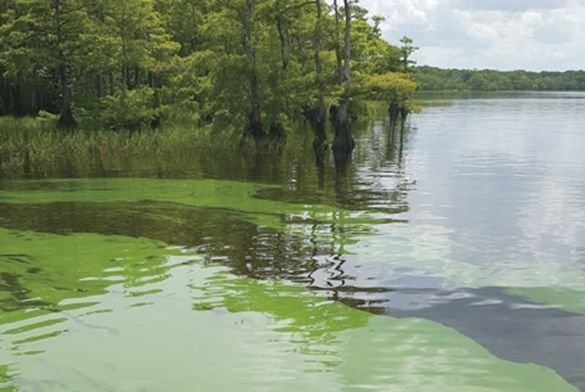
I hear you’ve been having a big problem with a nasty intruder in the Reflecting Pool there in Washington — not antifa, but an algae bloom.
You must be deeply annoyed to see the media treat this as a huge embarrassment for you. Slate called it “an inescapable metaphor for the Trump administration’s ineptitude, profligate spending, careless meddling with iconic federal properties, and general bad taste.” And that’s one of the milder descriptions.
Then to hear comics comparing it to the Iran War and calling it “The Strait of Warm Ooze,” must have you in a ketchup-hurling fury.
After all, your whole goal here was to hand out some no-bid government contracts to donors to do a quick rush job to help America enjoy a pretty blue Reflecting Pool in time for Saturday’s big Fourth of July celebration.
Now, instead of blue water, you’ve been dealing with a green mess that looks like something the Creature from the Black Lagoon would have called home.
To help you out, I’d like to offer some suggestions. After all, we’ve been dealing with algae blooms here in Florida for yeeeeeears.
I well remember the Fourth of July weekend 10 years ago, when a putrid blue-green algae as thick as guacamole forced Martin County officials to close Jensen Beach — about an hour north of Mar-a-Lago — as a health hazard.
“I’ve seen Jensen Beach closed for sharks,” the owner of the town’s Driftwood Motel told me then. “I’ve never seen it closed for an algae bloom before.”
One of her friends, a nurse, told me the worst part was the stench: “It smells like death on a cracker.”
A similar algae bloom erupted on the state’s other coast, prompting our governor at the time — a fellow you now know as Sen. Rick Scott — to declare a state of emergency.
We’re STILL dealing with this mess, too. Just last week, the Florida Department of Health issued an alert to everyone to beware the toxic algae in Lake Okeechobee. Residents were warned not to swim at certain places in the lake and to keep their pets away from it, too, or they’d wind up as dead as that trio of ducks found in the Reflecting Pool.
So, while I’m not coming to you with tears in my eyes, I am happy to offer some guidance for how to deal with your algae bloom based on how we’ve dealt with ours.
First, whatever you do, do NOT seek any advice from Gov. Ron DeSantis.
The master of the greenwash
I know your relationship with Gov. D has had more ups and downs than a playground teeter-totter in a hurricane.
An “up” was when your endorsement in 2018 helped him win office. A “down” was when he ran against you for the presidential nomination in 2024 and you dubbed him “DeSannctimonious.”

When it comes to dealing with algae blooms, you should treat the governor as if his name is DON’T-Santis.
The reason why dates to 2018, when we were afflicted with so many toxic algae blooms that it was called “the Summer of Slime.”
Scott, then the governor, was running for U.S. Senate. A lot of people blamed him for allowing the increase in pollution that was fueling the algae blooms. They booed him so thoroughly that he fled the protesters. For years afterward, he was known as “Red Tide Rick.” (Come to think of it, don’t ask him for advice either.)
DeSantis vowed to fix the algae bloom problem, and people believed him. After he was elected, he wrote an op-ed for the South Florida Sun-Sentinel that said, “I will fulfill promises from the campaign trail. That means prioritizing environmental issues, like water quality and cleaning the environmental mess that has resulted in toxic blue-green algae and exacerbated red tide around the state.”
After he took office, he appointed a panel of actual scientists to recommend countermeasures for the algae blooms. They did.
Then, I am sorry to say, he and the Legislature ignored nearly all of their recommendations. They passed a law that didn’t require polluters to do anything. He then hailed that weak law as if it were a major environmental victory.

“DeSantis is the master of the greenwash, and that has left us literally covered in slime,” said Cris Costello of the Sierra Club.
Algae blooms have continued, killing off so much seagrass in the Indian River Lagoon that more than 1,000 manatees starved to death.
Instead of doing what the scientists recommended, DeSantis cut a secret deal with an Israeli company called BlueGreen (no I am not making that up) Water Technologies. The state paid the Israeli company millions to repeatedly dump a hydrogen peroxide mix into algae-tainted waterways.
That cleared up the algae for a little while. But because the governor didn’t order his agencies to stop the pollution, the blooms just keep coming back.
“DeSantis’ fight against algal blooms in Florida will fail,” the CEO of BlueGreen Water Technologies wrote on social media in 2019. “There is no question that preventing raw sewage and runoffs from spilling into waterways must be addressed.”
DeSantis’ betrayal of his campaign promise turned out to be a harbinger of his whole career. He vetoed funding for restoring the Ocklawaha River, built a destructive tent city in the Big Cypress Preserve (even though that completely undercut all the restoration work he’s approved for the Everglades), and tried to put golf courses in Jonathan Dickinson State Park.
I hear your National Park Service has also been dumping hydrogen peroxide in the Reflecting Pool. You can see why that’s at best a temporary fix, but temporary is fine with DeSantis.
Unlike him, you should try to focus on the root causes of the bloom.
How to handle the heat
I consulted a number of my fellow Floridians about what you should do. You’ve probably never met any of them because they don’t hang out at any fancy-shmancy places like your Mar-A-Lago country club.
But they do know about algae blooms.
These folks reminded me that microscopic algae linger in small amounts in still water. The two ingredients for sparking the massive explosion that we call a bloom are 1) heat and 2) nutrients.
Let’s talk about the heat, first. That’s going to be the stickiest part of the discussion.
Although you’ve repeatedly complained about what you call “the Climate Change Hoax,” the data show that our days and nights are, in fact, getting warmer. It’s the reason our oceans are warming up and our hurricanes grow stronger a lot faster.
Climate scientists have repeatedly warned that one of the consequences of living in this warmer world is that there will be more toxic algae blooms just like the one we saw in the Reflecting Pool.
Since you keep telling us how smart you are, I’m sure you can see why it’s a bad idea to reject clear and convincing facts about the climate crisis that everyone can see.
Even your pal Vladimir Putin acknowledges that climate change is real. And the country run by your friend Xi Jinping, China, is on track to hit net zero emissions earlier than its goal.
I know how reluctant you are to ever admit you’re wrong. But doing something about the algae bloom doesn’t require you to announce that you’ve been wrong all along about climate change.
Instead, you can just say you’ve changed your mind about the color.
Don’t paint it black
When you first announced you’d be repainting the Reflecting Pool, you said, “You’re going to end up with a beautiful, beautiful reflecting pool. The way it’s supposed to be. Much better than it ever was, actually.”
You said you’d initially considered painting it turquoise but then someone persuaded you to paint it a deep blue like the American flag.

One of my sources, Gary Roderick, used to be the southeast bureau chief for the Florida Department of Environmental Protection. He pointed out that repainting the pool surface as a deep blue made it more likely that the water would get really hot, because darker colors tend to absorb more heat from the sun.
The only thing that would have been worse is to copy the Rolling Stones and paint it black. Imagine how hot the water would be then!
Now that the hydrogen peroxide is making the blue paint peel off (or vandals are cutting it, as you have claimed), this is the perfect time to repaint it a lighter color.
Here‘s my advice: Announce that you’ve reconsidered. Now, you say, instead of turquoise or blue, you think that the pool should be dazzling white.
Why white? Explain that you want it to match the purity of the character of our nation’s founding fathers. I bet the folks on Fox would fall all over themselves praising you for that.
If you repainted the Reflecting Pool white, it would tend to reflect (heh heh!) the rays from the sun that are currently warming the water like it’s a pot on the stove.
Doesn’t that seem like the move of a smart guy who’s aced all his cognitive tests?
Now let’s talk about what you’ve been feeding those little green monsters.
The cement pond
As we’ve learned in Florida, feeding the algae blooms nutrients like fertilizer and sewage tends to make them grow like those wacky pro-algae protesters have been chanting at the Reflecting Pool: “Let’s grow, algae, let’s grow!”
Some folks, like Capt. Karl Deigert of the Florida Rights of Nature Network, also blame the state’s rampant spraying of herbicides for fueling Florida’s blooms.
So, what’s making the blooms happen in the pool?
Despite the name, the Reflecting Pool is not, in fact, a pool at all. It covers nearly eight acres of surface area and contains more than 6 million gallons of water. Even a big, strong swimmer like Olympian Michael Phelps would get tuckered out swimming laps in that sucker.
The Reflecting Pool more closely resembles the “cement pond” the Clampetts of “The Beverly Hillsbillies” splashed around in. It’s a big concrete basin designed to reflect the surrounding monuments.
The water in the Reflecting Pool is not tap water (although city water sometimes gets used), nor is it from a Florida bottler like Zephyrhills. Instead, it’s drawn from the Tidal Basin, connected to the Potomac River, which earlier this year was heavily polluted by a 300 million gallon sewage spill.
The Reflecting Pool’s water goes through a filtration system, but it can’t catch every impurity, so I’m guessing some of the sewage got through.
Meanwhile, the nanobubblers that had been installed in the pool to guarantee clean water were apparently turned off for your Ultimate Fighting Championshiop birthday event. By the time they were turned back on, the algae had gotten quite a head start.
The hydrogen peroxide actually made things worse.
By dumping peroxide in the pool, park service employees knocked out the blue-green algae but that just made room for “a more persistent and harder-to-get-rid-of green algae,” according to Wayne Carmichael, a biological sciences professor at Wright State University, quoted by PBS.
Now the nanobubblers are back bubbling away and the algae has faded. But it could easily come back, especially if there’s another Potomac sewage spill. After all, algae also showed up bigly in 2012 after the last big renovation.
Now the park service is saying they’re going to drain it again sometime after the Fourth of July and start over. So, here’s my suggestion for eliminating what’s fueling the algae.
One of the donors supporting your Freedom 250 celebration is a Florida company known as Mosaic. The company mines phosphate, the main ingredient in fertilizer, and needs federal approval to expand one of their ginormous gypsum stacks.
Despite Mosaic’s frequent TV ad claims that it’s a friend of the environment, a lot of people around the state have blamed the company for the pollution that’s repeatedly fueled Florida’s algae blooms.
Why not ask Mosaic to foot the bill for refilling the Reflecting Pool with clean, filtered water that’s missing the Potomac poo-poo factor? Given their massive sales, I’m sure you could ask them to kick in some of the other kind of green to keep it clean, too.



