
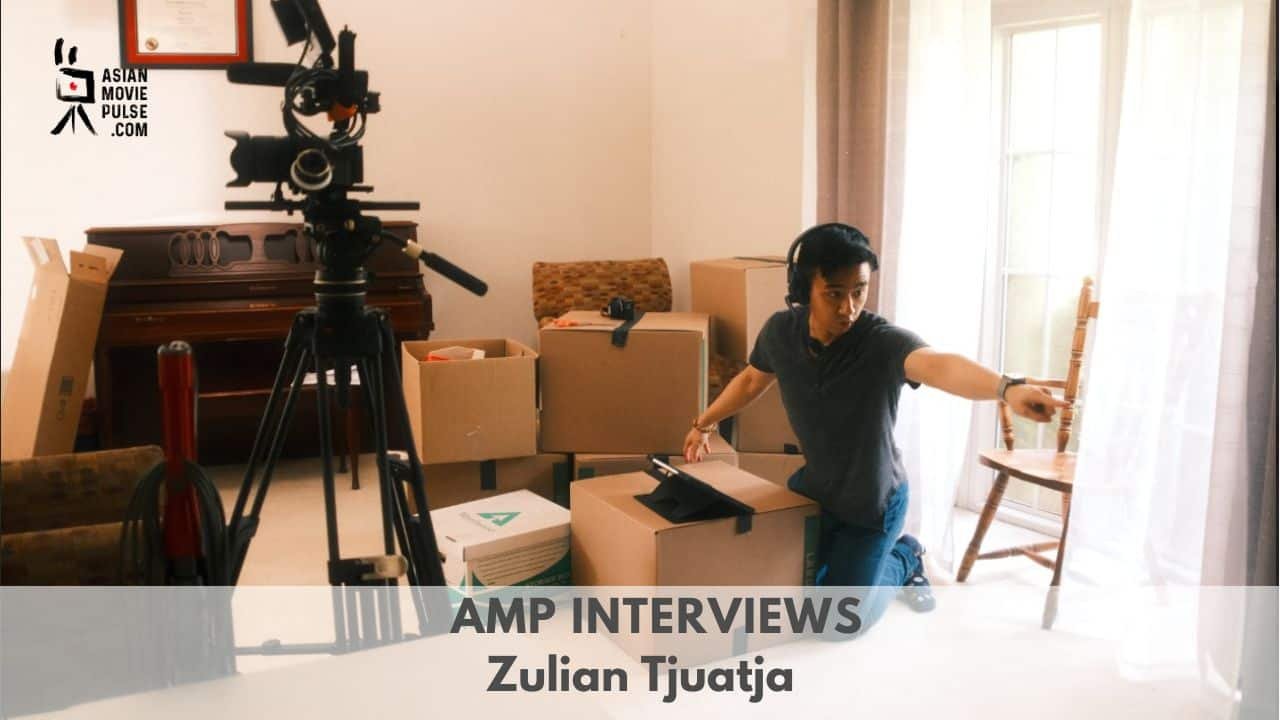
Zulian Tjuatja’s third narrative short, “The Dumpling Club”, explores grief, cultural heritage and human connection through the experiences of an Asian American man attempting to translate a cookbook inherited from his parents. The 20-minute film was recently featured as part of Asian Movie Pulse’s Submit Your Film Initiative.
Speaking to Asian Movie Pulse, Tjuatja discussed the real-life experiences that inspired the film, his decision to work primarily with non-professional actors, the relationship between language and food, and the restrained visual style he developed with cinematographer Andrew Huang. He also spoke about editing the film himself and his plans for his first feature.
A Story Rooted in a Real Community
The origins of “The Dumpling Club” can be traced back to Tjuatja’s arrival in Washington, D.C. Having moved to the city approximately three and a half years earlier without knowing many people, he began attending language-exchange meetings as a way of making friends.
Washington’s international community eventually led him to a Chinese-speaking group consisting of Chinese people, Chinese Americans and Asian Americans hoping to improve their language skills. The group also included people who had become interested in Chinese through their work or studies.
Among its members was Siwei Kwok, who would eventually play the protagonist of “The Dumpling Club”. As the two became friends, Siwei told Tjuatja about the death of his parents and his attempts to reconnect with his cultural background.
“A lot of ‘The Dumpling Club’ is based on his real life,” the director explains.
The production was even filmed inside Siwei’s actual childhood home. Rather than asking him and the other performers to completely transform themselves into fictional characters, Tjuatja created characters based on their personalities and experiences.
He also understood Siwei’s desire to improve his Mandarin as a way of honouring his parents. Learning Chinese had played a similar role in Tjuatja’s own life, allowing him to establish a stronger connection with his roots.
This shared experience became the catalyst for writing the film and placing Siwei at the centre of its story.
Check the review of the film
Food and Language as Gateways to Culture
For Tjuatja, the relationship between cooking and language was present from the beginning of the project.
“Food and language, to me, are the two most important gateways to any culture,” he says.
The director believes that these elements can help people form personal connections even when they come from completely different backgrounds. Recalling a visit to Greece, he notes that some of his most vivid memories involved spanakopita, moussaka, Athens’ cats and conversations with local vendors despite the absence of a shared language.
Once people find common ground through language or food, he suggests, it becomes significantly easier to develop a deeper relationship.
This idea informs Siwei’s journey throughout “The Dumpling Club”. Translating the recipes allows him to learn more about his family, but recreating the food is not enough by itself. The dishes only acquire their full meaning when he begins preparing and sharing them with other people.
The Mystery of the Family Cookbook
The cookbook inherited by Siwei was partly inspired by Tjuatja’s childhood. His ethnically Chinese family emigrated from Indonesia to the United States, where his parents relied on Chinese-language cookbooks published during the 1980s.
The books contained recipes in Chinese alongside English translations, but they included few or no photographs. As a child, Tjuatja found their appearance mysterious and felt that they contained parts of his parents’ lives that he had never personally experienced.
He wanted the cookbook in the film to convey the same sense of mystery. At the same time, it needed to be written entirely in Chinese so that Siwei would have a reason to attend language classes.
Finding an appropriate book proved more difficult than expected. Most suitable cookbooks were either bilingual or no longer in print. Tjuatja eventually located one on eBay and paid a considerable amount for it, considering it a worthwhile investment in the film.
He acknowledges that modern translation applications could have solved Siwei’s practical problem immediately. However, allowing the character to translate the recipes with his phone would have removed the need for the classroom and, consequently, eliminated the central story.
Turning a Classroom Into a Community
The classroom initially appears awkward and impersonal, populated by people who do not yet know one another. As Siwei becomes more comfortable, however, the same space gradually develops into a community.
Tjuatja portrayed this change by repeatedly using the same fixed camera positions. Instead of relying on close-ups or following the characters with a moving camera, he adopted a more observational perspective.
The repeated angles allow viewers to recognise the room immediately and concentrate on how the atmosphere and relationships within it have changed.
A similar transformation occurs inside Siwei’s house. At the beginning, the home functions as a relic of his previous life and a constant reminder of his parents’ absence. By the time Siwei invites his classmates to share a meal, it has become a warm and active communal space.
The change is also expressed through small visual details. Boxes that initially fill the house gradually disappear, while the lighting becomes brighter as Siwei begins to process his grief.
Casting Friends and Non-professional Actors
With the exception of two performers in smaller roles, Sophia and Zach, the actors had no previous experience appearing in a film. Most were people Tjuatja had met through Washington’s Chinese American community.
Jess An, who plays teacher Jenny, was another member of the language-exchange group. Originally from Beijing, she would frequently help beginners understand basic Chinese concepts during the meetings.
Her patience and willingness to teach led the other members to jokingly call her “Teacher Jess”. Tjuatja recognised that her natural personality would make her ideal for the role.
Following the production, Jess left her position in Washington’s nonprofit sector and became a Chinese-language teacher. For the director, this unexpected development demonstrated the effect that participating in the film had on her life.
Chris, who appears as one of Siwei’s classmates, is a half-Chinese, half-Salvadoran friend of the filmmaker. He also composed the film’s soundtrack and has written music for all of Tjuatja’s films.
Other cast members, including Grace and Jessica, were people the director met while making a documentary about Washington’s Chinese American community. The documentary brought him to a church in Chinatown, where he became friends with several younger members of its congregation.
Working with friends was partly a practical decision for a low-budget independent production, but it also contributed to the film’s natural performances and sense of genuine community.
An Observational Visual Style
Tjuatja and cinematographer Andrew Huang decided that the camera should behave as an objective observer rather than actively directing the viewer’s attention.
The filmmaker describes “The Dumpling Club” as a story in which how events happen is more important than the events themselves. Static shots and repeated compositions encourage the audience to notice gradual changes in the characters and their surroundings.
The approach was also suitable for a production filmed over only three days. By carefully selecting a limited number of angles, the team was able to work efficiently without abandoning its visual intentions.
Tjuatja and Huang extensively discussed the film’s colour palette during pre-production. Among their principal cinematic influences were Hirokazu Koreeda and Edward Yang, particularly their observational approaches and willingness to allow situations to develop naturally within the frame.
Writing, Directing and Editing
In addition to writing and directing “The Dumpling Club”, Tjuatja also edited the film. He considers writing, directing and editing the three positions that most directly determine the final result and therefore wanted to retain control of all three.
The editing process also functioned as an opportunity to improve his filmmaking skills. Post-production lasted approximately three to four months as he worked carefully to complete a version with which he felt satisfied.
Sound proved especially demanding. Although a sound crew had originally been expected to handle parts of post-production, several elements were not completed as planned. Tjuatja consequently took on much of the remaining work himself.
Despite the extended process, he preferred to devote the necessary time to the film rather than release something he did not feel represented his intentions.
Looking Towards a First Feature
Tjuatja has already completed post-production on another short film, which he shot in Japan near the end of 2025. He describes the project as significantly different from “The Dumpling Club”, with a more philosophical approach and a structure resembling a parable.
At the same time, he has entered pre-production on what he hopes will become his first feature film.
For “The Dumpling Club”, however, the intimacy of the short format allowed him to transform personal experiences, real friendships and familiar spaces into a story about recovering from loss. By connecting food, language and community, the film presents cultural heritage not simply as something inherited from the past, but as something that continues to develop whenever it is shared with others



