
There’s another notable first in the field of quantum physics to report on, and it’s all to do with electron spin: the tiny, built-in magnetism of these particles, as if each one is carrying a microscopic compass needle.
Previously, the force of these spins has only proved enough to nudge individual atoms in one direction or another. Now though, researchers have managed to shift something much, much bigger.
A team from the Okinawa Institute of Science and Technology (OIST) in Japan has published a new study in Science Advances that details how a centimeter-sized object can be nudged by these quantum forces.
It’s an important step forward for science at the boundary of the quantum (very small scales) and the classical (everything else). Crucially, the experiment deals with an object big enough to be subject to gravity – a fundamental force that hasn’t always sat well with the theories of quantum physics.
“There have been many efforts to test whether quantum mechanics holds for anything larger than a few tens of nanometers, so far without success,” says theoretical physicist Jason Twamley.
“Now, we have observed a classical mechanical response to a quantum force on an object that is eight to nine orders of magnitude more massive than the current state-of-the-art spin-mechanical experiments.”
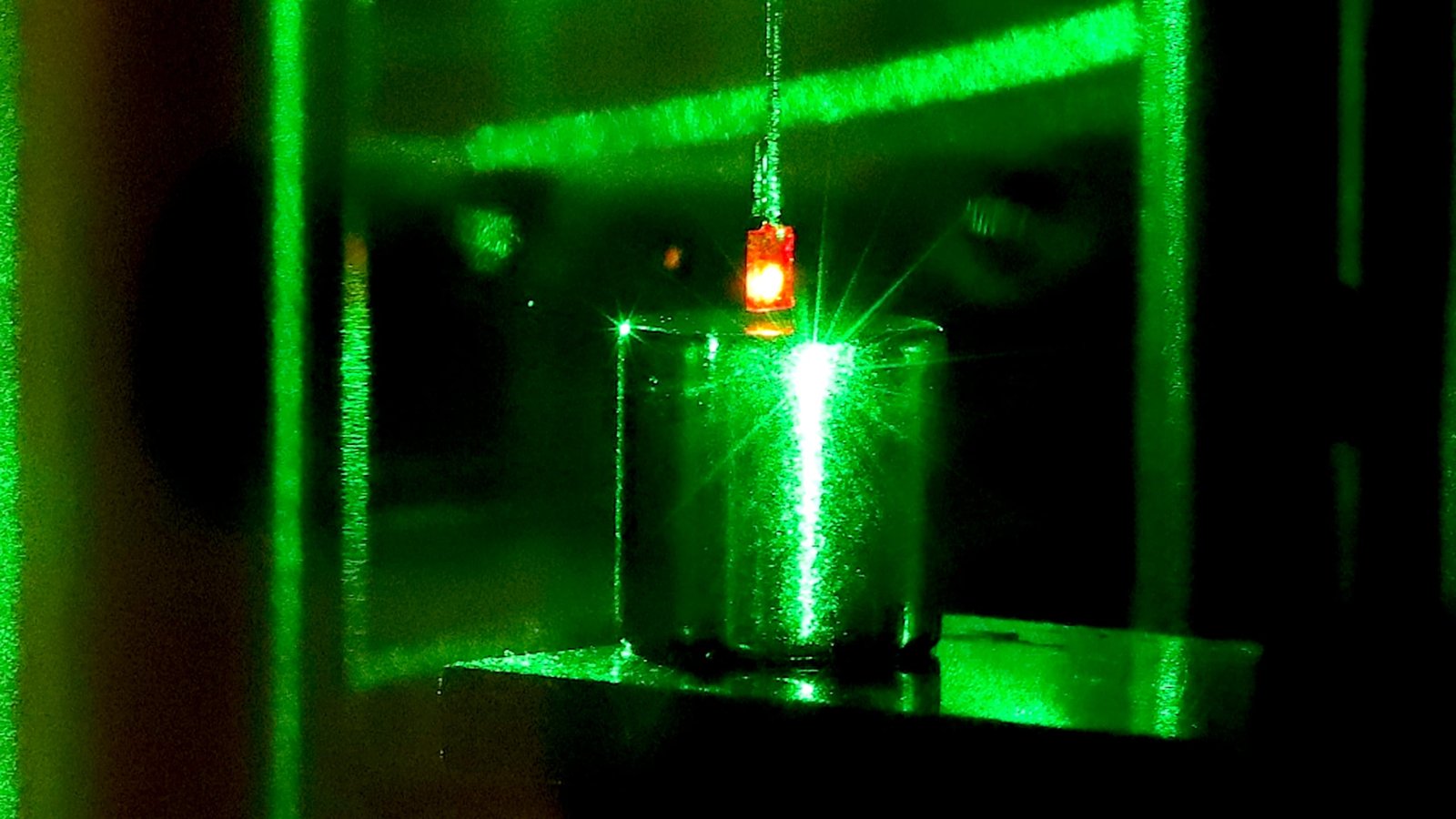
The researchers combined several clever experimental design choices to get their results, starting with the centimeter-sized object: a graphite plate, placed above a checkerboard of magnets levitating it.
Hanging from the plate was a 3-millimeter diamond with special atomic defects known as nitrogen vacancy (NV) centers. These defects give the diamond electrons with controllable spins, which were then manipulated by laser light. Another magnet was then used to turn those spins into movement.
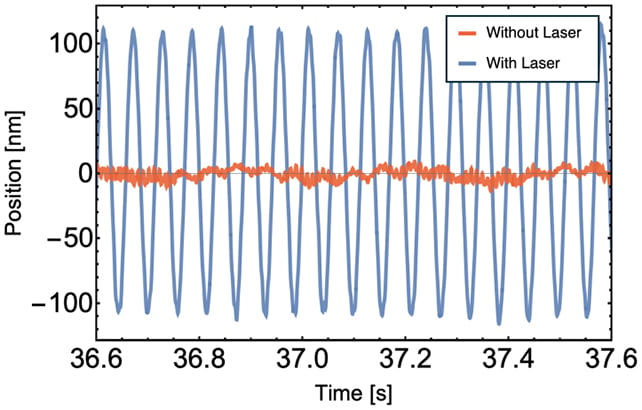
The whole assembly weighed around 128 milligrams (so just a few grains of rice), and was pushed by about 100 nanometers – roughly a thousandth of a human hair. It’s not much, but it’s enough.
“NV diamonds are well understood and easy to control,” says physicist Daehee Kim.
“That, and the fact that NV centers have some of the longest known coherence times, allowing them to maintain quantum superposition at room temperature much longer than other systems, makes them particularly attractive for generating macroscopic superposition of the motion or object in future research.”
When it comes to reconciling the massive (something like gravity’s effect on a planet) with the subatomic and the quantum, scientists often try and start small and then work their way up. Here the study team took the opposite approach: their setup wasn’t planet-sized, but was very large-scale in quantum terms.
“We’re in the opposite camp – going from large to small,” says physicist Anshuman Nayak.
“Just as diamagnetic levitation can lift maglev trains, it can also be used to levitate centimeter-wide objects holding diamonds, where the effect of gravity can be extremely strong, but quantum effects have not been observed.”
As is often the case with quantum research, for those of us who aren’t physicists it can seem rather esoteric and distant, but reaching milestones like this will help us answer some of the most profound questions about the Universe – including whether or not gravity follows quantum rules.
It’s worth bearing in mind that the movement here was classical – it was the quantum effect that triggered the movement that’s important. Further down the line, the researchers hope their approach can help in putting larger objects in quantum states, like superposition, where it effectively occupies two states at once.
“We’ve shown a large classical response from a small quantum effect,” says Twamley. “It’s no longer a question of whether such technology is possible, but of how we can refine experimental conditions to achieve quantum superposition within the regime of Einstein’s general relativity.”
“We’re pushing the bar from nanometers to centimeters. All we need is another order of magnitude, and we can finally observe Schrödinger’s cat in real life.”
The research has been published in Science Advances.
This article was fact-checked by Fiona MacDonald and edited by Fiona MacDonald. While we pride ourselves on our process, we are only human. If you spot a mistake, please let us know.



