
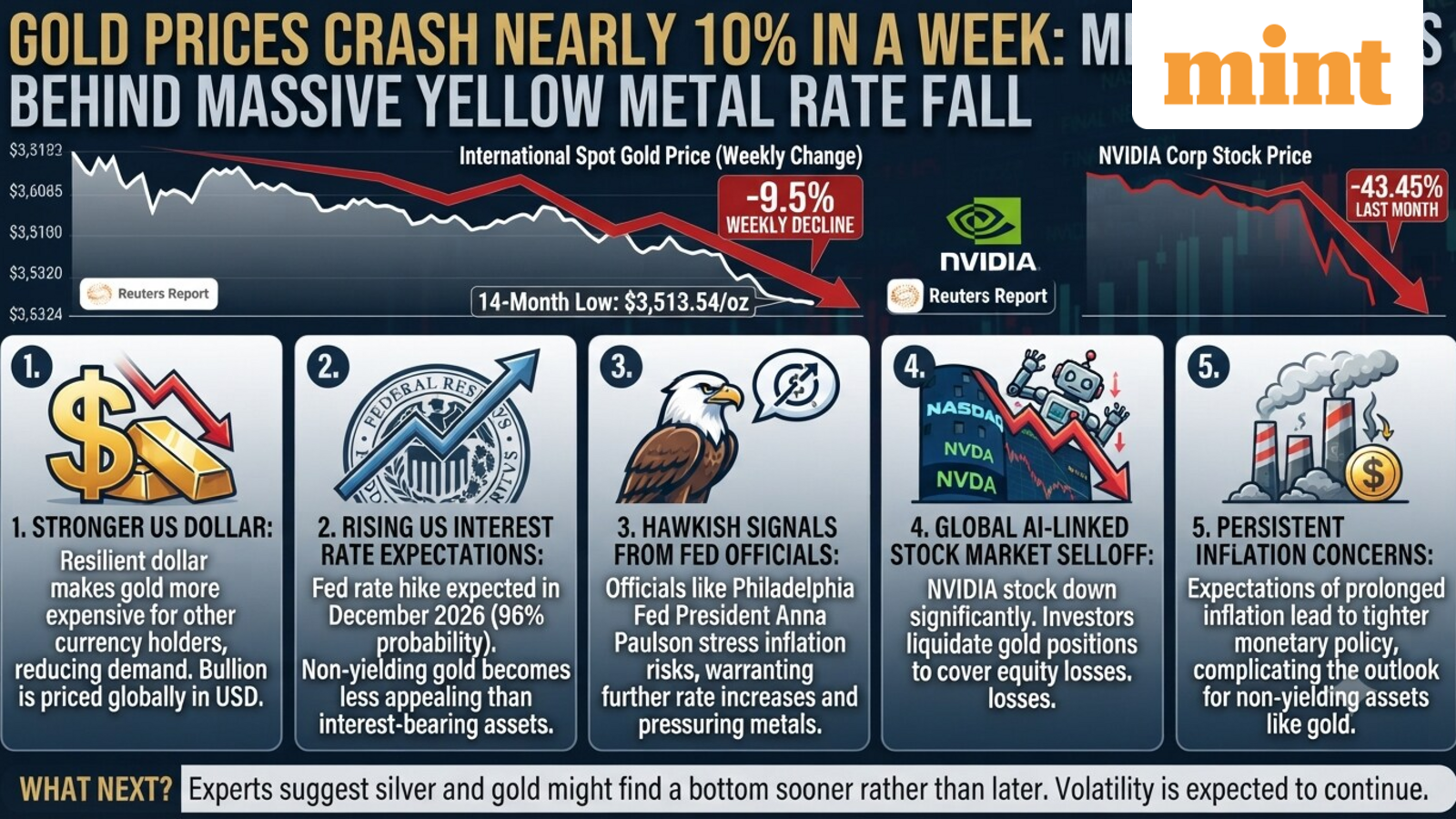
Gold prices extended their declines in international markets on Friday, 20 November, falling to a notable 14-month low as a stronger US dollar, rising interest rate expectations and a severe global stock market sell-off weighed on the bullion market.
Due to these developments, the yellow metal capped its worst weekly performance in eight months, with international spot prices reversing nearly 9.5% over the last week.
As per a detailed Reuters report, spot gold declined 2.8% to $3,518.50 per ounce by 2:36 p.m. ET on Friday, after touching $3,513.54, its lowest level since September 2025. US gold futures for December delivery also declined 4.5% to $3,519.10 per ounce.
Keeping these significant changes and Fed-related developments in mind, let us look at the major reasons behind the sharp fall in international gold prices, which resulted in a correction of about 10% in a week.
5 major reasons behind the sharp fall in international gold prices.
1. Stronger US dollar: A resilient dollar has resulted in making gold more expensive for investors and buyers who are holding other currencies. Thus reducing demand for the precious metal. Gold also generally faces immense pressure when the dollar strengthens; this happens because bullion is priced internationally in the US currency.
2. Rising US interest rate expectations: The expectations of another Federal Reserve hike in the month of December 2026 have contributed to weakening the appeal of gold. As gold does not generate interest, higher interest rates make yield-bearing investments relatively more lucrative and prudent, especially in the current environment. As per CME’s FedWatch tool, markets are pricing in a 96% probability of an upcoming 25-basis-point rate hike in December.
3. Hawkish signals from Fed officials: Not only this, but recent comments from top US Federal Reserve policymakers and officials have reinforced concerns that borrowing costs might rise further. Philadelphia Fed President Anna Paulson, for example, underlined inflation risks that could require a proper response and subsequently warrant another rate increase, adding to the pressure on precious metals.
4. Global AI-linked stock market selloff: The NVIDIA Corp stock declined by 14.01% in the last trading session. In the last month, the stock has lost 43.45% of its value. Thus marking a very serious AI market downturn. This ongoing technology stock rout has also contributed to gold’s decline. As per Reuters, some investors are liquidating their gold positions to ensure that they are able to cover their losses in equities, adding to the selling pressure.
5. Persistent inflation concerns: Now there are clear expectations of continuous volatility and prolonged inflation that can subsequently result in a tighter monetary policy. These factors have also resulted in complicating gold’s outlook, as investors reanalyse and check the appeal of not only gold but also other non-yielding asset classes.
What next?
In summary, it can be stated that further volatility and market swings cannot be completely ruled out for now, but experts such as Jim Wyckoff have elaborated in their discussion with Reuters that silver and gold prices might find a bottom sooner rather than later.
Going forward, investors are going to closely follow the US monetary policy decisions, how inflation pans out in the US, the global equity markets and the performance of the US dollar in comparison with other currencies, for cues on the next move of precious metals.
Disclaimer: Gold prices are influenced by global economic developments, currency movements and market sentiment, and may change frequently. The information provided is for general purposes only and should not be construed as investment advice.



