
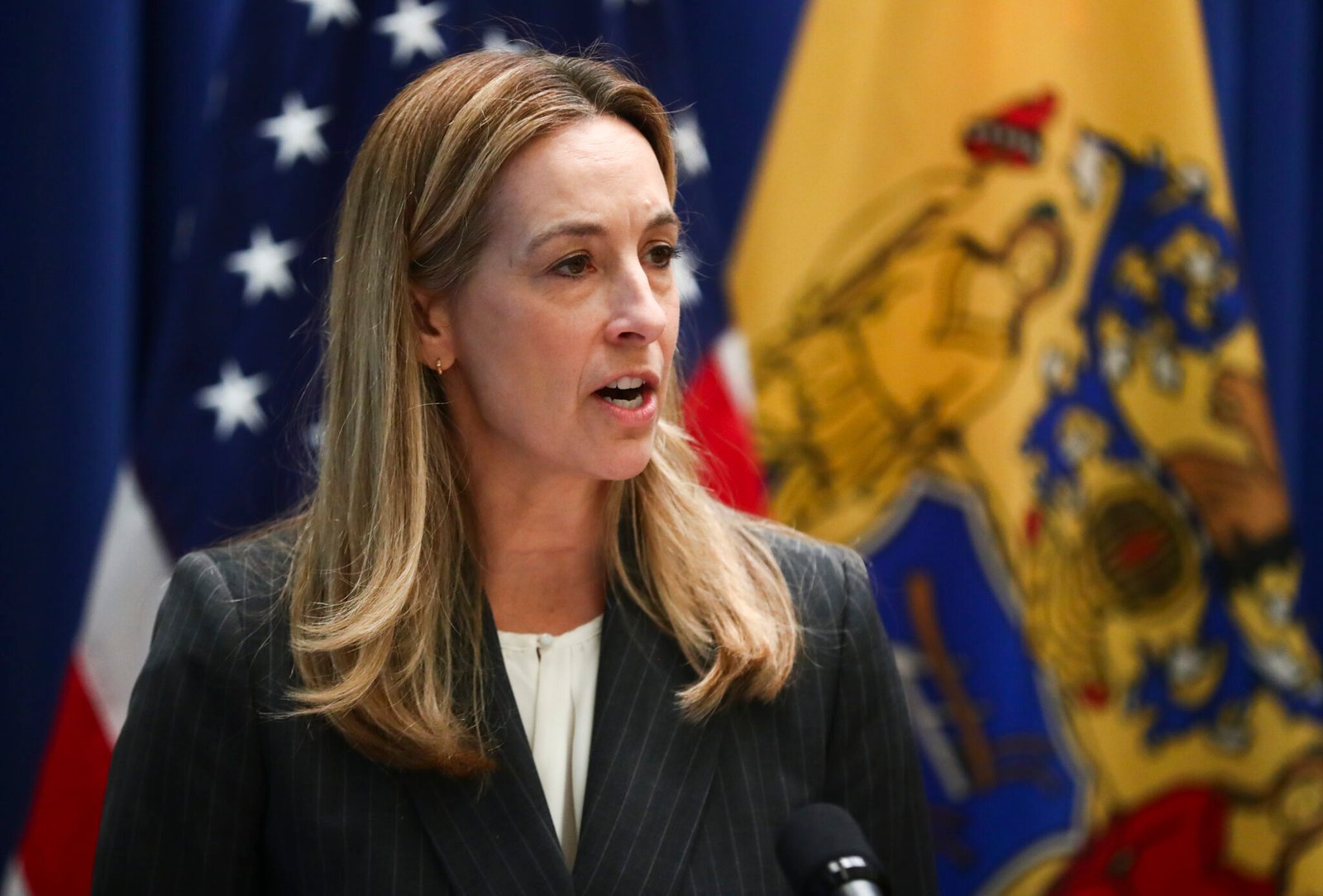
With the gerrymandering battle heating up nationally as Democrats and Republicans eye control of the U.S. House next year, Gov. Mikie Sherrill says she’s open to redistricting New Jersey’s congressional map and would prod Trenton’s legislative leaders to act if GOP states redraw their districts to benefit Republicans.
Sherrill’s comments, made on CNN Thursday night, came after the U.S. Supreme Court on Wednesday struck down Louisiana’s congressional maps as unconstitutional, sparking a scramble by GOP leaders to dismantle districts where racial minorities have historically delivered Democratic wins. President Donald Trump and House Speaker Mike Johnson have cited the ruling in urging states to redraw maps to give Republicans an edge in November’s midterm elections.
“If Trump is going to try to attack fair voting across the country, then New Jersey is going to stand up so that we can create, you know, a counterbalance to whatever he’s doing,” said Sherrill, a Democrat.
Rep. Rob Menendez in primary fight with challenger Mussab Ali
Under the state constitution, redistricting in New Jersey now sits in the hands of a bipartisan commission, which in the last round of redistricting drew maps that handed Democrats nine House seats to Republicans’ three.
But legislators could pack the commission with Democrats and task them with gerrymandering, or they could redraw the map themselves to skew bluer by suspending the commission temporarily as Virginia recently did or abolishing it altogether — if voters agree by referendum to amend the constitution to give them that power, said Dan Cassino, a professor of government and law at Fairleigh Dickinson University, and executive director of the FDU Poll.
A request for comment from Senate President Nicholas Scutari (D-Union) was not returned. Assembly Speaker Craig Coughlin (D-Middlesex) declined to comment.
Referendums require the Legislature to agree — once by a supermajority vote or twice by a simple-majority vote — to put a question to voters. Democrats control both legislative chambers in the Statehouse.
But lawmakers break for summer in two months, with budget hearings now monopolizing their time in Trenton. So there’s little chance they could get a referendum on this year’s ballot, and even if they could, voters would be voting under current maps in November’s election, when control of Congress is up for grabs.
Sherrill would probably have a tough time persuading even legislators in her own party to act on redistricting anyway, Cassino said.
That’s because New Jersey’s biggest Democratic strongholds are urban, where candidates of color can count on solid support from a predominantly Black and brown electorate, he said. Redrawing districts to shift some of those minority voters to whiter, GOP-leaning districts would dilute their voting power and threaten the chances of victory for candidates of color, he said.
New Jersey’s congressional delegation is evenly split between white and nonwhite representatives. The Democratic delegation has three Black, three Latino, and three white members, while the GOP delegation is all white.
“Politically, this is really fraught,” Cassino said. “This becomes an intramural fight between Democrats. In other states where there’s less of an issue of minority representation, it’s not as big an issue. If you’re a whiter Democratic state, it’s not as big an issue. In New Jersey, this would be Democrat-on-Democrat violence.”
That’s why Alex Wilkes, a Republican strategist, suspects Sherrill’s CNN comments were “a little more circumspect than her usual combative posture when it comes to all things Trump.”
“I think she knows that from the special election in her own district, the fissures between the machine Democrats and the ascendant progressives are real and only intensifying,” Wilkes said. “I wouldn’t be surprised if Democrats who fought like hell to draw the map the way it is are putting pressure on her not to upset the apple cart and trigger huge primaries that could endanger their incumbency.”
In the Democratic primary race to replace Sherrill in Congress after her gubernatorial win, former Rep. Tom Malinowski was considered the frontrunner with establishment support, but his progressive rival Analilia Mejia snagged a surprise win. Mejia later won the special election and is now a sitting congresswoman.
Wilkes said Sherrill needs the support of her party especially now, as lawmakers mull her first state budget plan — and its many proposed, controversial cuts. She pointed to the battle by Democratic legislators in Virginia to seize control of redistricting there, saying it dented Gov. Abigail Spanberger’s approval ratings.
Sherrill, who was briefly roommates with Spanberger when both first joined Congress, “had a preview into how this very fight took a bite out of her pal Governor Spanberger’s honeymoon period, and with her upcoming budget fight, she seems fully aware of the fact that she needs a lot of political capital to get through it,” Wilkes said.
In most states, legislators handle redistricting in congressional and state legislative districts, according to the National Conference of State Legislatures.
Ten, including New Jersey, instead have redistricting commissions that do it, five more have advisory commissions that assist legislators in drawing district lines, and three others have “backup commissions” called into action only if legislators can’t agree on maps, according to the conference.
The last time voters saw a referendum on statewide ballots in New Jersey was in 2021. Then, voters considered two gambling questions — whether to allow sports betting on college teams (no) and whether to permit charities, schools, and other groups to use bingo and raffle proceeds to fund their work (yes).
Earlier ballot questions sought voter approval for everything from legalizing marijuana (yes in 2020) to authorizing the state to issue bonds to fund public libraries (yes in 2017).
GET THE MORNING HEADLINES.



