
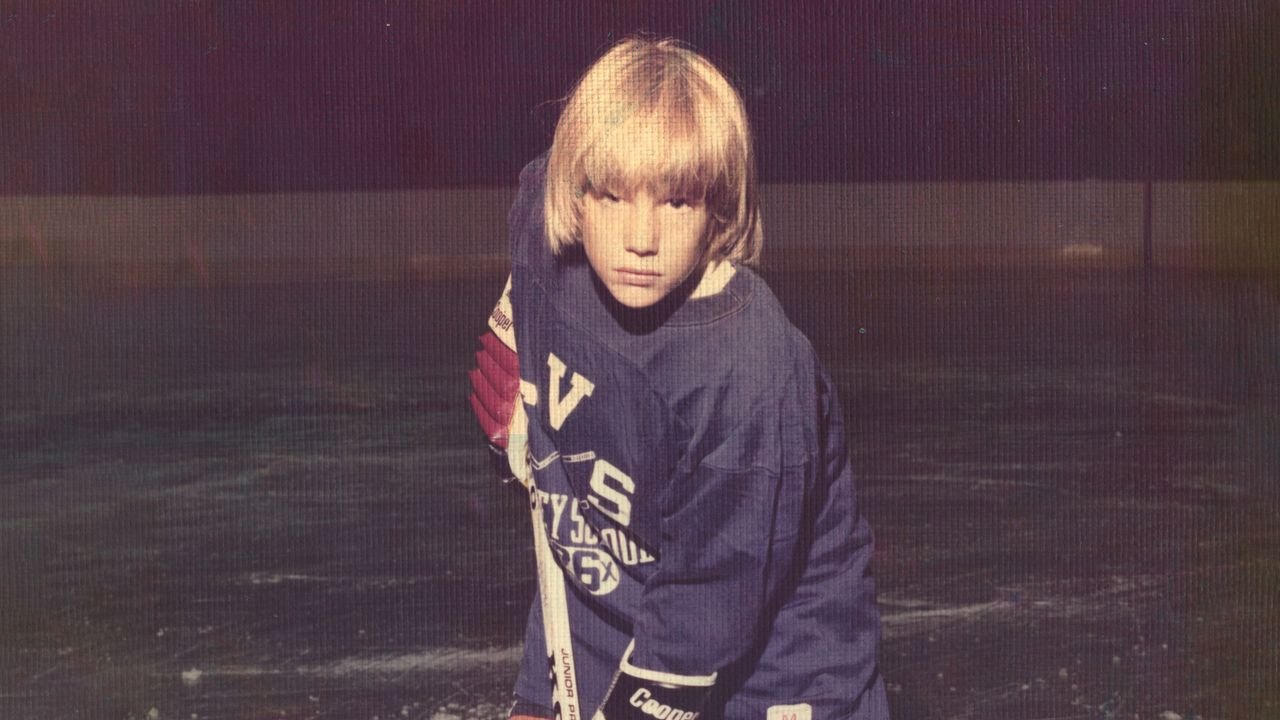
My participation, as driver, dad, coach, manager, crank, and fan, sucked the strength out of me, like going overboard in a wintry sea. The rank refrigerated air, the burnt coffee, the Tastykakes, the cross-chop of excitement and stress and boredom and disgruntlement. By Monday, I was saturated by it all, sallow and hoarse.
On the weeknights, it was my turn to play, on whatever team in whatever league. One night, my father, after a business dinner nearby, dropped by the rink to watch. Beer league means never playing in front of your parents, or anybody at all. So this was an oddity. I experienced a little flutter at the first sight of him, standing in the corner up against the glass. Coach P., in the overcoat. A teammate nudged me on the bench: “Is that your dad?”
It had been a lifetime since he’d appraised me on the ice: a skinny longhaired kid in Pelham purple lost amid the carnage of a bantam game in the Bronx. Now about the age he’d been then, and attuned to his presence, I skated harder than usual. But, when the third period began, I noticed he was gone.
The next morning, I waited for his report. He called in the afternoon. “What did you think?” I asked.
“You guys are terrible!” he said.
I was cocksure enough to find this pronouncement more inaccurate than unkind, needy enough to find it hurtful, and man enough to see the sense in it.
A Sunday 7 A.M. game at the Playland Ice Casino, in Westchester, versus the Rye Rangers. The kids arrived in darkness and began warming up in the parking lot. The younger you are, the earlier you play. Perhaps it’s to weed out the faint of heart. The kids who learn to wake up at 5:30 A.M. to play hockey are the same ones who in thirty years will have the fortitude to skate at midnight.
One of my beer-league teammates, a master rigger of industrial cranes, and I were assistant coaches. His son J. and my boy James were teammates and friends as mites. J. was tiny, with long curly hair and goggles like Kareem Abdul-Jabbar’s, and he treated James—who was eight, a year older, tall and wiry, with a blond bowl cut and a volatile streak—as the big brother he didn’t have. The head coach was Lada, a former Czech junior player fresh in town from Kopřivnice. He spoke very little English. He led skating clinics for the kids, designing convoluted edge-work drills that he couldn’t explain. He had J.’s dad and me demonstrate the sequences, then barked at us, half facetiously, when we got it wrong, endearing him to the kids. When James lost his temper on the ice, which was often, Lada bellowed, “Red eyes!,” his term for hot temper, and benched James for several shifts, the son seething while his father, pretending to be objective, tried to ignore him.



