
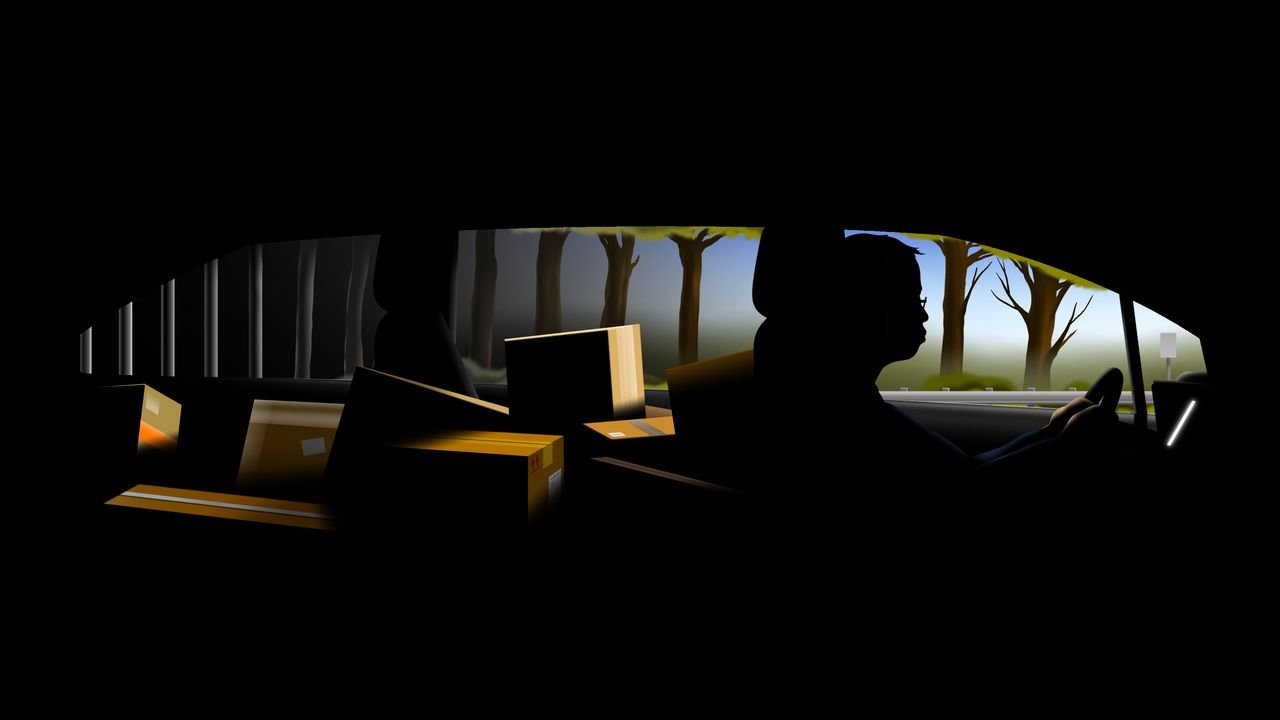
About seven hours after leaving home, Zhuo arrived at the address he had been given—18 State Route 37. He was surprised to find that he was at a gas station. Zhuo tried to rest in his car, and then, at exactly 11 A.M., the pickup time, he wrote to his customer in Mandarin: “Are you outside?”
“Yes, right away,” his contact replied. But no one showed up, and when Zhuo texted again, the contact responded, “Bro, my friend overslept. He is packing.” After another forty minutes, Zhuo’s contact wrote to him, “Let me know how much you charge for the waiting fee.”
“Tell him to get ready faster because I need to drive seven hours back,” Zhuo replied.
Eventually, around 2 P.M., a man wearing sunglasses and a Buffalo Bills ski hat showed up in a white pickup truck. Zhuo had expected his passenger would be Chinese, but this man was not; Zhuo had no way of communicating with him beyond a few words. The man directed Zhuo to follow him and drove a short distance to a house, where he loaded twelve items from a garage into Zhuo’s minivan: cardboard boxes, a suitcase, two bags, and a plastic bin with an orange top.
As the items filled the back of the van, Zhuo started clearing off the front passenger seat. “You sit here,” he told the man.
“No,” the man replied. “I am not going.”
“O.K., O.K.” Zhuo said, then called the man who’d hired him. “He’s not going to New York?” he asked in Mandarin. “Only these things are going to New York?”
The customer confirmed that this was accurate. As Zhuo started driving, the two kept talking, with a camera in the rearview mirror recording the conversation. “You’ve got all the stuff—don’t go messing with it!” the customer said.
“What do you mean by messing with it?” Zhuo replied. “I am heading back now. Don’t worry.”
Thirty seconds after Zhuo hung up with the customer, he called a friend, a fellow-driver in New York City. “Let me ask you something,” Zhuo said as he drove. “I got a situation.” He explained where he was and what had happened, then asked his friend if he thought the boxes contained “anything not clean.”
“Very hard to say,” his friend said.
“So what should I do now?”
“How am I supposed to know? Why don’t you open it and inspect it?”
Zhuo said that he would not “dare open up other people’s stuff,” and the two discussed the situation. “Could it be marijuana in the car?” Zhuo asked. “What does marijuana even smell like?”
“Marijuana smells like marijuana,” his friend said.
“I did smell something kind of fragrant,” Zhuo said.
He had never smoked marijuana, he would later say, and he had not been exposed to it while growing up in China, where it is illegal. “Shit, I’m just feeling unsure about this right now,” he told his friend. “When I came over earlier, while waiting, I felt that something was off.” But he had just driven nearly seven hours. “I didn’t know what to do,” he said. Then “this non-Chinese guy walked over” and “handed the box of stuff to me.”
“Damn, there might be something in there,” his friend said.
“If there’s this much product, wouldn’t it be worth tens of millions? If I fucking sell it, could I then go back to China and retire?” Zhuo said with a nervous grin. He put on a blinker and turned back onto State Route 37.
“Once you sell it, you could end up rotting in prison,” his friend said.
“So,” Zhuo asked, “what should I do?”
“How should I know? I don’t know. I never had this kind of experience.”
The longer the two friends spoke, the more uneasy Zhuo seemed to become. As he drove, he was surrounded by images of leaves once again, on billboards and in storefronts. Behind him, the luggage and boxes were stacked so high that they were visible to passing cars. “I’m going to find a place in a bit, dammit, pull over and see what it is,” Zhuo told his friend.
He also toyed with the idea that he could stop thinking about what might be in the boxes. “I feel like if I am not aware, if I don’t open it,” he said, “it is O.K. If I am unaware, it’s fine. If there really is something . . .”



