
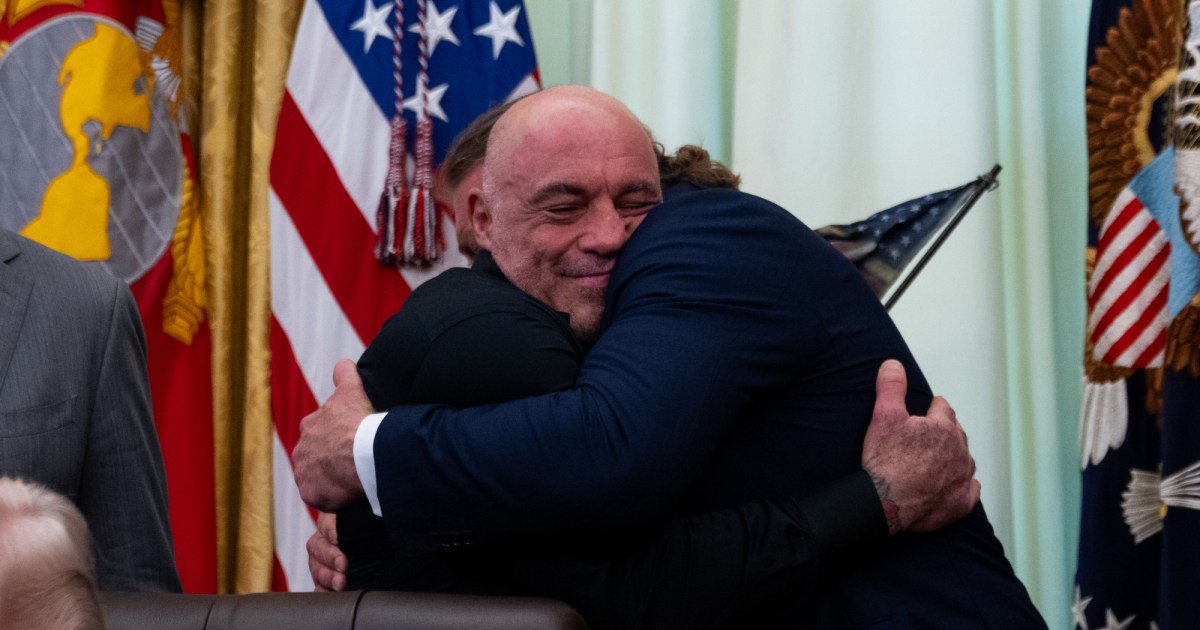
Joe Rogan hugs W Bryan Hubbard, CEO of Americans for Ibogaine during the executive order signing ceremony in the Oval Office on Saturday.Allison Robbert/ZUMA Press Wire
President Trump signed an executive order on Saturday calling for the acceleration of research on certain psychedelic drugs as treatments for depression and other conditions. Podcaster Joe Rogan stood with him as he signed the order—and Trump indicated that Rogan was a major inspiration behind the push to fast-track legalizing ibogaine, which is used outside the United States to treat post-traumatic stress disorder.
Rogan has championed ibogaine for years. A year ago, on his podcast, he said “Ibogaine, in particular, has helped a lot of people. It gives you, like, a review of your life, apparently.” Two weeks ago, he interviewed the CEO of Americans for Ibogaine, who also stood by as Trump signed his order to ease access to the drug.
Rogan’s relationship with Trump has recently been strained, as the podcaster critiqued the president’s war on Iran. (Trump, in response, referred to Rogan as a “liberal,” a charge Rogan would likely deny.) But Rogan’s texts to Trump, he told reporters, were what brought this to fruition: “Sounds great, do you want FDA approval?” Rogan said Trump responded. “It was literally that quick.”
Rogan isn’t the only nationally prominent figure pushing psychedelics. The drugs’ path to legitimacy is fueled by early-stage investors hoping to stake their claim to a market many view as the next cannabis.
Billionaire tech investor Peter Thiel has spent the better part of the past decade investing heavily in psychedelic pharmaceutical companies. He’s a major backer of Compass Pathways, a British company seeking to commercialize psilocybin, the psychoactive ingredient in magic mushrooms, in particular for therapeutic use. He’s also invested in AtaiBeckley, a German company working on hallucinogens. On Thursday, the stocks of both companies spiked on news that Trump would likely be giving his stamp of approval to ibogaine this weekend.
Another financial beneficiary might be the state of Texas, which announced it would be conducting its own ibogaine clinical trials in late March, to the tune of $50 million. And then there’s the Mercer Family Foundation, a major conservative grantmaker that helped get Trump elected, which has donated over $1 million toward psychedelics-related treatment for PTSD in combat veterans.
At the White House Saturday, Trump didn’t talk much about the money behind all this. Instead, he asked if he could get some ibogaine.
“Can I have some, please?” he said. “I’ll do whatever it takes…I don’t have time to be depressed. If you stay busy enough, maybe that’s what works too, that’s what I do.”



